The history of the Philippines is long and vast, and I have not designed this blog to capture it most effectively; I have merely structured it to help both orient the reader and provide contextualization for the upcoming blogs, and set the tone for my personal reflections as a Western history teacher. Do not associate this blog with a legitimate attempt to give the long, complex history of the archipelago a semblance of the justice it truly deserves. As a U.S. history teacher (primarily) based in Louisiana (again – primarily), I have always been fascinated with Filipino history. This is for many reasons, but mostly due to two significant factors: The history of the Philippines is deeply intertwined with my home state and country, and, secondly, the first known Filipino settlement was in St. Bernard Parish, my home parish. Having connections with many Filipino-Americans, who are passionate about their homeland, is also inspiring.
I appreciated that on our first day, we visited the Philippine-American Educational Foundation (PAEF) headquarters in Manila to listen to various lectures on Filipino education, history, and culture. The first one provided background information about the Fulbright program, followed by a lecture on Filipino history. It was evident that the professor, John Ray Ramos, a lecturer at Ateneo de Manila University, was passionate about the history of his home country.
From Indigeneity to Colonization
To provide this context, I’m going to incorporate information from Professor Ray, the book “The History of the Philippines,” by Luis H. Franca, and from tidbits I gained on three tours: Fulbright-sponsored tours of the Intramuros (Manila’s historic walled area) and the U.S. Embassy, and a self-guided tour of the Manila American Cemetery and Memorial. Professor Ray, Franca, and the Intramous tour all started with Indigenous history, telling us the estimated years of the earliest human evidence on the islands (circa 700,000 BCE). Professor Ray showed us the iconic photo of the Manunggul Jar (890–710 BCE), which consisted of two figures atop its handle, representing the journey of the soul to the afterlife. Prior to colonization, it was evident that the earliest inhabitants maintained a heavy belief in an afterlife – one based primarily on seafaring narratives. Many of the Indigenous peoples, especially the early Malay migrants, traveled to the islands on ancient wooden boats – called “barangays.” Filipinos still employ the term barangay as the smallest village, district, or local government unit – smaller than a parish in Louisiana. Barangay “captains” lead the unit.

The Franca book, Professor Ray, and the guide for the Intramuros tour dove heavily into the 300-year-long period of Spanish colonization, which inevitably had a profound impact on the archipelago. The Spanish tried multiple colonization attempts after Ferdinand Magellan met his maker. Eventually, Miguel de Legazpi found success. After suppressing numerous resistance campaigns, the Spanish quickly sought to establish a brutal and extractive hierarchical system that, of course, elevated themselves at the pinnacle at the grave expense of the local Indigenous populations. Professor Ray described it as a “vertically and racially segregated society.” They pushed Christianity primarily through imagery – not literacy – as they colonized whom they perceived as “savages” through “the sword and the cross” (Ray, 2026). The Spanish established the Philippines as a trading post and missionary staging ground for the Empire. Chinese attempts to wrestle it away from Spain were ultimately unsuccessful, but a large Chinese population lived on the islands to serve as a cheap labor force, establishing what is widely considered the world’s oldest “Chinatown.” Spanish officials viewed the Chinese population with deep suspicion, especially after a few rebellions, and faced their cannons toward their area, still facing that direction today.
The intricacies of how the Spanish conducted this structure are vast, but I will focus on a few aspects. Spain initiated a colonial resettlement policy – called Reducción. Reducción forced scattered Indigenous communities to centralize into organized town centers, or poblaciones. This system aimed to make tax collection, political rule, and religious conversion much easier; it was a matter of full control. The consequence, of course, was the erasure, or minimization, of Indigenous decentralized organization and culture. Friar corporations and conquistadors (and their descendants) owned vast lands, called haciendas. Much of this is similar to how Spain structured Latin America.
This structure of the Philippines and its distance from Spain led to the friars gaining more power and prestige, even to the point where they would imprison politicians who opposed their reign. This structure, along with other variables, led to the Philippines being more conservative compared to its Latin American counterparts. This political and economic conservatism is why the Philippines did not rebel when Latin America roared against its oppressors in the early 19th century.
The Philippines gained wealth through the famous Galleon trade, which connected the islands to Mexico, where goods were unloaded, and then to other Spanish colonies (like Louisiana for a time) and Spain. For three centuries, the Spanish capitalized on the Indian Ocean Trade, integrating the Philippines into Asian and Pacific trade networks while extracting resources from the archipelago to gain unprecedented wealth. This trade connected Spain to Asia, Latin America, and Europe. The population of Manila boomed. Some of the Filipinos on the Galleon Trade escaped Spanish oppression by jumping ship in New Orleans and settling in the swamps of what became my home parish, St. Bernard Parish. This settlement, named Saint Malo after a legendary maroon, is the first known Filipino settlement within the borders of what we now call the U.S.

The wealth gained by the Crown often conflicted with the wealth of the clergy. In 1872, these tensions led to Spanish officials executing three Filipino priests, dubbed the Gomburza Martyrs. This sparked widespread anger and unified Filipino resentment against consistent Spanish abuses, leading to a colossal Filipino nationalist movement. Many leaders emerged during this time; José Rizal became the most notable of them. Rizal was a multifaceted intellectual and a political activist, so much so that his political writings inspired the Philippine revolution and ultimately led to his execution by the Spanish. Although his goals failed, he helped cultivate a national identity separate from Spain. Rizal’s bold stance and martyrdom are why he is one of the most revered figures in Filipino history, embodying the “living soul” of the revolution. On the aforementioned tour, we saw the cell that Rizal spent his last days in before his execution. We also visited the park where Spain executed him.

Rizal’s tragic death ignited the KKK (not the US version, of course) – officially known as the Kataas-taasang, Kagalang-galangang Katipunan ng mga Anak ng Bayan – into action. The KKK was a revolutionary society founded by Andres Bonifacio, Deodato Arellano, and Ladislao Diwa, with the goal of complete independence. Rizal’s death mobilized the masses in ways he had envisioned while he was alive. In 1897, 28-year-old Emilio Aguinaldo became the leader of this anti-Spanish movement. Just one year later, Aguinaldo and his followers, with some U.S. assistance, ousted their Spanish oppressors and declared independence, ending a 300-year reign.
Although I read much of this history in Franca’s book, it felt more authentic and meaningful hearing this from an acclaimed public historian. It became even more significant seeing the sites in person. Text from book pages became spoken words, which became physical sites.
A Faraway U.S. Colony
Despite the win for independence, the U.S. did not grant it to the Filipino people. Rather, the U.S. incorporated the country into its burgeoning Empire. The U.S. desired the archipelago’s rich resources and profitable exports, notably timber and other rare materials. The U.S. and Spain negotiated the terms of the Treaty of Paris without the inclusion of Filipino nationalists. This decision would ultimately turn the Filipino movement against its new imperial oppressor – the U.S. The U.S. launched a brutal war to suppress and pacify the Philippines, leading to the Philippine-American War (1899-1902).
Many historians argue that the U.S. committed genocide (as later defined by the UN in 1948) during this campaign. Professor Ray briefly touched on it with the time allotted, but he did not cover it in detail due to time constraints. Regardless, the U.S. committed widespread atrocities during the Philippine-American War, including massacres, mass torture, forced relocations, and policies that caused massive civilian suffering on an unprecedented scale. Whether those actions constitute “genocide” depends on how narrowly one defines genocidal intent, but the historical consensus agrees on the sheer scale of mass brutality of the occupation.
Thanks to another Fulbrighter, Dave, I learned more about the Bud Dajo massacre. He printed out an article titled “The Ghosts of Bud Dajo: How an American Massacre Shaped the Philippines” (Coronel, 2025). After the Philippine-American War concluded, Moro Muslims in Mindanao continued to resist U.S. rule. Many refused to pay new taxes or send their children to U.S. “schools.” U.S. General Leonard Wood decided to use brute force to squash this resistance. In 1906, during the midst of the fighting, many Moros took refuge inside the crater of Bud Dajo, an extinct volcano, on the Philippine island of Jolo. Thousands of U.S. soldiers bombarded the crater with artillery and then stormed those seeking refuge. The Moros tried to fight back, many only with spears. U.S. troops killed as many as ~1,000 people, many women and children. Only six survived.
It was deadlier than the massacres at Wounded Knee and My Lai. One U.S. officer described babies searching through piles of bodies for their mothers. Another soldier admitted they shot “everything in reach… regardless of age or sex.” Mark Twain said that the massacre had “no resemblance to a battle … We cleaned up our four days’ work and made it complete by butchering these helpless people.” Historian Kim Wagner argues that Bud Dajo was not simply an isolated tragedy, but reflected patterns of colonial warfare: overwhelming force against civilians, followed by lackluster investigations. Soldiers went unpunished. President Teddy Roosevelt even congratulated Wood, who later became Governor-General of the Philippines. Today, Bud Dajo remains a powerful memory in Moro communities. Such history explains why tensions continue to persist. Despite the magnitude of the massacre, most Americans, and many Filipinos, have never even heard of it.
After effectively suppressing dissent and pacifying/unifying the islands, the U.S. viewed education in the Philippines as a primary tool for continual pacification and colonial transformation, similar to how Spain had used Catholicism to exert control. Rather than simply increasing literacy, the U.S. education system was designed to create a “good colony” by instilling U.S. political, economic, and cultural ideals. Schools promoted English, U.S. history, “democratic” values (despite an undemocratic Jim Crow system at home), and concepts of citizenship while often subduing Indigenous traditions and pre-colonial Filipino identities. Through Filipinization, the U.S. gradually increased Filipino participation in government and provided opportunities for self-governance, but this process occurred solely within a U.S.-designed political framework. Instead of allowing Filipino nationalism to develop independently, colonial education specifically sought to reshape nationalism into a form that supported U.S. interests and encouraged unwavering loyalty to U.S. institutions.
Beyond education, U.S. colonial rule transformed Filipino society through capitalism, consumerism, and a colonial economy that inextricably connected the Philippines to U.S. markets. This was immediately evident upon arrival. The U.S. promoted mass privatization, expanded trade, and encouraged the consumption of U.S. goods. The economy prioritized U.S. interests by positioning the Philippines as a supplier of raw materials and a market for U.S. products.
In this way, the U.S. attempted to mold the Philippines “in its own image” by reshaping not only government and economics but also language, history, civic attitudes, values, and culture (John Ray Ramos, 2026). In my opinion, this created a form of mis-education (similar to that of minoritized populations within the U.S.) because U.S. schools often taught Filipino students U.S. perspectives while Filipino history, Indigenous knowledge, and nationalist movements were diminished or overlooked. As an unfortunate result, the U.S. employed education as a tool of modernization and a mechanism for “suppressing” and “diluting” Filipino nationalism under colonial rule. I did not want to perpetuate this historical process in any lessons that I gave to Filipino students.
World War II
During WWII, the Philippines became one of the most important battlegrounds in the Pacific because of its strategic location and its status as a U.S. commonwealth. Many Americans, including most of my U.S. students, are often unaware that Japan attacked the Philippines shortly after its 1941 attack on Pearl Harbor. Japanese forces quickly overwhelmed Filipino and U.S. defenders, and by mid-1942, the combined U.S. and Filipino forces surrendered. The fall of the Bataan Peninsula and the surrender of Corregidor easily marked one of the largest military defeats in U.S. history. General Douglas MacArthur famously promised that he “shall return” as he retreated from the islands.
Japan subjected Filipino and U.S. prisoners of war to the brutal Bataan Death March, during which an estimated 10,000 died from starvation, exhaustion, and mistreatment – far higher than the death toll at Pearl Harbor. Under Japanese occupation (1942–1945), Filipinos faced severe hardships, including food shortages, forced labor, censorship, and unprecedented violence. Japan attempted to establish the Philippines as an independent state under its control, creating the Japanese-sponsored Second Philippine Republic. Most Filipinos and the non-Axis world viewed the government as an illegitimate puppet regime.
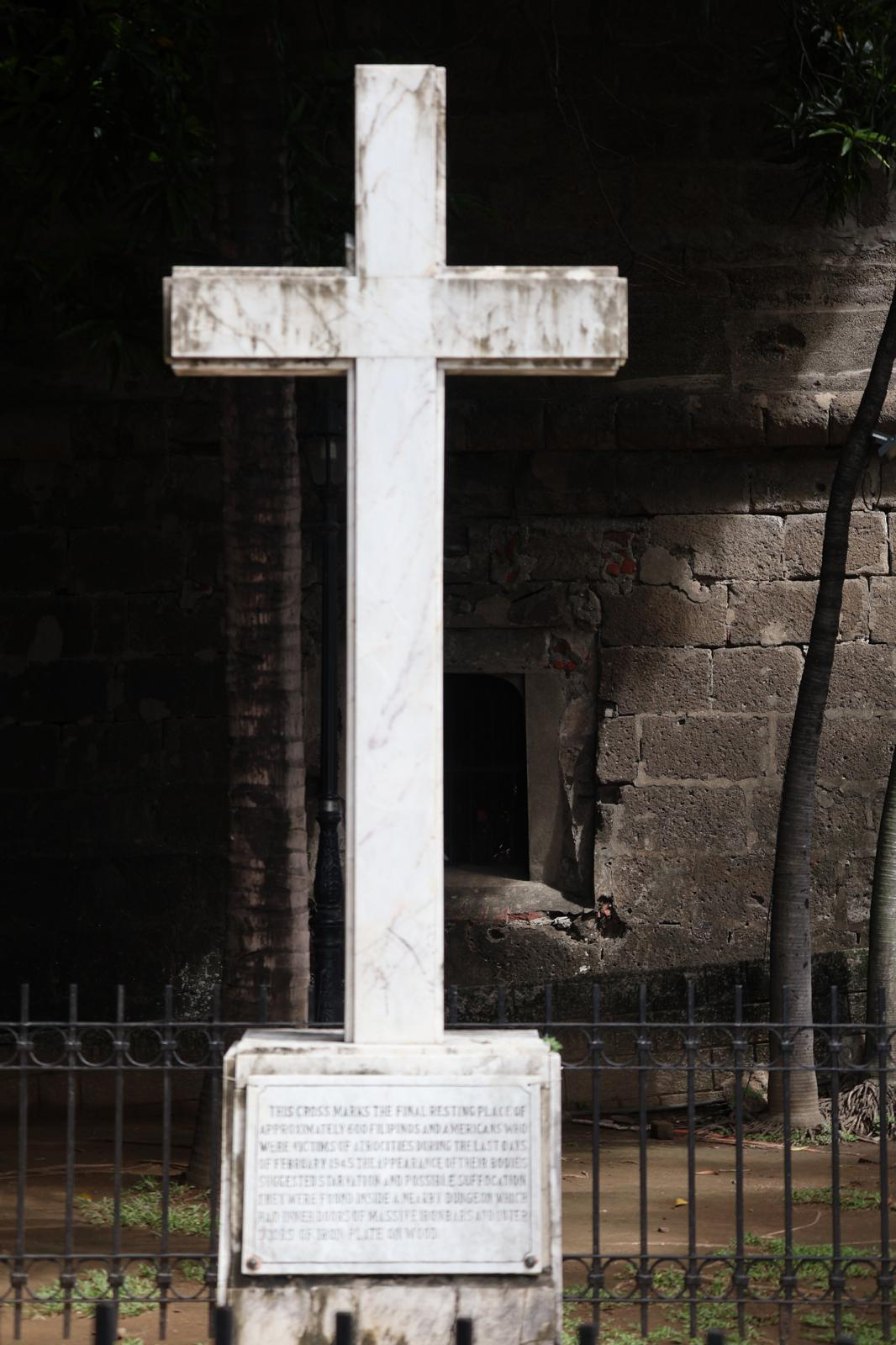
Despite the brutal Japanese occupation, widespread Filipino resistance movements emerged throughout the country. Guerrilla groups, often composed of former soldiers, civilians, and local leaders, fought Japanese forces, gathered intelligence for the Allies, and protected communities. During our tour of Intramuros, our guide showed us the White Cross Memorial – a solemn white marble memorial in Fort Santiago that marks the mass grave of about 600 civilian and guerrilla prisoners. It felt odd to see such a small symbol and space to honor the memory of hundreds who fought against Japanese imperialism. Despite its size, the space held a power you could feel in your bones.
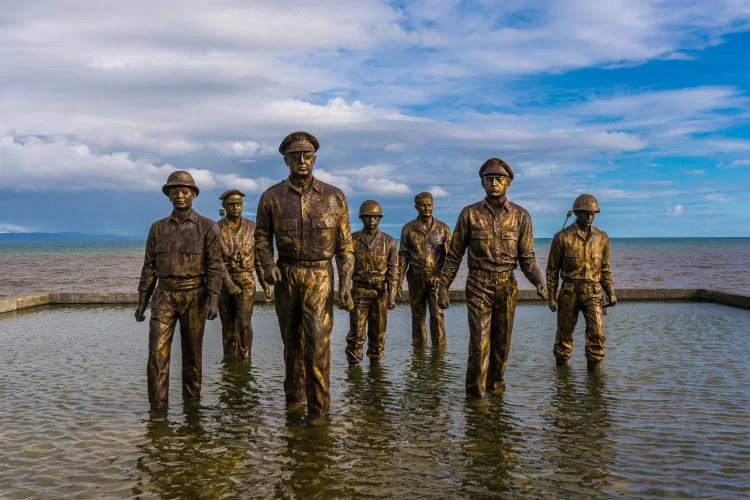
The war also deeply affected Filipino civilians, especially during the brutal Battle of Manila in 1945, after General MacArthur “heroically” returned with U.S. forces. Filipinos today largely celebrate and memorialize him due to his successful efforts against the Japanese. I’ve heard multiple people reference the “shall return” quote during conversations about history.
The battle resulted in the destruction of much of Manila and the deaths of an estimated 100,000 civilians, making it one of the deadliest urban battles of the war. Japanese forces committed deliberate mass murders, torture, and widespread atrocities against non-combatants. Historians dub this the Rape of Manila (Paggahasa ng Maynila). Heavy artillery and intense urban combat firepower deployed by U.S. forces to root out entrenched Japanese soldiers also resulted in massive loss of life. For some reason (classic Eurocentrism?), many overlook this battle compared to others despite its massive death toll.

During our tour of the U.S. Embassy, we saw numerous bullet holes still visible from that fight. In our Intramuros tour, we also saw more damage, including a spot where U.S. tanks pushed through the ancient walls, leaving lasting damage.

After Japan’s defeat and liberation by Allied forces, the Philippines gained full independence from the U.S. on July 4, 1946. The U.S. charged many of the Japanese leaders with war crimes at what is now the U.S. Embassy. During our tour of the Embassy, we stood at the exact place where these trials occurred. We weren’t allowed to take photos within the Embassy, but here’s what it looked like during those trials.

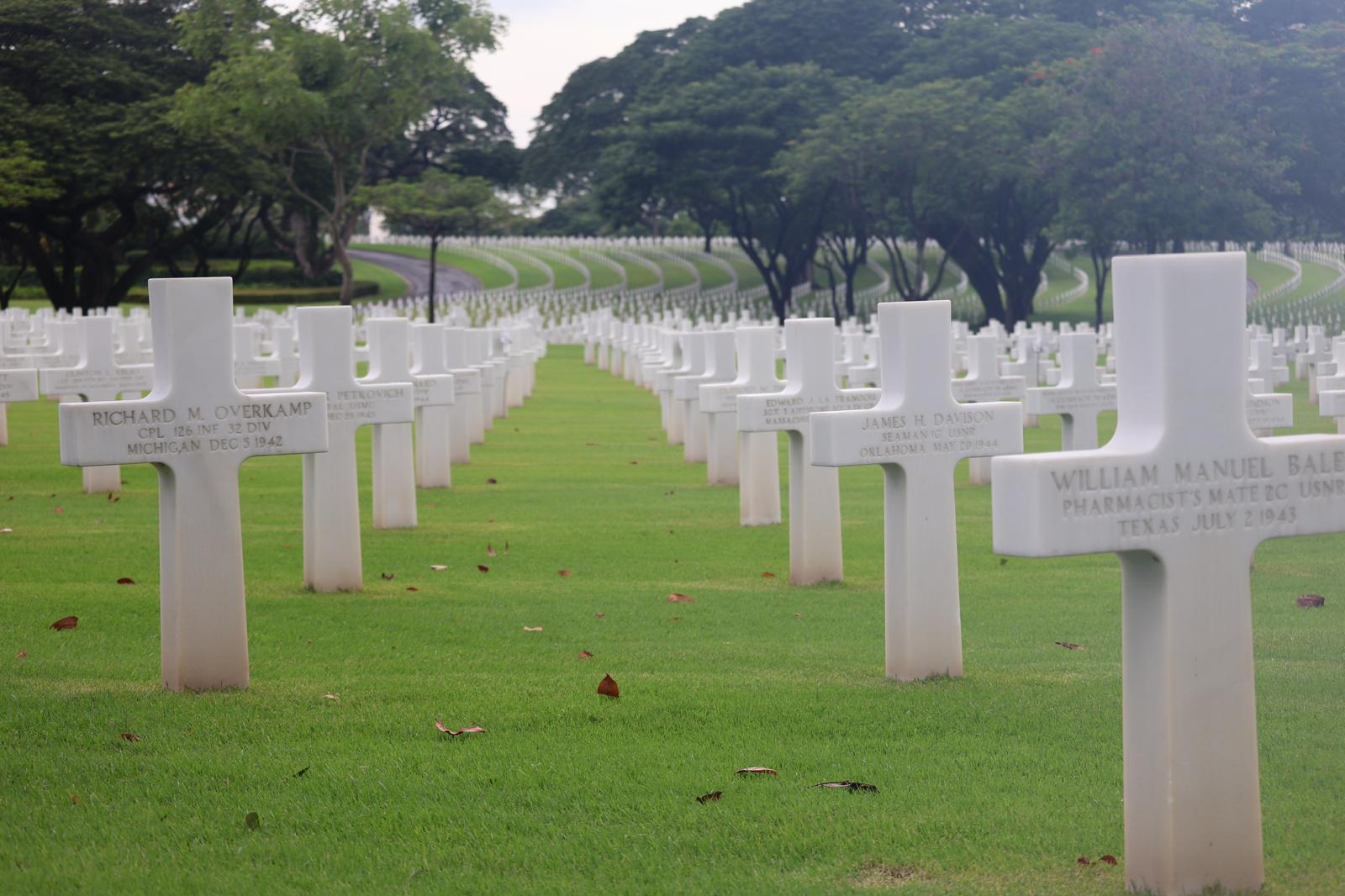
During the fight in the Philippines and throughout Southeast Asia, over 100,000 U.S. soldiers died. Many of them, including a close relative of mine (check next blog for reflections), are buried or memorialized in Manila American Cemetery and Memorial.
WWII also left the Philippines devastated economically and socially, but also strengthened Filipino nationalism, as the experience of occupation and resistance reinforced age-old demands for complete sovereignty and self-determination. Still, even after achieving independence and up until today, the U.S. exerts soft power to exercise heavy influence over the country.
As I conclude, I must emphasize that my blog does not capture the essence of the country, as Filipino history is a rich and complex saga of resilience, adaptation, and the ongoing struggle for identity and self-determination – even today. In fact, these words are far from even scratching the surface. From the diverse Indigenous societies that thrived before European contact, to centuries of Spanish and U.S. colonial rule, and through the hardships of WWII, Filipinos continuously shaped their own culture while responding to external, often bad-faith, influences. Although colonial powers attempted to reshape Filipino society, language, economy, and nationalism, it became evident during my duration that Filipinos preserved their deep-seated traditions and developed a strong sense of national identity. By the end of WWII, the Philippines had endured centuries of foreign domination and conflict, yet emerged with a renewed determination to define its own future as an independent, autonomous nation.
Despite centuries of brutalization from occupying forces, it would be a grave mistake for one to view Filipino history solely through the lens of narratives of destitute or victimization. It is a saga of survival and triumph to form arguably one of the most dynamic peoples in the world, with an unparalleled, breathtaking culture and legacy. I am beyond honored to have experienced a mere taste of it, however brief.
See an error or have questions? Contact me: chrisdier3@gmail.com.
Sources & Further Reading:
- “Noli Me Tángere,” by José Rizal
- “The History of the Philippines,” by Luis H. Franca
- “Bayani Biographies: Jose Rizal,” by John Ray Ramos
- “Massacre in the Clouds: An American Atrocity and the Erasure of History,” by Kim A. Wagner
- “The Ghosts of Bud Dajo: How an American Massacre Shaped the Philippines,” by Sheila S. Coronel
- “How to Hide an Empire: A History of the Greater United States,” by Daniel Immerwahr

 Chris Dier