Personal Reflections on Historical Memory in the Philippines
In terms of historical memory, I am always intrigued by how a society views and interprets its past. In the Philippines, I became fascinated with the various ways in which people on these islands interpret their long, multifaceted history.
On Historical Nomenclature
I often wondered about the name of the country – the Philippines – named after King Philip II of Spain. One Fulbrighter asked John Ray Ramos, our resident historian, whether there were conversations about changing the name of a country praising a European monarch. The historian gave a short answer stating that the name has essentially been “reclaimed” and its meaning is entirely divorced from its original intention– reminiscent of certain historical terms in the U.S. Taking that name became a symbol of empowerment. Professor Ray stated that this was the consensus among many Filipino historians and activists within the last decade. I quickly contemplated what thoughts emerge when I think of the Philippines, and ultimately saw deep value in what the historian stated. A quick Google search exemplifies this is still an ongoing dialogue – not one an outsider, much less a Westerner hailing from the former colonizing country, should weigh in on.
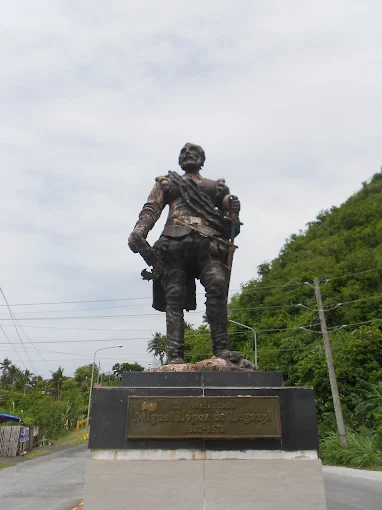
I stayed in Legazpi during my site visit, named after Miguel López de Legazpi. Legazpi was a brutal conquistador, best known for leading the successful expedition that firmly established Spanish supremacy over the islands in the 16th century. He completely dehumanized and eagerly sought to subjugate the local populations. Yet, there is a city named after him, complete with a statue of him situated at a busy intersection near the coastal night markets. One of our Filipino guides in Legazpi said that classes only teach him so students can get an answer right on a test, and that there is no active celebration of the person. I thought of the Confederate statues that were taken down in New Orleans.
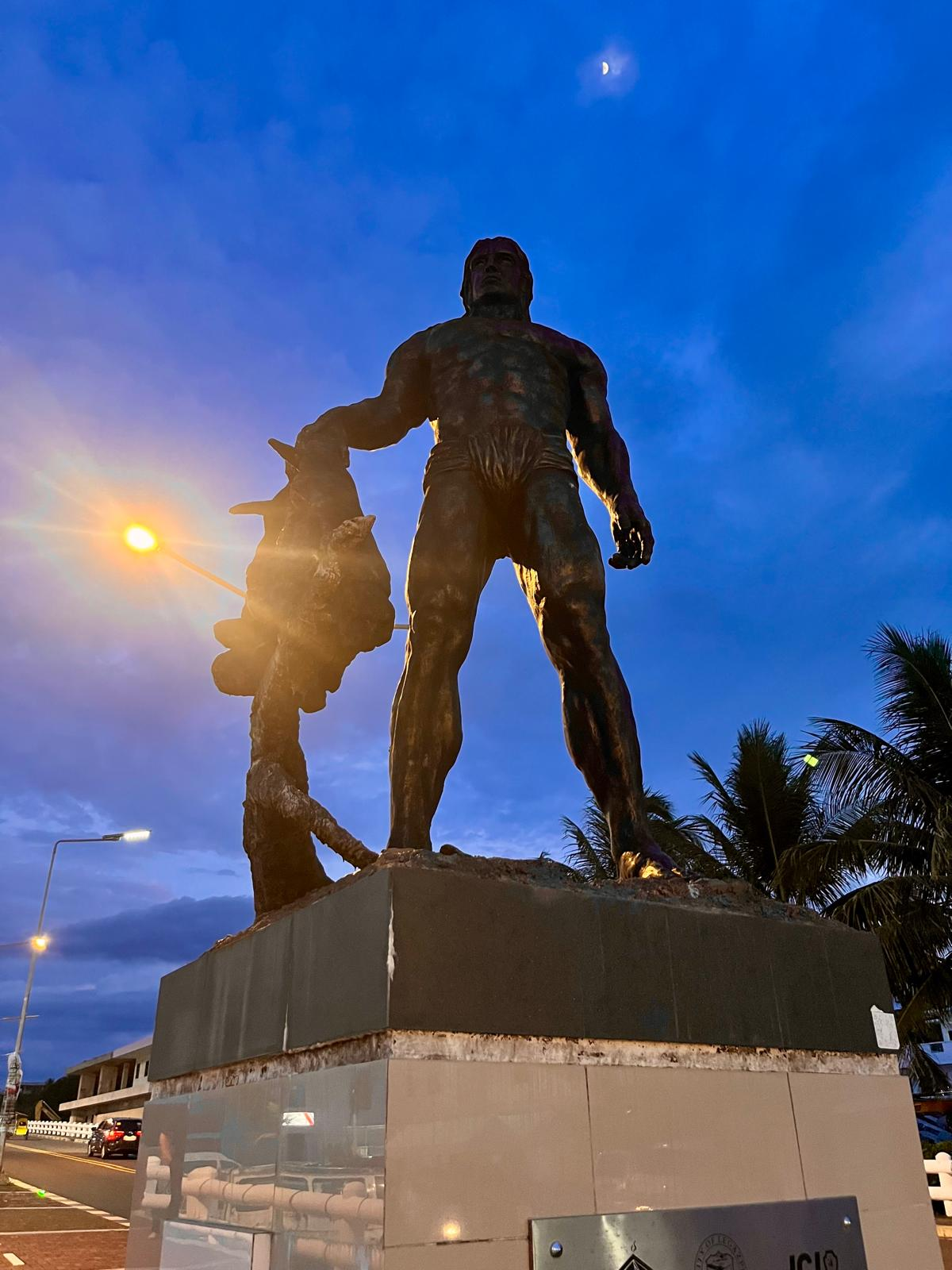
During my first day at Legazpi City Science High, the students welcomed us with Indigenous dances that praised their folk heroes – such a powerful introduction. One of the folk heroes, Baltog, is the first great hero of the Ibalong Epic, a pre-Hispanic traditional folk story from the Bicol region. The people of Bicol know him as the brave pioneer settler who introduced agriculture and skillfully killed a massive wild boar with his bare hands. It is profoundly fascinating that this legend predates Spanish colonization and survived through a vibrant oral tradition, knowing that these traditions are thriving despite centuries of foreign influence designed to suppress culture.
The Legacy of Global Empires
During all of my conversations and tours, it seems that there was a collective sense of anti-Spanish and anti-Japanese sentiment (rightfully so on both ends), but such sentiments did not extend to the U.S., at least not nearly as much. There seemed to be a proclivity to view U.S. imperialism in a much softer light than the Spanish era or under Japanese imperialism. I found this slightly peculiar as historians estimate the U.S. killed over 200,000 Filipino civilians in the Philippine-American War. Such sentiment was most evident during the Intramuros tour, in which the guide revered all of the martyrs for Filipino independence and heavily praised U.S. military efforts during the Battle of Manila.
Could this be due to the U.S.’ educational aims when the Philippines was a U.S. colony? It is difficult to imagine such U.S.-designed curricula instilling an objective take on the vast war crimes during the Philippine-American War. Even today, the curricula in the U.S. do not present an objective take on that war. Most curricula in the States – at least as far as I’ve analyzed – want students to know that the Philippines was simply a colony that the U.S. rightfully earned after easily defeating Spain in 1898. If a student is fortunate, the teacher may even discuss the role the U.S. played in defeating Japanese forces there.
Nowhere was this more evident than on our tour of the U.S. Embassy. The tour guide and the representatives praised U.S. efforts in the Philippines in both the tour and subsequent conversations. No one mentioned the protests against the U.S.-led Pax Silica that just occurred outside the U.S. Embassy. Pax Silica is a U.S.-led international initiative launched in 2025 to secure global supply chains for AI, advanced semiconductors, and critical minerals, functioning as a Western-allied counterweight to Chinese technological dominance. The growing influence of China concerned some of the officials in the embassy, and they made no attempts to hide that concern. The anti-Pax Silica protests, and the accompanying online discourse, are evident that there is a large contingent of Filipinos who reject U.S.’ soft power approach.
During the tour, the Embassy tour guide praised American teachers, dubbed Thompsonite teachers, who moved to the Philippines after the Philippines-American War, as she gestured to framed photos of early 20th-century American teachers. Outside, we saw the physical remnants from the Battle of Manila – the bullet holes on the flagpole displayed like a badge of honor. She also showed us the gravesite of the U.S. flag that fell during the war. Later, we entered the exact location the U.S. charged Japanese army officers for their crimes against humanity. Obviously, holding war criminals accountable is a necessary and just move. However, the tours and representatives should be more objective regarding U.S. imperialism. This tour reaffirmed my obligation to teach U.S.-Filipino history more objectively during my upcoming lessons.
As I spent more time in the Philippines, it grew ever more evident that such pro-U.S. sentiments mostly stemmed from the U.S.-Filipino joint effort during WWII. Many Filipinos discuss the vast horrors Japan inflicted on the country as if it happened yesterday. The profound impact and legacy of WWII on Filipino memory cannot be understated. As Americans, we were fortunate that the unfathomable war never truly hit within our borders (outside of our territories), and thus our view of that conflict is etched differently in our collective memory. No one can say the same about the Philippines.
Manila-American Cemetery and Memorial
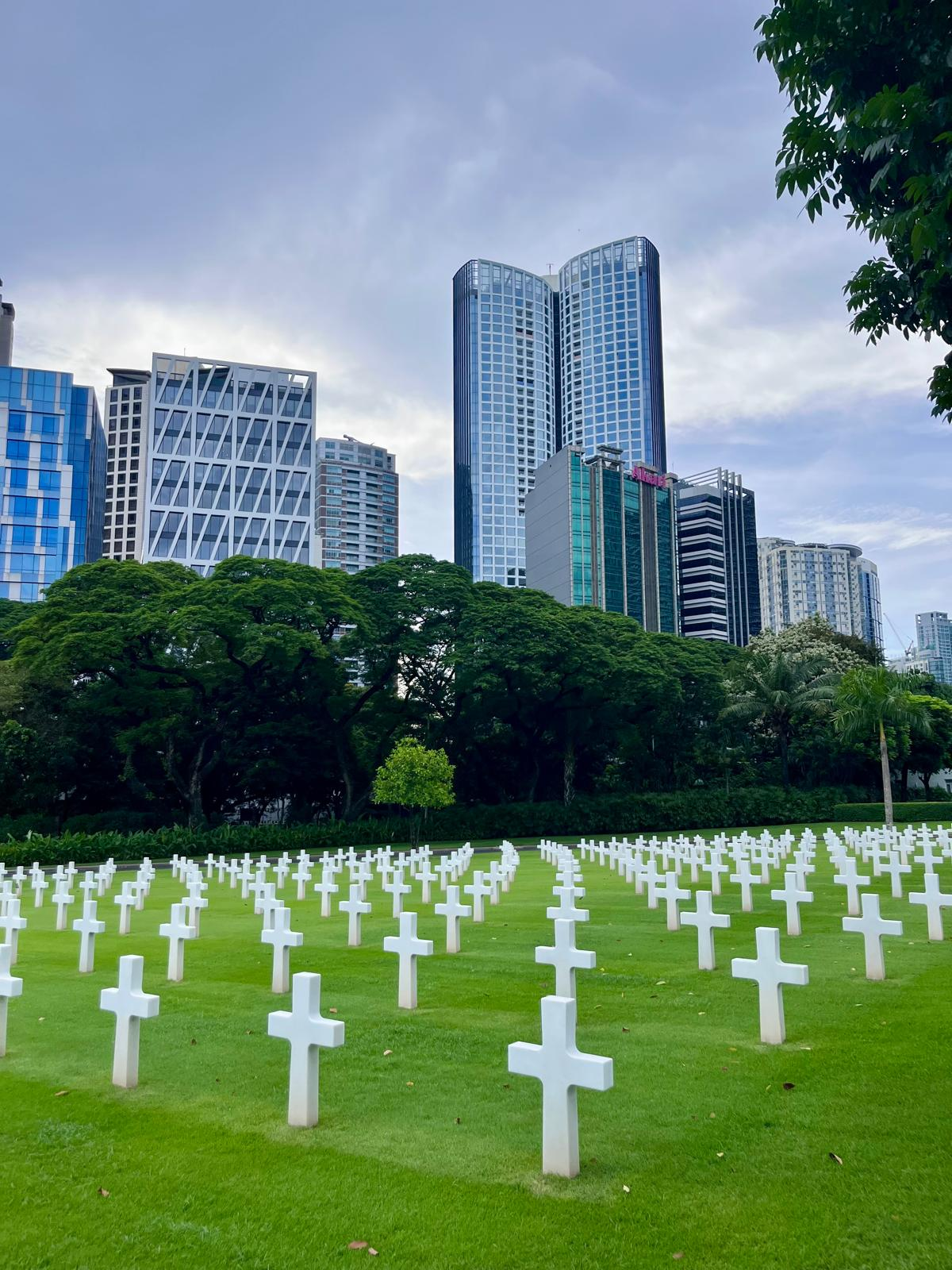
In Manila, I used some of my free time to visit the Manila American Cemetery and Memorial, which commemorates over 36,000 soldiers Missing in Action (MIA) and over 17,000 Killed in Action (KIA) – totaling over an estimated 53,000 US soldiers. When I put feelers out in the group chat, three American Fulbrighters accompanied me on the journey. The cemetery was vast and seemingly endless. White crosses and the Jewish stars spread neatly across a finely trimmed grassy knoll while Manila skyscrapers towered in the distance. It was an odd juxtaposition. The latter may not have occurred without the sacrifices made by those buried in the cemetery.
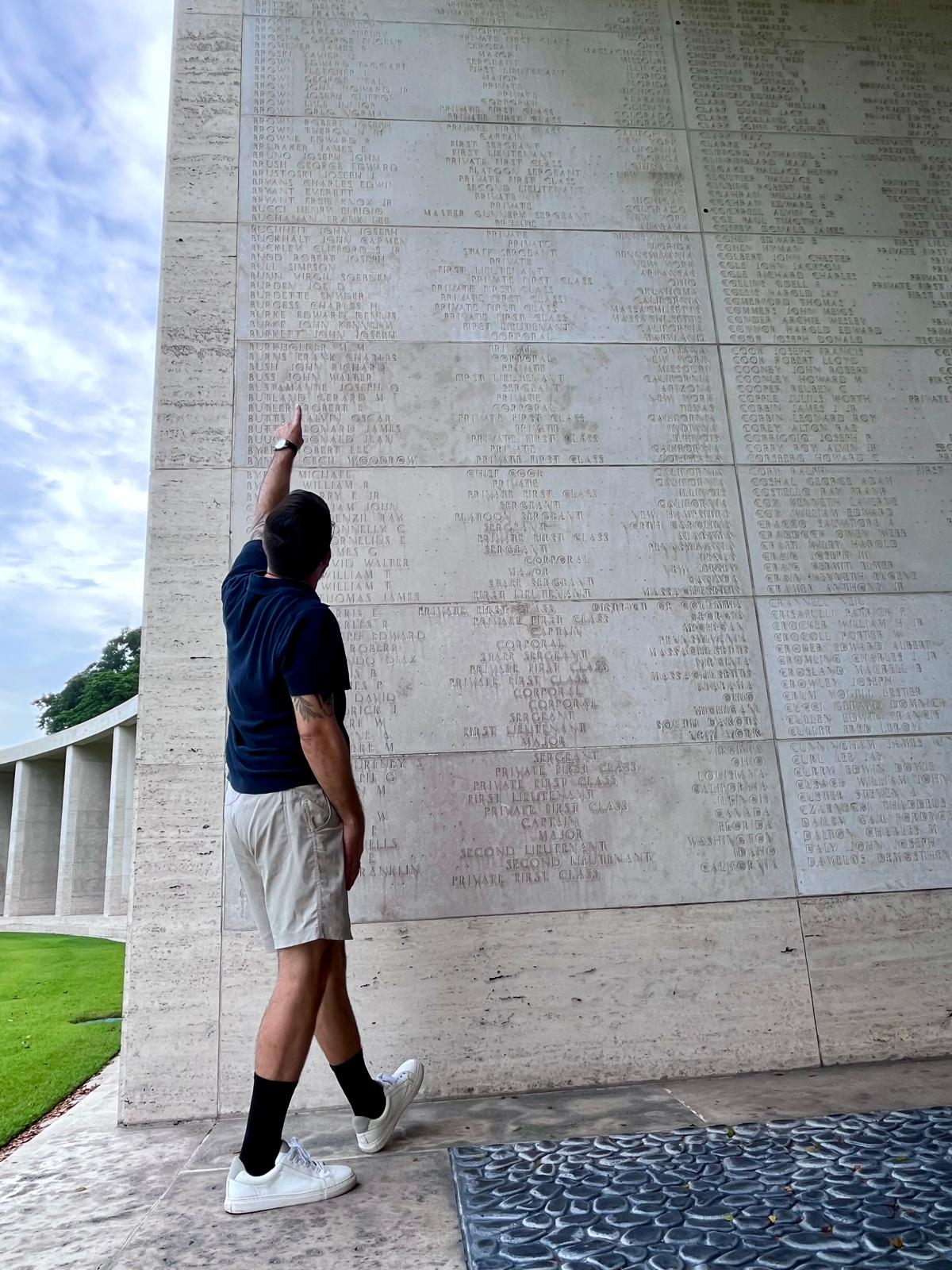
The experience became more personal as we approached the wall of those MIA. Before I left, my mother tasked me to find the name of our relative, Joseph Bruno. Joseph heroically died in Papua New Guinea fighting Japanese forces. I have heard his name and story throughout my life, so I knew how much this visit meant to my mother. However, I failed to realize the grave personal impact it would have on me. After searching in the Marines section of the wall with the help of my new buddies, we spotted Joseph’s name etched into the wall. My heart jumped.
A local guide approached us after our quick photoshoot and asked to escort me to the Visitor Center. There, one of the curators pulled up information about Joseph and printed an official U.S. government certificate. He told me as much information about Joseph as he could find. To surmise, he died in Papua New Guinea protecting his comrades – the ultimate sacrifice – and those comrades buried him there. I became emotional as I listened. He organized the certificate and information into a neat folder – a custom of the museum for family members who visit. Apparently, I was the first known relative of Joseph to visit the center.
It was an emotional and surreal experience to know that somewhere in the world, a relative of mine is buried, yet he is being memorialized almost a century later in such a beautiful, heartwarming fashion. While I was playing soccer in college when I was his age, he was fighting in foxholes with boys who had just become adults in a brutal war against global totalitarianism. It caused me to reflect on the privileges I’ve had growing up.
The museum at the Manila-American Cemetery and Memorial did quickly emphasize that the U.S. rejected the Filipino nationalists’ desire for independence after the Spanish-American War. After, it was what one might expect a military museum would cover – battle strategies, diary excerpts from soldiers, propaganda posters, photos of complete devastation, and the like. It was indeed an informative museum, especially for military history buffs.
Closing
The historiography of the Philippines is as complex as the history itself, and this reflection by no means seeks to minimize it. Any Westerner, especially a white American, entering these lands must first seek to understand; I truly felt I was mostly successful in accomplishing that goal. In doing so, it is evident that Filipinos have a deep understanding of the history of their homeland. People speak about historical events and people from ancient days as if they experienced or knew them personally. Ancient epics hold just as much weight as pop culture icons. The lands in which various influential leaders, like José Rizal, trekked are sacred. In all of the historical richness woven throughout the Philippines, notions of agency, resistance, and love are consistent throughout.


