I arrived in the Philippines from Barcelona on a warm, sunny day. Entering the country was seamless. “Traveling alone?” was the only question the customs agent asked me. The Fulbright team was incredibly accommodating from the start, from communication to transportation. JoJo, one of the Philippine-American Educational Foundation (PAEF) employees on the ground, greeted me at an airport gate with a photo of myself.
My first impressions of Manila surprised me in ways I didn’t expect. It immediately looked like a place I’ve never seen before, yet in other ways appeared eerily familiar. Manila looked like a sprawling Southeast Asian city with an evident and unique mixture of Latin American and U.S. influences; the former influence made the country also appear distinctly Latin American in some characteristics. After all, this was only the third Southeast Asian country I have visited. It was quickly apparent that the country was a former Spanish and U.S. colony. I knew this would be apparent, of course, but I did not realize just how much it would be. Everything looked somewhat foreign, but the signs and street names were almost entirely in English or Spanish – both languages I am literate in – which gave it a sense of familiarity that I wasn’t necessarily prepared for. Almost no signs were in Filipino. During the drive to the hotel, it soon dawned on me that this was the first time I’ve visited a country that was a former colony of my home country and is now independent.
I checked into my hotel room at the Ascott Makati hotel. The room was much grander than I anticipated, arguably one of the largest hotel rooms I’ve ever stayed in. It was complete with a kitchen, living room, dining room, bathroom with a massive tub, and a bedroom with a king-sized bed. At first I felt as if I was given the wrong room, but then as I settled in I started to remind myself that as teachers we work so incredibly hard throughout the year that we should enjoy being treated nicely.
Since I arrived solo almost a half-day prior to the other Fulbrighters, I decided to walk around a bit. I recognized I was staying in a rather wealthy area of the city, but I was still surprised with the sheer amount of U.S. chains in close proximity. I’m accustomed to American fast food being readily available in massive cities around the globe, but I was not expecting to see other American giants: TGIFs, Texas Roadhouse, Foot Locker, etc. I didn’t particularly like what the existence of these chains represented. It is strikingly evident that the U.S.’ influence did not stop after the U.S. gave the Philippines its independence, nor did it cease after the U.S.-backed dictatorships.
I’m unsure of the exact reason, but Manila did not necessarily speak to me as other cities have. I thought maybe it was due to its size, but other bustling cities spoke to me on my first day: Istanbul, Hanoi, and Hong Kong, to name a few. Despite this, what I found most striking from all the Filipinos whom I had the pleasure to speak with during the first 24 hours was an abiding sense of unparalleled kindness. Everyone seemed keen to assist, a warmth atypical in many cities. I also know better than to judge a country by a city and certainly not to judge a city by a few city blocks. For this reason and more, I knew I had to keep an open mind and grew excited for the upcoming journey.
My perception of Manila started to drastically change once we went into neighborhoods and schools. The Filipino people were gracious and kind wherever we went. There was a certain level of passion seemingly embedded in their identity that I appreciated. It soon became apparent that the Filipino people are what make these lands so special.
Legazpi
While Manila did not necessarily speak to me initially, Legazpi certainly did. Legazpi is a coastal city best known as the home of Mayon Volcano, famed for its symmetrical, perfect cone shape. Located in the Bicol Region, the city serves as a major hub for eco-tourism. Perhaps because it was smaller, the warm welcome, or because it was our home base, I’m unsure exactly, but I felt much more at home.
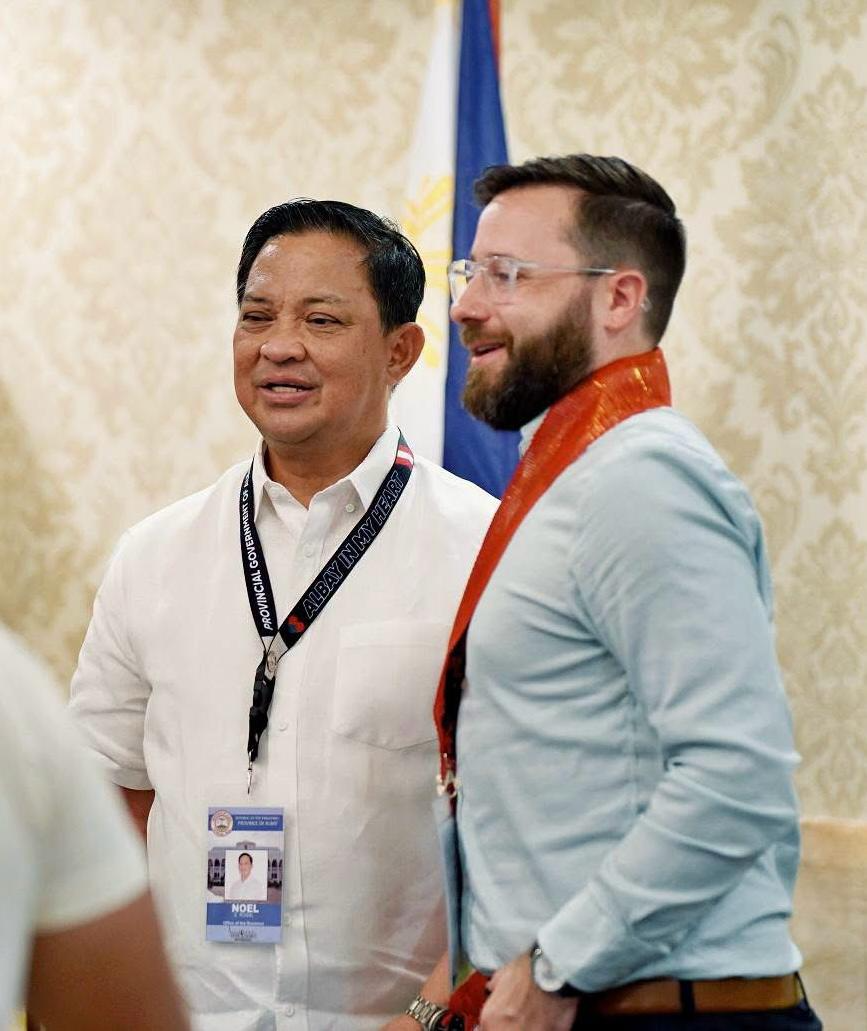
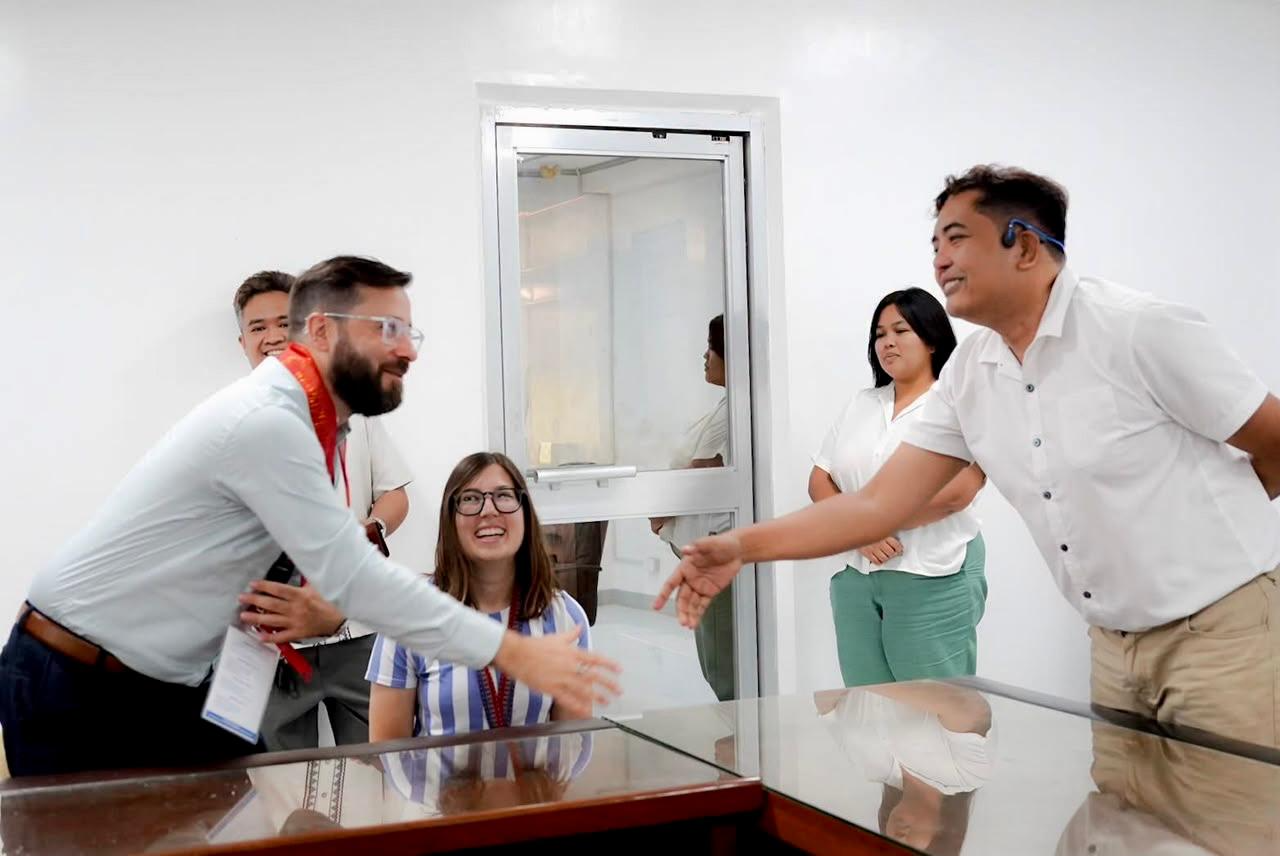
In Legazpi, Legazpi Science High welcomed us with open arms. It wasn’t just the students and regular folks who seemed to appreciate our presence, but the local politicians also wanted to meet us. We met Noel Rosal, the Governor of Albay. Rosal cleared his schedule to graciously host us. We also met folks from the Office of the Mayor of Daraga. Such meetings have left a lasting impression as they imply how important our visit was to the people of the region. They truly made us feel valued, which was just humbling.
Noel Rosal, the Governor of AlbayIn the Office of the Mayor of Daraga
Beyond its natural landmarks, Legazpi is celebrated for its distinctive Bicolano cuisine, which prominently features rich coconut milk and spicy chili peppers. In reality, all of the food from every region we visited was remarkably delicious. Not only was it just tasty, but it seemed every dish was made from the heart, truly showcasing the kindness of the Filipino people.
Radical Listening
Overall, traveling through the Philippines as a U.S. educator and a guest is an exercise in radical listening. You quickly learn that the country’s true landscape isn’t defined merely by the towering cone of Mayon Volcano or the high-rise sprawl of Manila’s skyline. Instead, it lives in the profound spirit of kapwa – the sacred recognition of a shared identity and interconnected humanity. It was in the spaces where that spirit thrived that my guiding question was best addressed.
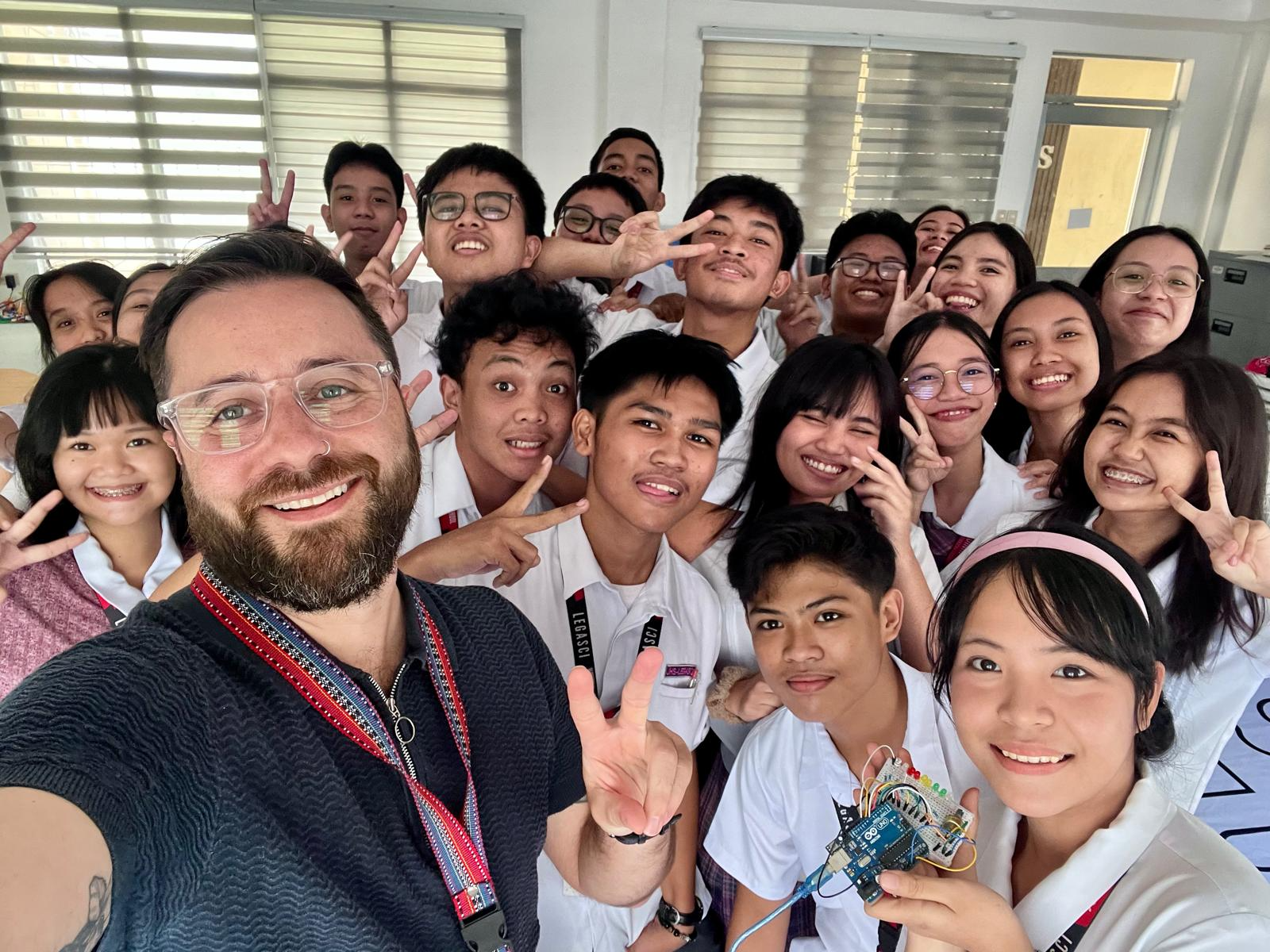
Throughout my journey, this philosophy ceased to be an abstract academic concept and became a lived, vibrant reality. I saw kapwa in the selfless dedication of teachers from various schools and community centers, empowering families with a sense of dignity that defied circumstances. I felt it in the quiet reverence inside the century-old, volcanic-stone walls of Daraga Church, in the warm hospitality of Judge Adille opening his home in Legazpi, in the peaceful nature while cruising on an ATV, and in the peace-centered dialogues shared with the local Imam inside a modest neighborhood madrassah. Out of all of these experiences, I felt the most alive when teaching in front of those kind and brilliant Legazpi students. Whether across lines of faith, class, or geography, the Filipino people I met offered their culture, history, and homes not as passive artifacts to be observed, but as generous invitations to connect – and connect we did.
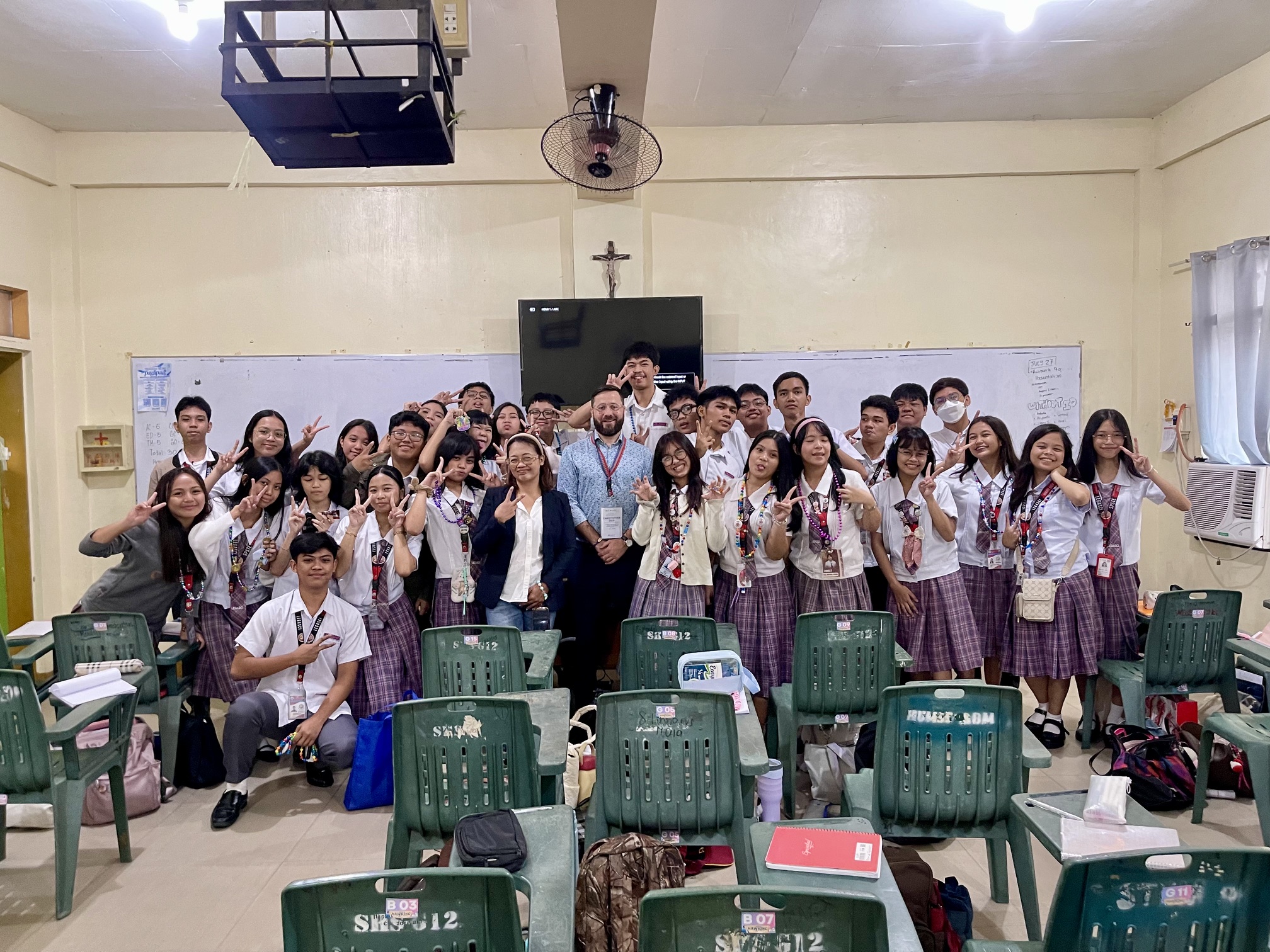
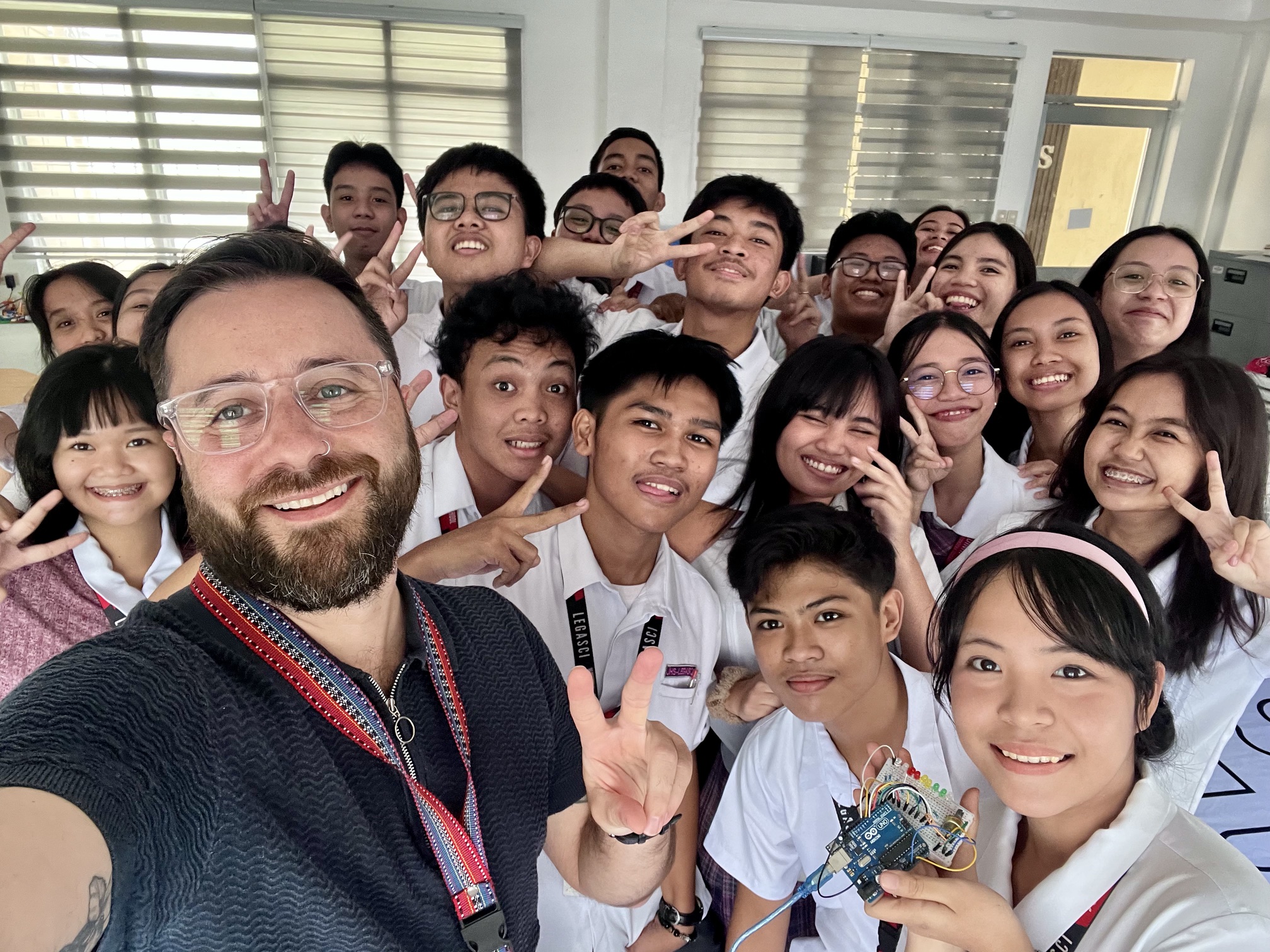
The Legazpi City Science High class that I observed and taught
Coming Home
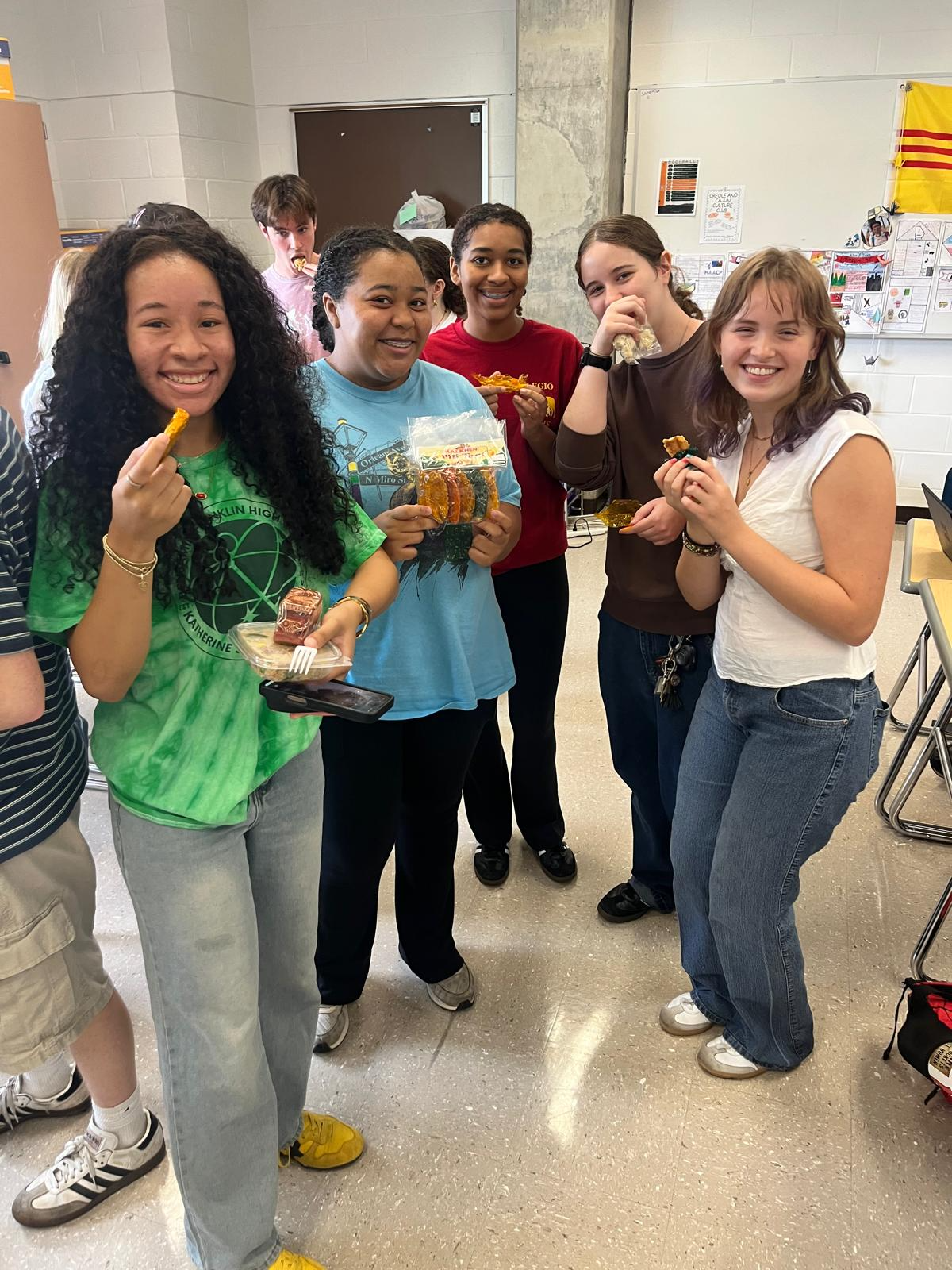
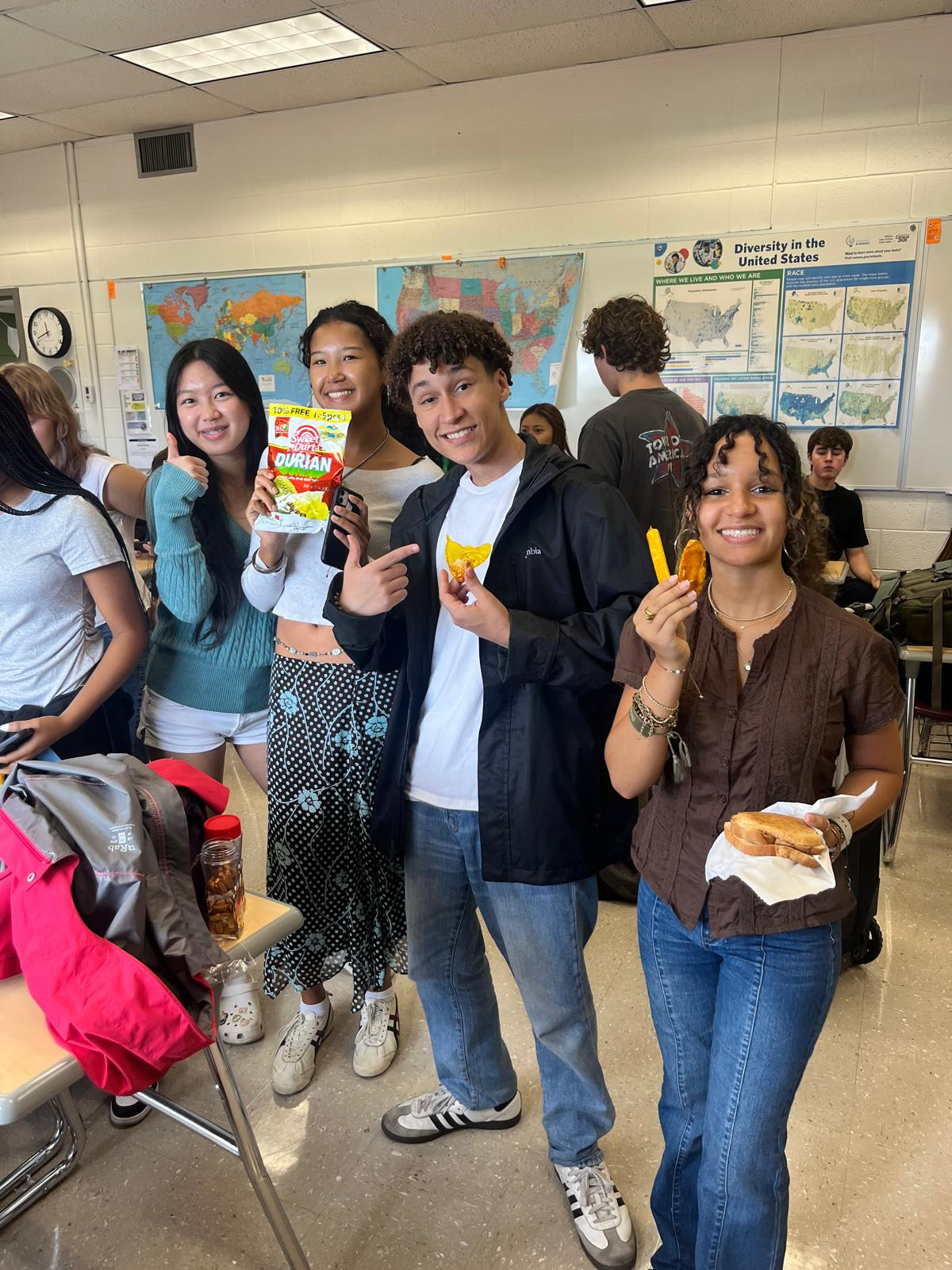
As the journey approached the end, I almost did not want to return home. The Philippines lured me in in a way that was just unprecedented. Ultimately, returning home means honoring the promise I made during those transformative weeks: to refrain from simple pity or passive nostalgia, and instead allow these experiences to shape how I walk through the world. To this extent, I ended up bringing a ton of snacks and gifts that Filipinos gave me and gifting them to others, from family to my students. I didn’t know it at the time, but returning from the Philippines with a plethora of gifts is such a common occurrence that there is a word for it – pasulubong, which translates to “homecoming gift” or “travel souvenir” in English. My U.S. students appreciated and ate all of the treats. It was beautiful to witness such cultural exchange.
The Philippines captures your heart and leaves an indelible mark on your soul – not just because of its breathtaking natural beauty or its unique cultures, but because it challenges you to see others more deeply. I’ve heard others try to express this sentiment to me before this journey, but it is truly something that must be felt there. My time in the Philippines, albeit all too short, was one of the most remarkable experiences I’ve ever had in my life. I pray to one day return. As for now, I return to my own community with a renewed sense of purpose, carrying the warmth, gratitude, and enduring spirit of kapwa forward into everything I teach and build and with everyone I connect with.
Upon arrival, Manila did not necessarily offer a view of the vast nature the Philippines has to offer: towering skyscrapers, congested streets, compacted living spaces, etc. We quickly witnessed the beauty of the country as we departed for the resort in Batangas. On the ride there, I caught plenty of glimpses of the majestic mountains and colorful coastlines. I also saw U.S. chains, notably Starbucks, which is always disappointing to see, whether it’s in rural Philippines or urban New Orleans. We convinced our van driver to let us stop and take photos of the overlook.
Scenic views along the Tagaytay-Nasugbu Highway in Barangay Dayap Itaas
Batangas
The Pico Sands Resort offered a short walk to a beautiful beach that was nestled in a valley between large hills. I was ecstatic to see this stunning side of the country. Feeling the sand between my feet and the warm, fresh water blessed my soul. Despite this, I did consider the environmental impact of a resort, considering the research on their habits of hoarding fresh water for the wealthy elite.
Pico De Loro Beach
Pico Sands Resort
At the resort, the Fulbrighters and I signed up for a snorkeling excursion where we witnessed colorful fish, lounging starfish, and other creatures of the sea. We also jumped off the boat into the water on numerous occasions. Check out the GoPro footage on my IG (@chrisdier3) highlights to get a better feel for the journey. The boat ride offered views that were even more splendid than from the beach. Being in the water always soothes my soul in ways I am unable to comprehend.
Albay Province
My second experience of nature was the Mayon Volcano outside of Legazpi, our home city. The Mayon Volcano … Before arrival, one of our Filipino hosts notified us that if the top of the volcano is clear, that means that those visiting the city have “good hearts.” Edgar, our main Legazpi host, and a few other Filipinos greeted us at the airport with a joyous welcome and sashes. It felt nice to be so welcomed in a place so far from home. After departing the airport, I immediately felt that Legazpi, despite being much smaller, was much more uniquely Filipino than Manila. Despite it being at night, I’ve quickly noticed the city was not as perturbed by globalization and Westernization as Manila.
Mayon Volcano on our first morning in Legazpi
As I stepped out of the car, I noticed an ashy smell that was completely unfamiliar to me. It was the smell of a being in proximity to an active volcano. The fact that one day I’m snorkeling off the shores of Batangas cliffs and then smelling fumes from a volcano the very next day speaks volumes about the country’s diversity. The next morning, I immediately looked out my window to see if the view of the top volcano was clear. I’m not one who embraces superstition, but I certainly recognize the cultural significance of such beliefs. Luckily, the view was clear as day. After hearing about this belief over a dozen times from various locals, I continued to feel a relief at seeing the tip of the volcano. Maybe I am one who embraces these beliefs.
Being in a city next to an active volcano did frighten me, especially after recent news reports and hearing about a massive 19th-century explosion that buried much of Legazpi in ash. We also received notifications on our phones warning us of pyroclastic flows and landslides caused by the ongoing eruption. Pyroclastic, a word I just learned, refers to fragments of rock, ash, and volcanic glass ejected during explosive volcanic eruptions.
However, I’ve learned that the Mayon volcano is one of the most monitored volcanoes in the world and that the warning signs can be identified way in advance. I’ve also read about evacuation procedures. All of which provided the necessary relief to enjoy my time there. My Katrina experience has always had me respecting and fearing what can transpire if nature decides to act. In 2005, I experienced a Friday of normalcy to a Monday where chaos reigned supreme.
Regardless of any ease I felt, seeing the lava spewing from the volcano one night did not assuage my fears, despite how beautiful of a sight it was.
Climate Change
At Legazpi City Science High School, Edgar and another Filipino Fulbrighter, Cheryl Pavericio, presented on climate change. What immediately caught my attention was how personal climate change was for the co-presenter, Mrs. Pavericio. She had been deeply impacted by a typhoon in 2005 that flooded her home. As she talked about her experience, I couldn’t help but think about Katrina and how easily memories of that time can come rushing back, even twenty years later.
I later researched the typhoon she was referring to and found that a small tropical storm hit Legazpi in 2005, but Typhoon Reming, a massive typhoon that struck the Philippines in 2006, caused unprecedented damage and led to more than 1,300 deaths across the country. Regardless of the exact storm, I found myself thinking about how strange and fascinating it was that we could be sitting thousands of miles apart from where Katrina happened, yet have such a similar point of reference in our lives within almost the same time frame.
Obviously and inevitably, I shared a little bit about my own personal history with Katrina. It was one of those moments where the distance between Louisiana and the Philippines seemed to disappear, albeit for a brief moment. In the same years that my life was turned upside down by a climate change-induced disaster, so was the life of someone living on the other side of the world. And now, twenty-plus years later, we were sitting in a small room in a school in Legazpi sharing those stories. I’m positive neither of us could have imagined this moment back then. Katrina was such a defining event in my life, and yet here I was in the Philippines finding another person whose own life had been shaped by an eerily similar experience. These moments make me feel less alone.
It was a powerful reminder that climate change and natural disasters are not abstract ideas that happen somewhere else. They affect real people, real homes, and real communities. More importantly, they connect us in ways that we probably never expected. I came to the Philippines to learn about another country and another education system, but cherished moments like this reminded me that there are experiences that transcend invisible borders and geographic barriers. We may live thousands of miles apart, speak different languages, and come from vastly contrasting cultures, but we can still understand one another through such life-changing experiences.
The Filipino teachers had also created some of the first climate change educational materials in Southeast Asia. They incorporated climate change science into various subjects and created workbooks based on those subjects. After the presentation, they showed us these impressive workbooks. I really appreciated this approach because it treated climate change as interdisciplinary rather than content that belongs exclusively in a science classroom. It made me think about my own positionality as a white Westerner with a much larger footprint than most of the world. The experience also caused me to think about my own teaching and the responsibility educators have to help students understand the world around them, particularly when environmental changes are already affecting their own communities – from Louisiana to Albay.
Exploring Albay
After extensively learning about climate change, typhoons, and the devastation that natural disasters can wreak, it was interesting to experience the landscape itself. Our guides took us to a museum to learn more about the Mayon Volcano, which, despite not being my forte, I learned quite a lot. Our guides took us on an ATV tour of Albay. The views were stunning, and every stop there was another reminder of how incredible the natural environment can be.
Edgar and I on the ATV tour in Albay
We explored the Cagsawa Forest Trail, a one-hour route featuring river crossings and lush local greenery. Because the volcano was still active, we weren’t allowed to do the tours that went too close to Mayon, but even from a distance, the scenery was stunning. We crossed beautiful streams and traveled through the dense greenery, eventually getting incredible views of the majestic Mayon Volcano. Again, feel free to check out my IG highlights to see more photos and videos of the adventure.
There was something almost surreal about looking at Mayon after spending so much time learning about the effects of climate change and volcanoes. The volcano was beautiful, but it also represented the power of nature that the people of Albay have aptly learned to live with. Not just living with, to be fair, but even building structures, like churches, out of volcanic rock. I kept thinking about how different that relationship with nature must feel when you know that the same landscape that provides so much beauty can also threaten your home and your community.
Quitinday
On our last day in Albay, our guides took us to Quitinday Hills. Our experience there gave us yet another opportunity to experience the unique landscape of Albay up close. The topography was striking, with rolling hills, farmland, and lush terrain stretching in every direction. What made it even more fascinating was learning that this land was underwater at some point in the distant past. One of our guides actually pointed out geological evidence of this by pointing out the fossilized shells embedded in the ground, which made me look at the landscape differently. He also pointed out the Jovellar Underground River. It’s odd to stand atop land and hear water rushing underneath you. What appeared to be just beautiful hills and greenery was also a stark reminder of how much the earth itself has altered over time.
We hiked through the area, working our way through the hills and taking in the scenery along the way. The higher we climbed, the more expansive the views became. The greenery, farmland, and surrounding hills made the hike feel like we were walking through a completely different world from dem Louisiana swamps and flatlands. If I had to compare it to another place, I’d say the region resembled Maui. After reaching the endpoint, the wind had really picked up, which made the moment even more memorable as two of us faked like it was going to blow us off the cliff. Standing there, taking in the scenery with the wind roaring around us, I was able to appreciate just how beautiful and unique Albay’s landscape really is.
Trekking the Quitinday Hills allowed me to experience the history and geography of the place rather than simply learning about it. I was literally walking through a landscape that had once been submerged for eons, surrounded by evidence of a much older world, while experiencing the beauty of Albay in the present.
Quitinday Hills
Our time in the Philippines ended up being much more than climate change presentations, ATV tours, museums, hikes, and the like. It became a journey about shared connection – between people, between places, and between the past and the present. Katrina had shaped so much of my identity, and I never expected that one of the places where I would better understand that experience would be in Legazpi, Philippines – a place I had just heard about last year. Twenty-plus years after a storm changed my life, I was thousands of miles away talking to someone whose life had also been changed by a storm. Throughout most of my stay in the Philippines, I stayed in a city in the shadows of what is widely considered one of the most active volcanoes in the world, seeing firsthand the environment that makes this place both beautiful and vulnerable.
Such experiences made me cherish the Philippines, especially Legazpi, in ways I had not previously anticipated. I left humbled and in awe as the experience was a powerful reminder of just how interconnected we really are. Such is the impact a glowing paradise has on the soul.
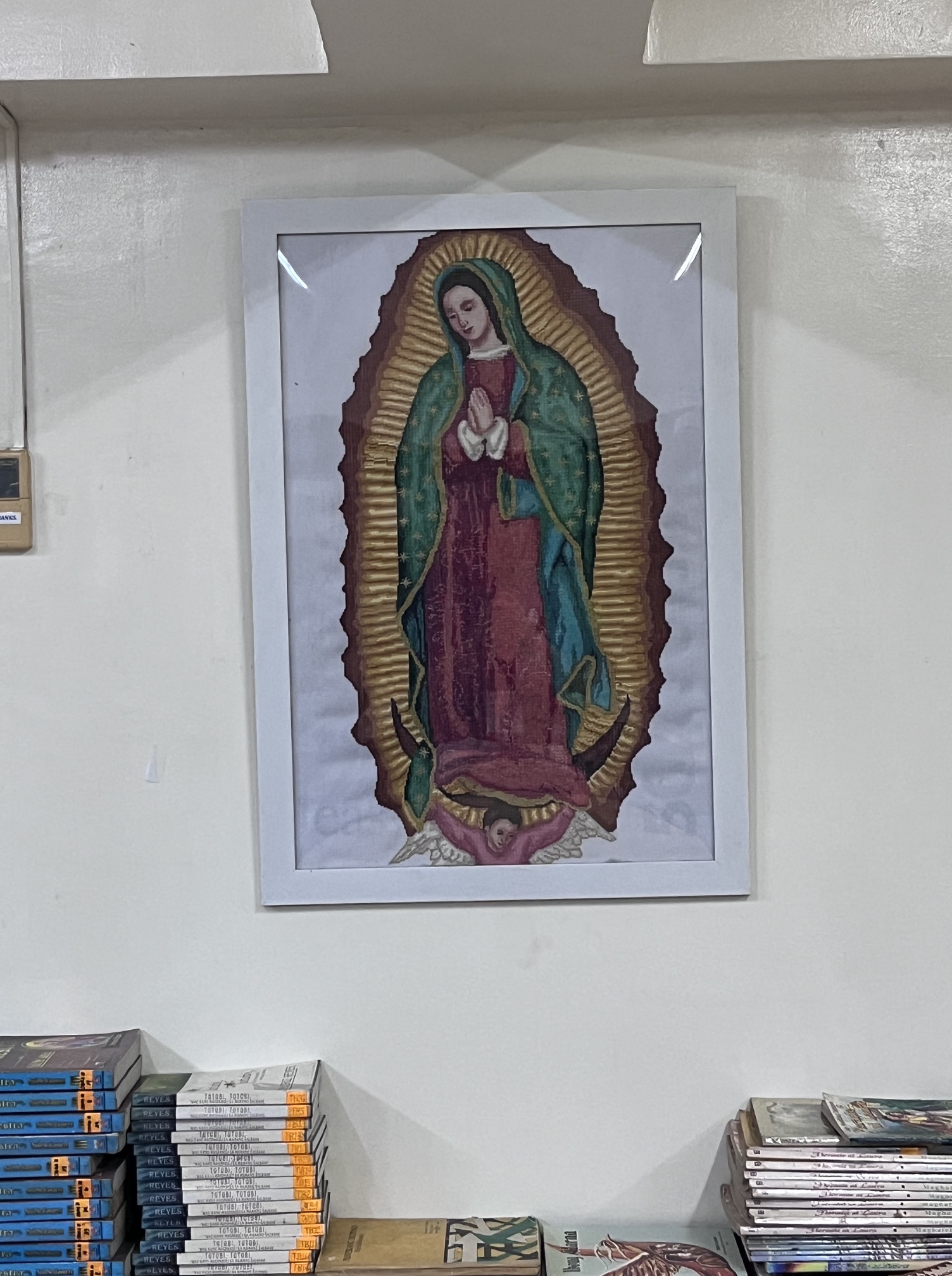
Immediately upon arrival, it is evident that Catholicism plays an integral part in Filipino life and culture. In many ways, it felt inseparable from everyday life in the Philippines. It is all-encompassing. Taxi drivers had rosaries hanging from their rearview mirrors, schools had statues of Mother Mary everywhere, murals of Saints lined the streets, government buildings greeted you with crucifixes, and houses had Saint figurines delicately placed throughout them. Even when you weren’t actively visiting a church, religion was still present in the background of everyday life. It was not confined to Sunday mornings or the walls of a church; rather, it is intricately woven into the fabric of Filipino culture.
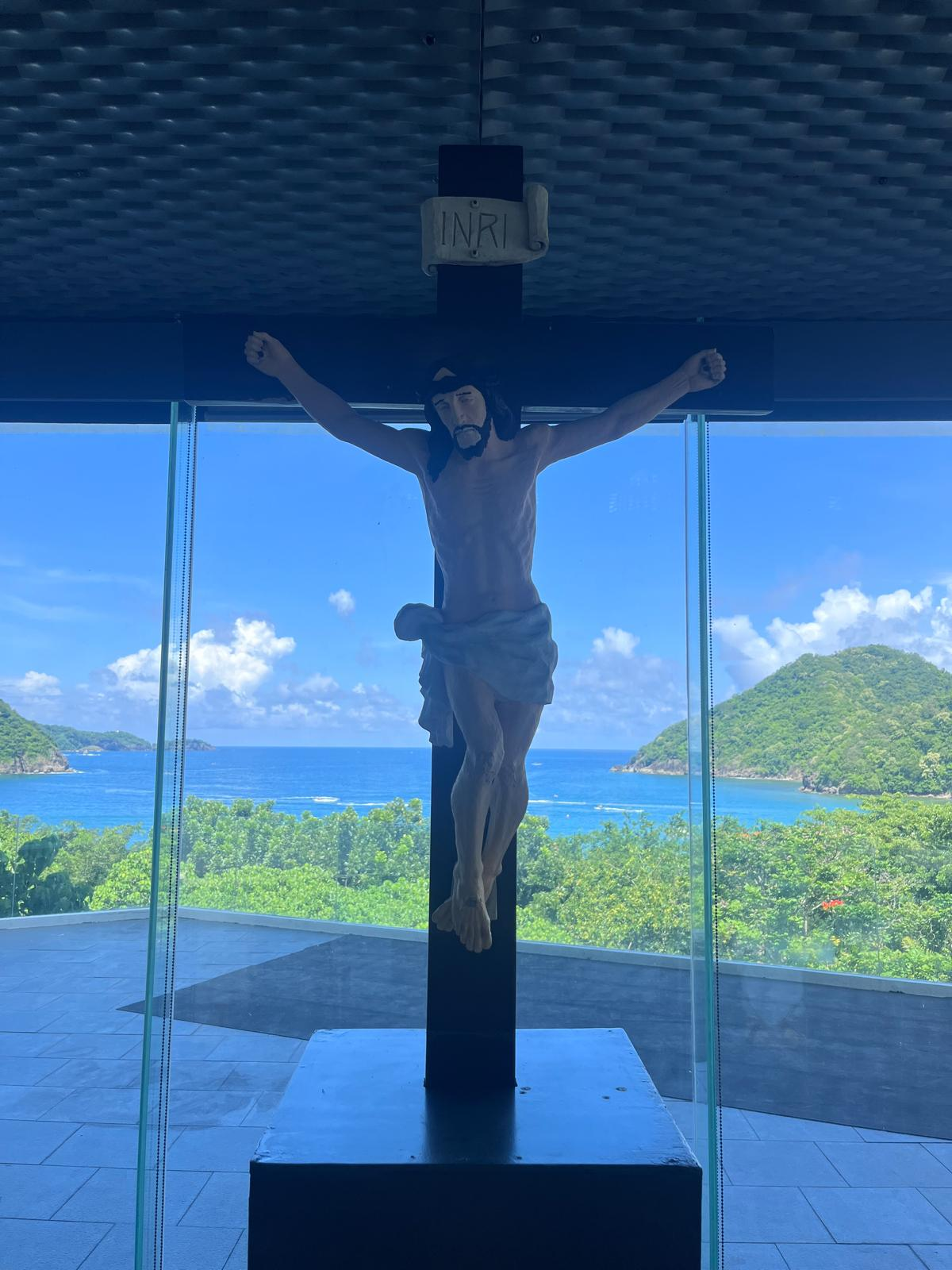
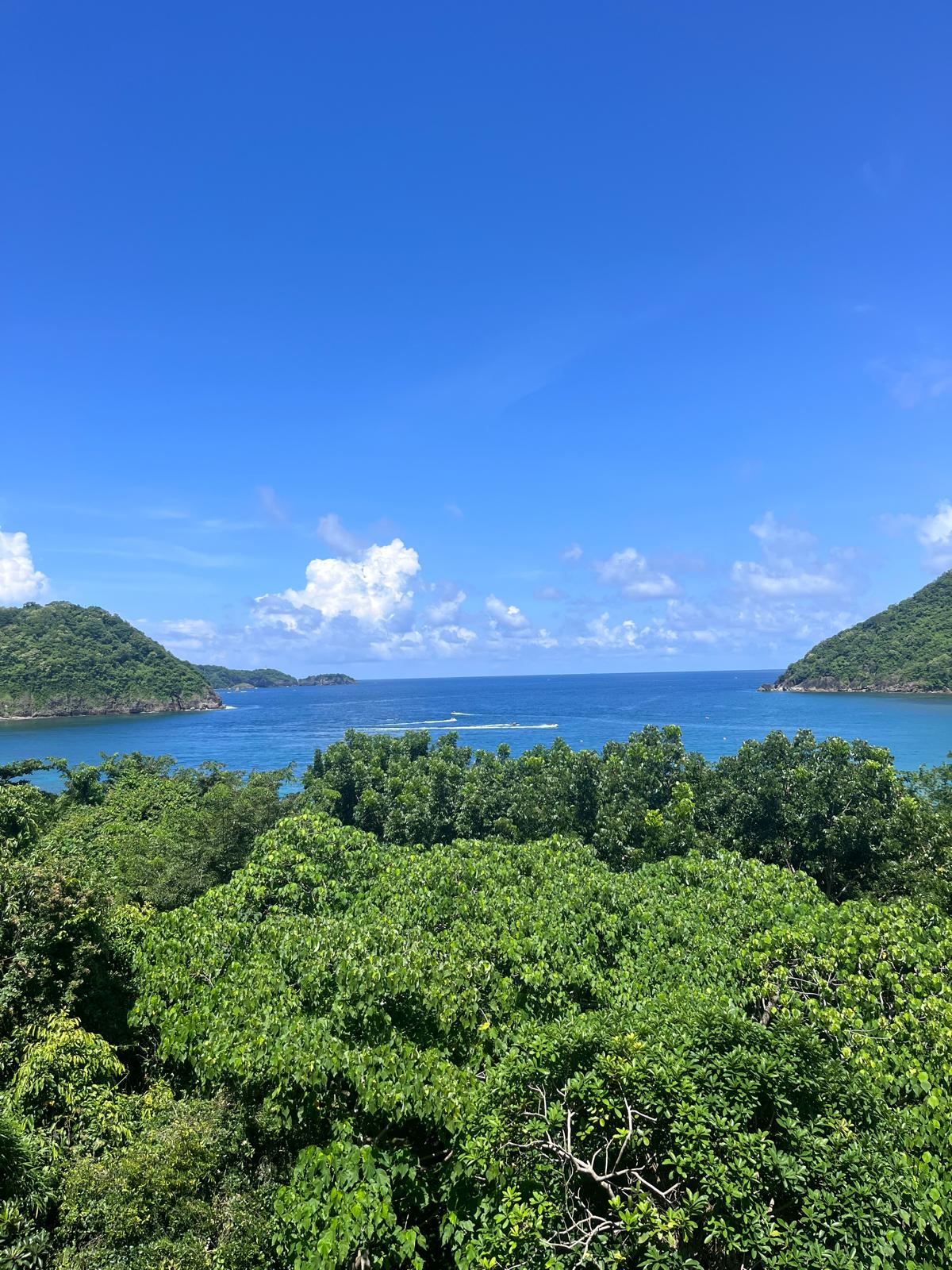
This sparked quite a few conversations among the American Fulbrighters. A spontaneous yet iconic moment of the trip occurred on the morning we checked out of the Pico Sands Resort, a coastal resort in Batangas. Since we had ample time, Siletta, a fellow Fulbrighter, invited a few of us to visit the local Catholic Church with her. St. Therese of the Child Jesus Chapel was a small rectangle surrounded by glass windows. Upon arrival, the lone worker sprayed our hands with holy water. Despite growing up a strict Catholic, this was new to me. The church was atop a hill near a cliff; the glass allowed for a beautiful view of the mountainous coastline and ocean. It’s not every day that you see a crucifix in front of such a stunning view.
St. Therese of the Child Jesus Chapel
As we perused the church, a conversation regarding religion organically emerged as two of the Fulbrighters who were Muslim inquired about the objects inside the church (e.g., the Tabernacle, chalice, statues of Saints, etc). The other four of us were raised Catholic – although different types of Catholic – from vastly different places across the U.S., even the globe. We shared our knowledge and upbringings as Catholics, some of which were humorous. The two other Fulbrighters then talked with us about their experiences with Islam. It was a heartwarming exchange of cultures. This isn’t the first time I’ve experienced such conversations as I taught about Islam, visited Islamic countries, have close Muslim family friends, and the like; however, having this cultural exchange with kind folks whom I got to know decently during our travels while atop a hill in Batangas, Philippines, while overlooking epic scenery, was certainly a first. It was one of those moments I felt fortunate to have these folks as travel companions.
View from outside the chapel
Since Catholicism dominated the Philippines, Catholic churches were everywhere. If I wrote about every church and chapel we visited, this blog would be endless. Instead, I’d like to focus on the three breathtaking churches that truly left me in awe:
Nuestra Señora de la Portería Church
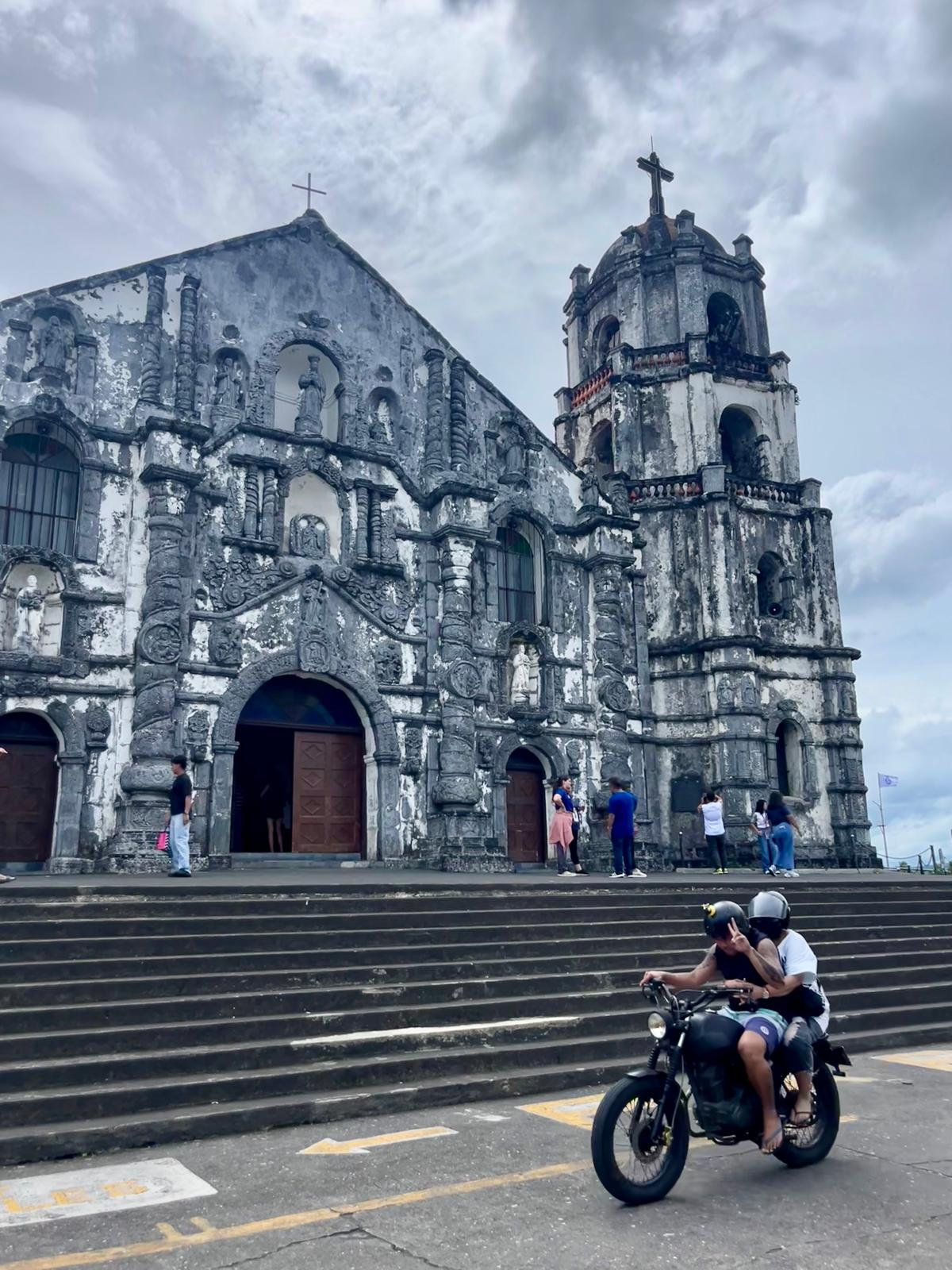
Arguably one of the most unique churches we visited was the Nuestra Señora de la Portería Church in Daraga, Albay. The church sits atop a hill and immediately commands your attention because of both its architecture and its setting. From the elevated church grounds, you can see the imposing Mayon Volcano in the distance. Unfortunately, the volcano was hiding a bit that specific morning. The church itself is remarkably ornate, with an elaborate Baroque façade covered in carved religious imagery, twisted columns, niches containing statues of Saints, and intricate foliage designs. The façade almost feels as though it were carved rather than constructed.
Nuestra Señora de la Portería Church
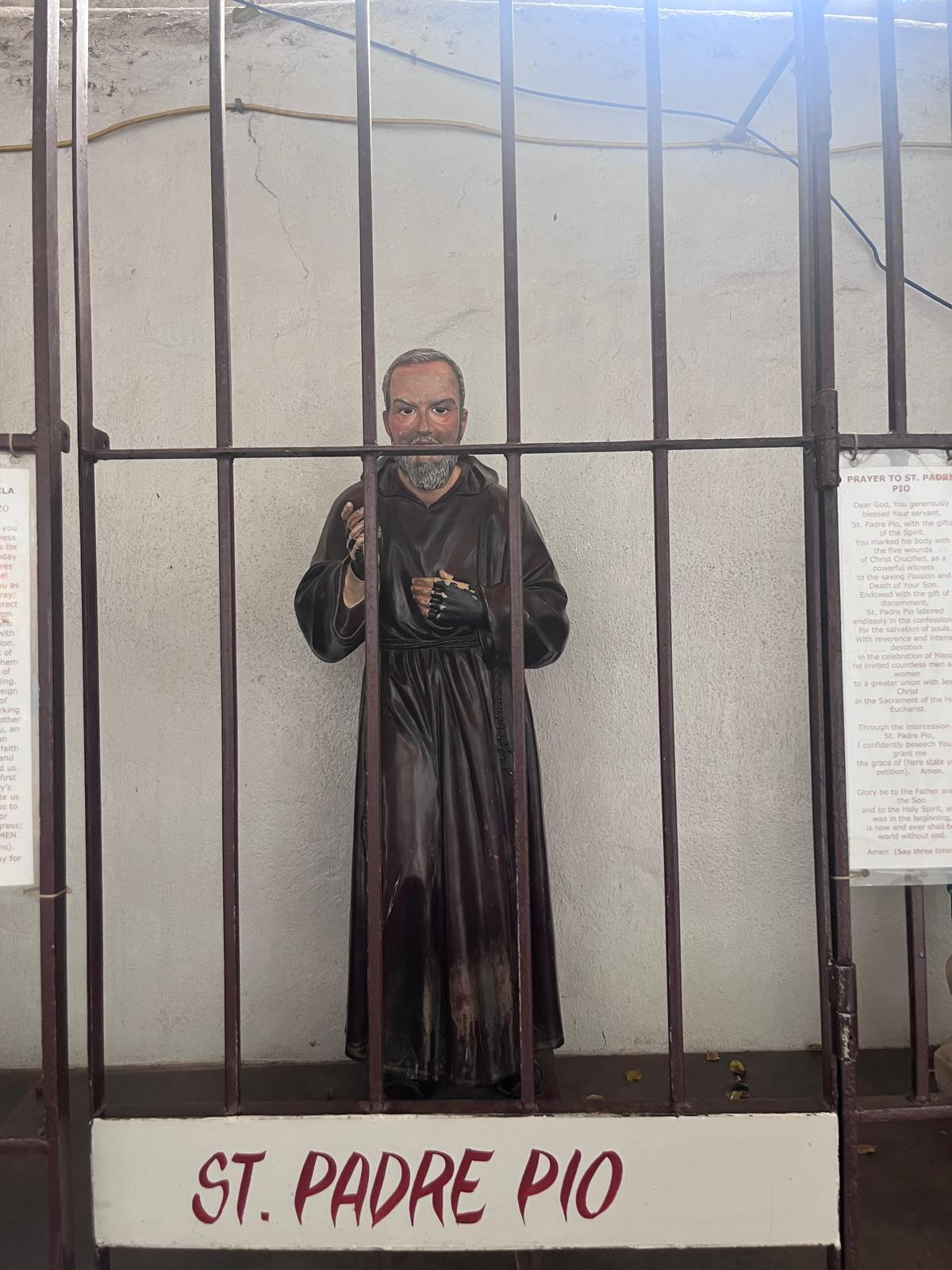
The church was built by Franciscan missionaries in 1773, after settlers moved away from Cagsawa because of concerns over the Mayon Volcano. In my opinion, the most fascinating part of the church is that it was constructed using volcanic rock from Mayon. The volcanic stone walls have survived for centuries and provide a striking contrast to the elaborate decorations carved into them. The church’s bell tower, eastern and western façades, and baptistry were declared a National Cultural Treasure in 2007; it doesn’t take an expert to see why. This church is considered so holy that the Saints figurines are locked behind iron bars, as locals swear they have healing powers. It was fascinating to stand inside a building whose very construction was tied so closely to the landscape surrounding it.
Minor Basilica of the Immaculate Conception
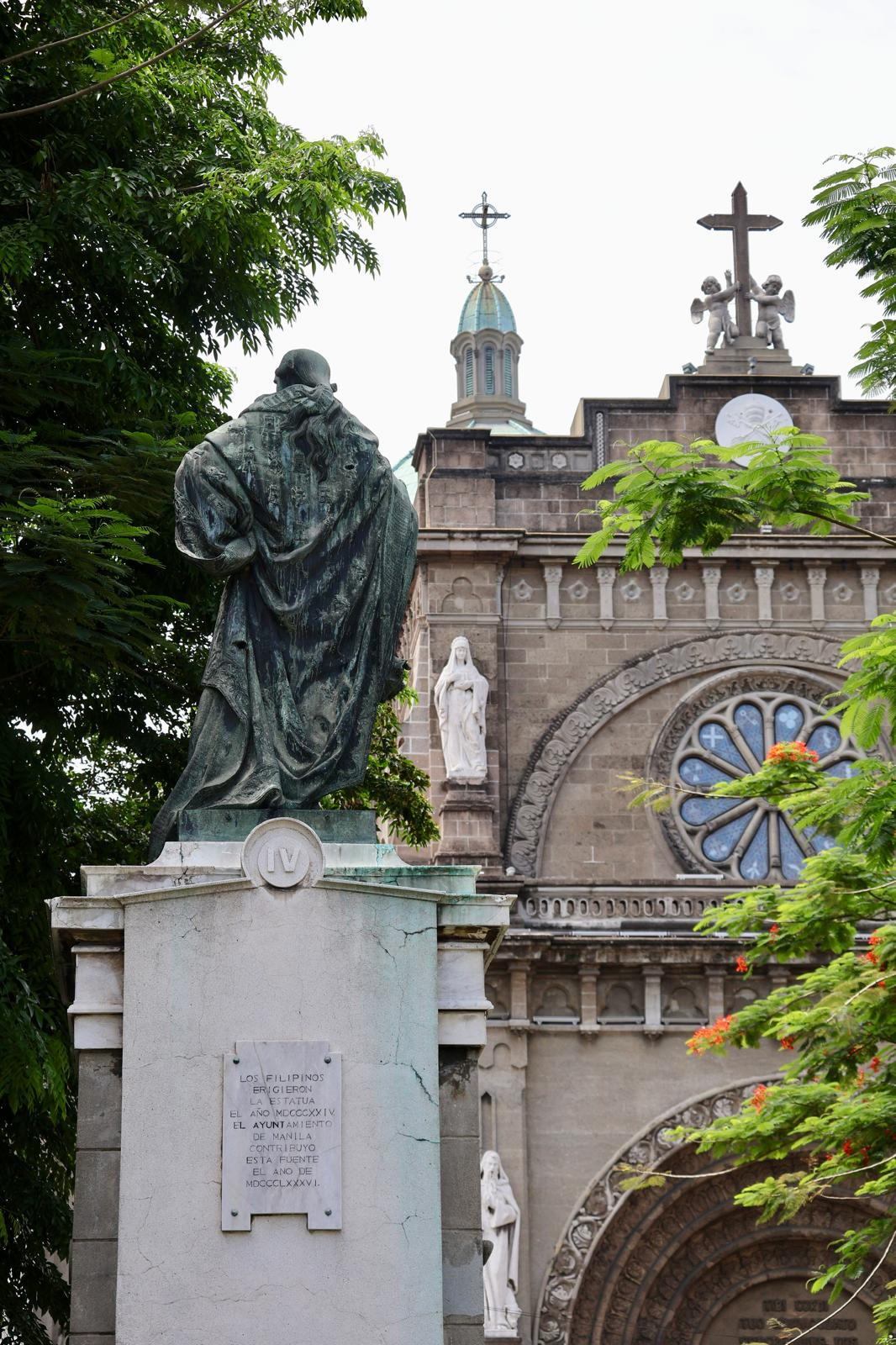
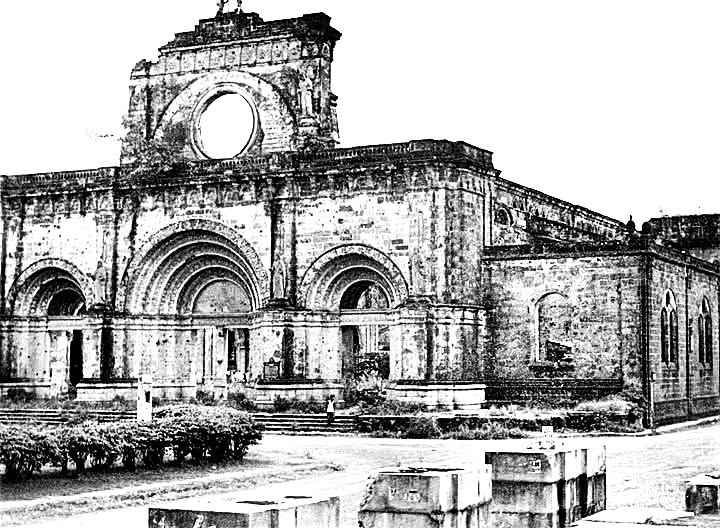
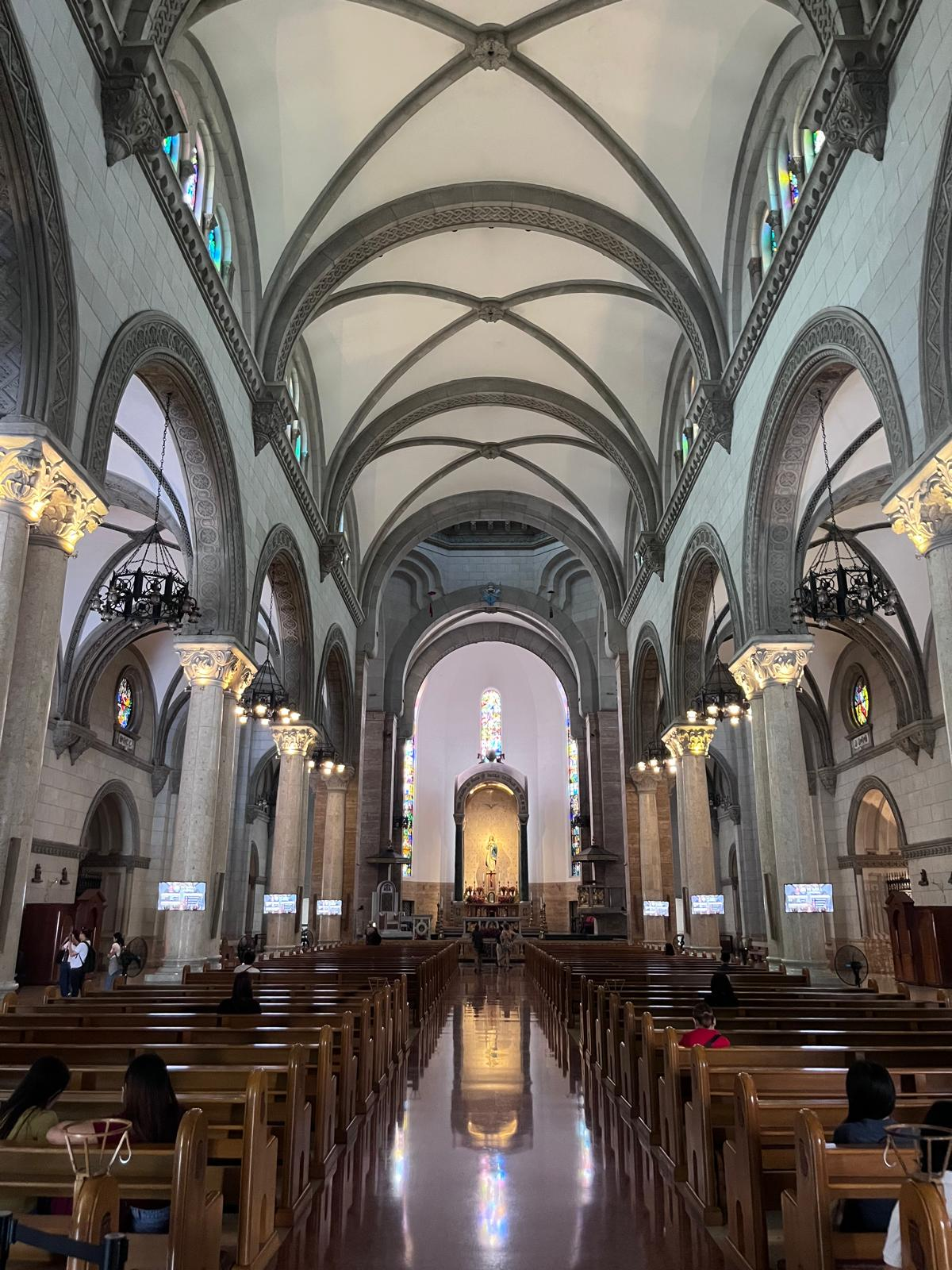
Another church that left an impression on me was the Manila Cathedral, formally the Minor Basilica of the Immaculate Conception. The cathedral has a long and complicated history, having been destroyed and rebuilt multiple times because of fires, earthquakes, typhoons, and war. The seventh cathedral was almost completely destroyed during the Battle of Manila in 1945, when much of Intramuros was devastated during World War II (see this blog to learn about why). The ruins of the cathedral remained for years before the decision was made to rebuild it. The present cathedral was reconstructed between 1954 and 1958 under the direction of Archbishop Rufino Santos and architect Fernando Ocampo.
Minor Basilica of the Immaculate Conception from Plaza de Armas
What struck me most about the Manila Cathedral was the idea that what I was looking at was, in many ways, a symbol of restoration. The cathedral survived natural disasters and bombing campaigns, yet it was consistently rebuilt and remains one of the most important Catholic churches in the country. Walking through it, knowing that so much of Intramuros had been destroyed around it, made the building feel less like simply yet another beautiful church and more like a physical representation of Filipino resilience.
Minor Basilica of the Immaculate Conception – post WWIIInside the Minor Basilica of the Immaculate Conception (2026)
I know not how folks in Manila will receive such a perspective, but I could not help but feel that even the history of the cathedral itself mirrored the history of the country – repeatedly damaged, consistently rebuilt, and gracefully preserved.
Archdiocesan Shrine of Nuestra Señora de la Consolación y Correa
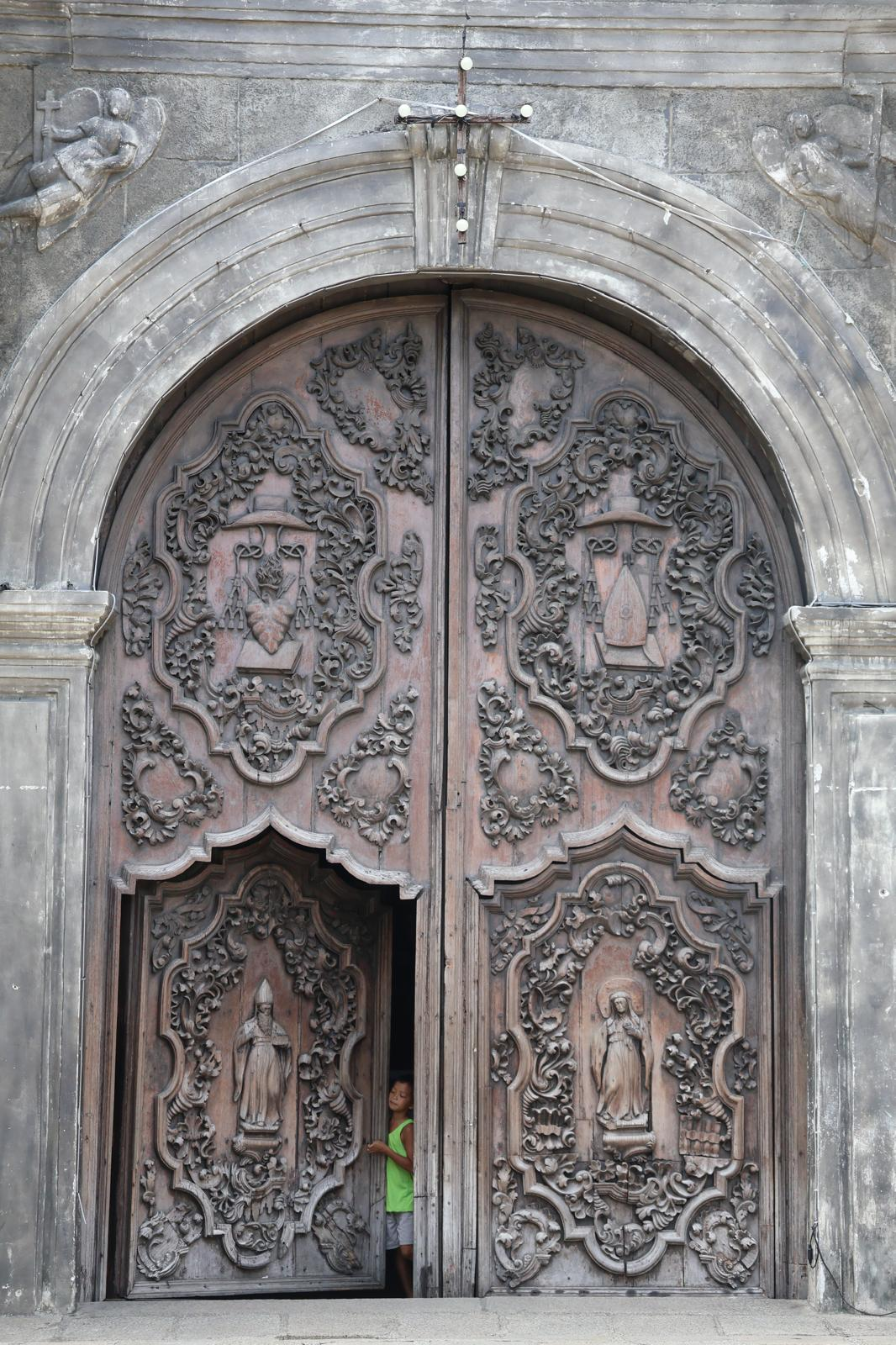
Archdiocesan Shrine of Nuestra Señora de la Consolación y Correa (San Augustin Church) was perhaps the most historically significant church we visited. Also located in Intramuros, San Agustin is the oldest stone church in the Philippines, with the present structure completed in 1607. Augustinians built the church, and it has also survived centuries of earthquakes, wars, political changes, and the destruction of much of Intramuros during WWII. In fact, San Agustin was the only church in Intramuros to survive the Battle of Manila relatively intact.
Ornate doors of Archdiocesan Shrine of Nuestra Señora de la Consolación y Correa
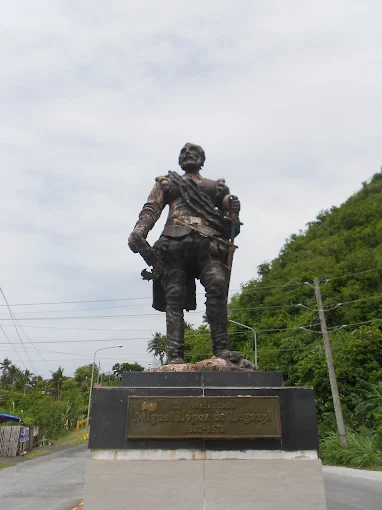
Its age alone was enough to leave me in awe. I stood outside the church for quite some time, marveling at the fact that this is a church that has been standing since the early 1600s. It is made from locally quarried adobe stone and lime mortar, and its thick walls and distinctive architecture helped it withstand the numerous earthquakes that destroyed other structures throughout Manila. The church is also filled with history beyond its walls; the ashes of Spanish conquistador Miguel López de Legazpi are buried inside, and the church has been the site of numerous important events in Philippine history. It was also designated as one of the four Baroque Churches of the Philippines on the UNESCO World Heritage List in 1993. Unfortunately, we were not allowed to take photos inside the church. Maybe this church – standing strong in the face of endless adversity – better represents the Filipino spirit.
Nuestra Señora de Salvación
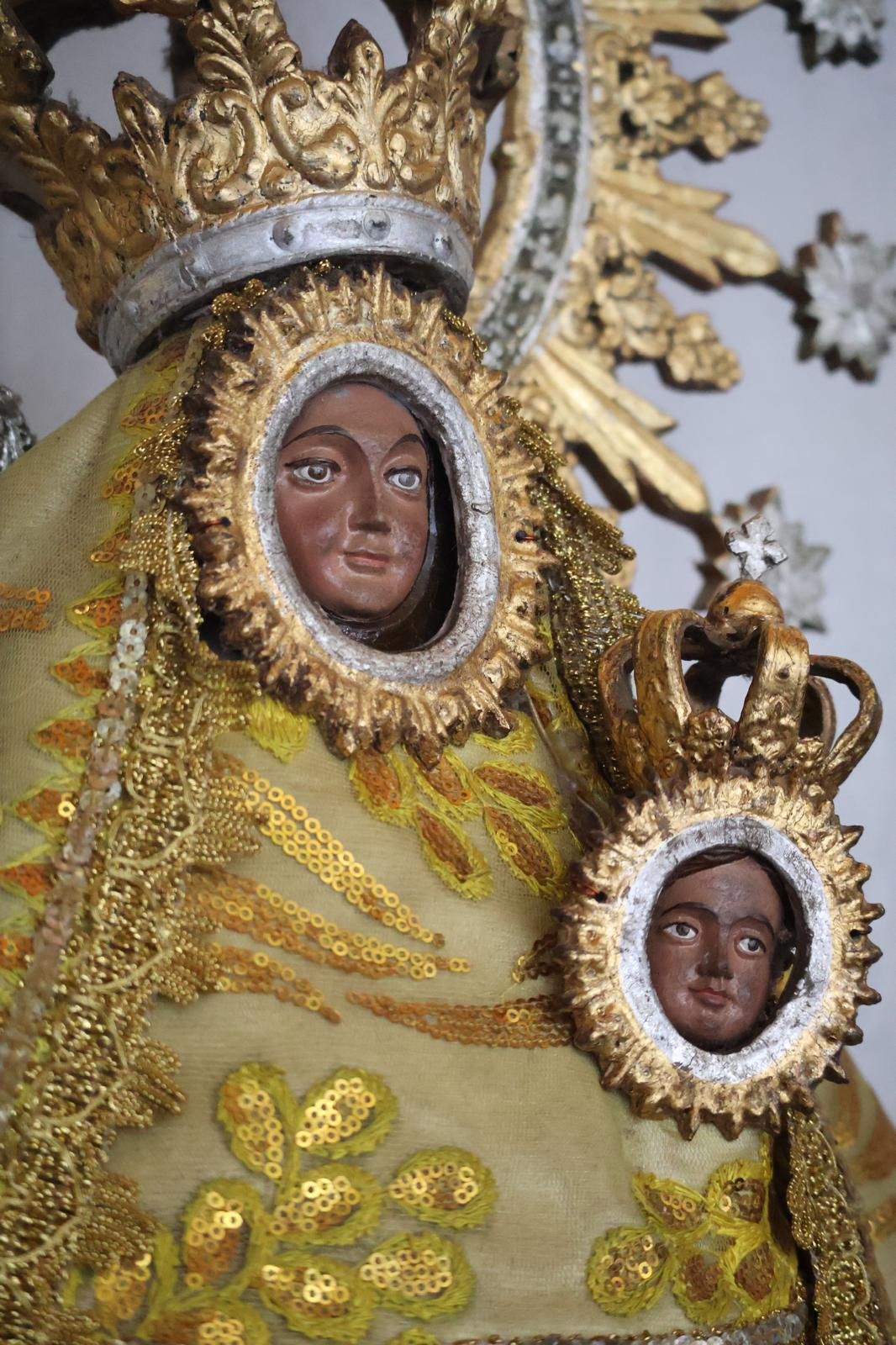
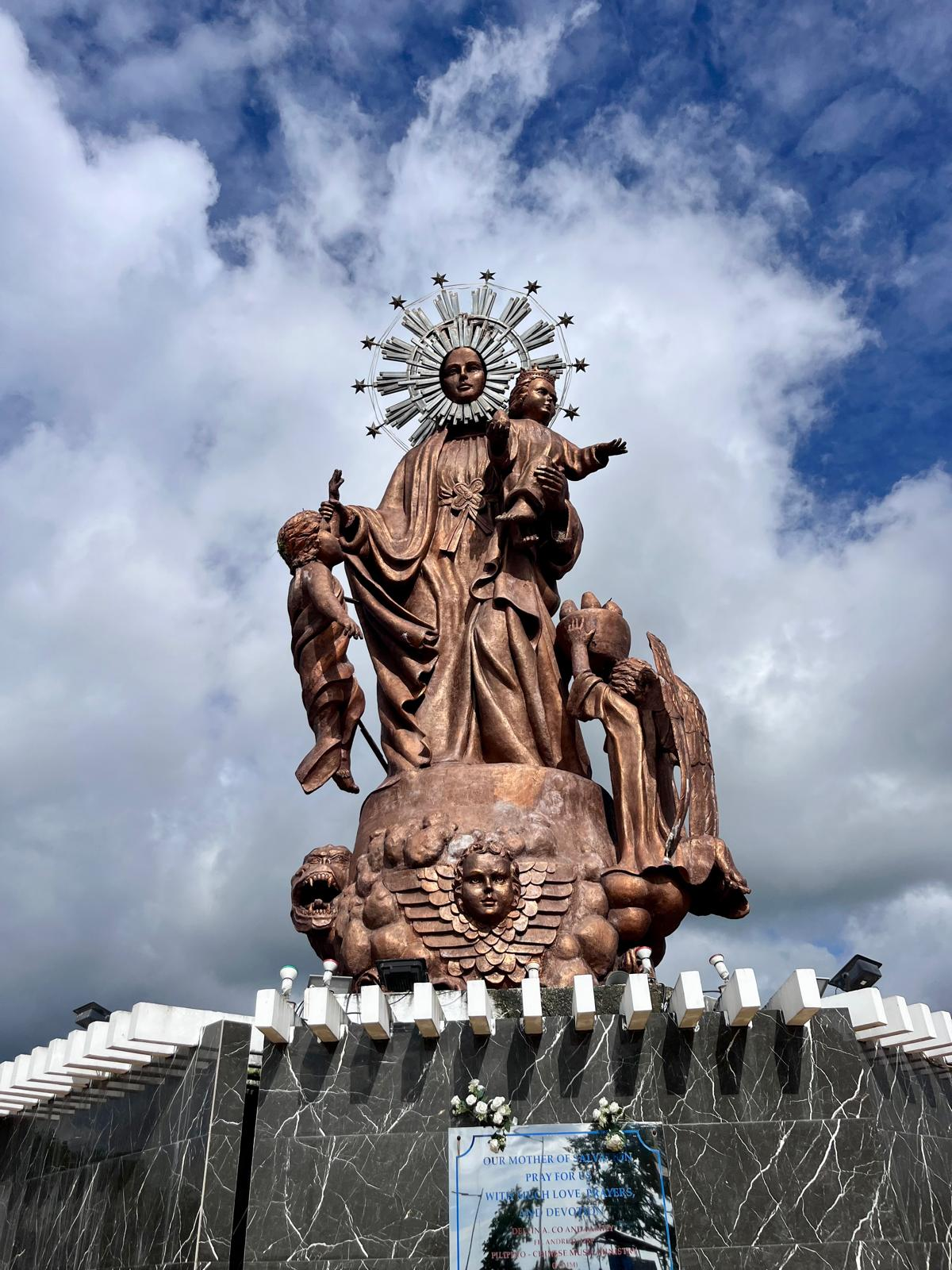
On our last day in Albay, we stopped by the Our Lady of Salvation statue. Nuestra Señora de Salvación is the heavenly patroness of the province of Albay and the Diocese of Legazpi. The enormous statue stands overlooking the landscape, making it difficult to miss as you travel through the area. Seeing the statue was another reminder of just how deeply Catholicism is woven into the identity of the Philippines. Religious iconography was not simply confined to churches; they were often placed prominently throughout communities, serving as visible reminders of faith in everyday life. Standing beneath Nuestra Señora de Salvación on our final day in Albay felt like an appropriate way to close out our time in a province where faith was paramount.
Nuestra Señora de Salvación, Albay
Islam in the Philippines
Edgar, who was our main host in Legazpi, and the other hosts felt it was important for us to experience Islam in the Philippines.
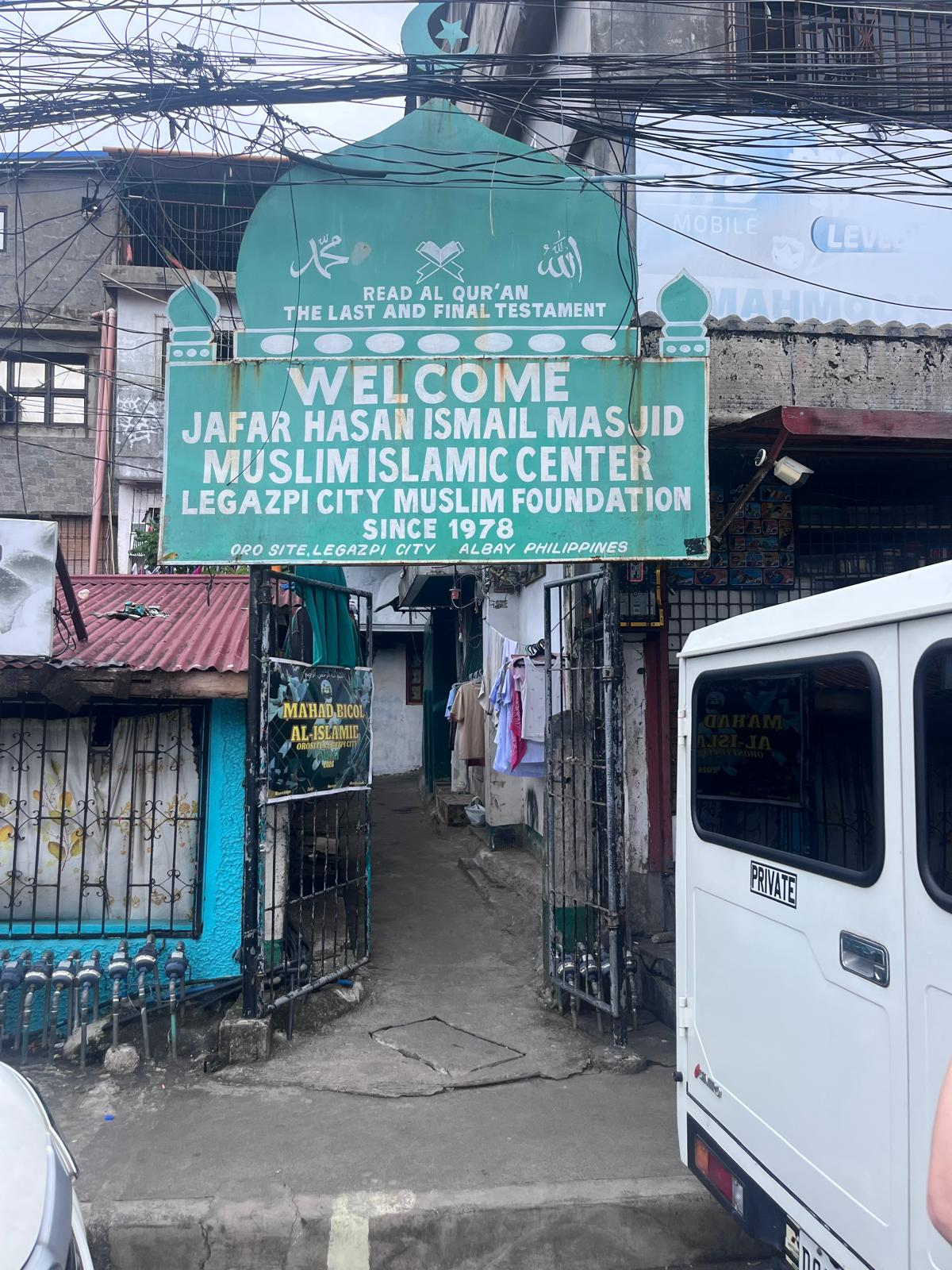
We entered into a small madrassah, a school focused on Islamic religion and learning, in Legazpi, around the corner from Oro Site High School. Arabic was written across the boards, immediately signaling that we had entered a very different educational and religious environment from the Catholic schools and churches we had visited throughout our time in the Philippines. One of the Filipino guides asked me to translate the Arabic for him, and was shocked when I told him I could not read Arabic. I often think my beard gives people the wrong impression. We sat with the Imam, who spoke heavily about peace and how the true goal of Islam is to find that peace. I wondered if he spoke so heavily about peace because he presumed Americans are misinformed about Islam. I appreciated this visit, as it spoke to the religious diversity of the country and provided another perspective on a religion that is often misunderstood in the US.
When people often think of the Philippines, they usually don’t think of Islam, despite Islam predating the arrival of Christianity. Islam had already reached parts of the southern Philippines centuries before Ferdinand Magellan arrived in 1521. Muslim traders and missionaries helped spread Islam throughout parts of the archipelago, particularly in Mindanao and the Sulu Archipelago. Over time, powerful Muslim sultanates emerged, including the Sultanate of Sulu and the Sultanate of Maguindanao. These communities developed their own political systems, cultures, traditions, and networks of trade – much of which can still be seen today. The arrival of the Spanish and the subsequent spread of Christianity dramatically altered the religious and political landscape of the Philippines, but Islam remained deeply rooted in the southern Philippines and continues to play an important role in Filipino history and culture. The Philippines’ 2020 census counted nearly 7 million people identifying with Islam – about 3 million more than in the US (depending on how Muslim populations are estimated), making it the country’s second-largest religious affiliation after Roman Catholicism.
Speaking to Muslim students, sharing meals with the Imam, and visiting the madrassah were crucial as they challenged the assumptions that can easily develop when we think about the Philippines solely through the lens of Catholicism. Catholicism is undeniably a dominant part of Filipino culture, but it is not the only religious story. Islam has its own long and deeply rooted history in the country, one that actually predates Christianity’s arrival. Sitting in that madrassah and listening to the Imam speak about peace was a reminder that the Philippines is much more religiously diverse than outsiders, myself included, may initially realize.
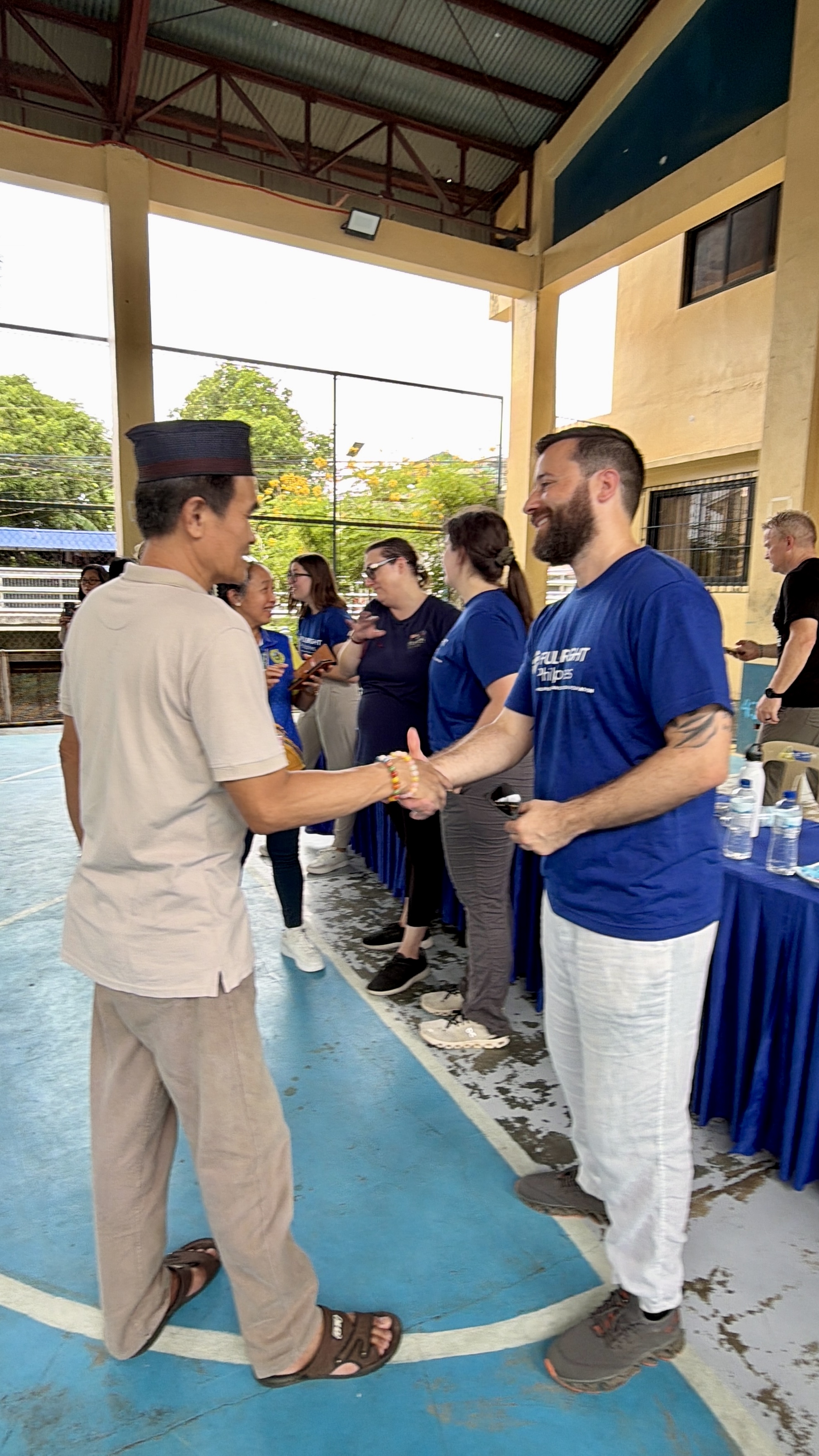
Speaking with a local Imam after playing traditional games with the students, Oro Site High School
Ultimately, what I respected most about the Filipino people was the reverence and devotion they had for their religion. Faith seemed to be everywhere. It wasn’t simply something Filipinos practiced; it was something that was visibly woven into their culture, history, families, schools, and communities. As someone who grew up Catholic myself, there was something particularly meaningful about seeing that level of devotion in another part of the world. At the same time, experiencing Islam alongside Filipino Muslims reminded me that religious faith takes many different forms here. I left the Philippines with an even greater appreciation for the way Filipinos have preserved, practiced, and passed down their faith – and for the role that religion continues to play in shaping the identity of the country. It’s not a passive aspect of identity; it is one that is also lived in their interactions.
Undoubtedly, the Philippines is rich with culture, and a sense of a strong community is paramount. Community and culture are interwoven; culture is embedded in every facet of culture. I was slightly aware of this truism from my Filipino-American friends, and from all I have studied; however, experiencing it in the Philippines was equal parts mesmerizing, breathtaking, and captivating.
Manila
My introduction to Filipino culture unsurprisingly started with karaoke on the first night. After our first day at the Philippine-American Educational Foundation (PAEF) headquarters, Filipino educators took us to a karaoke spot in a Manila mall. In the “Beyoncé Room,” dozens of U.S. and Filipino educators sang pop songs, ranging from Celine Dion and Beyoncé to Journey and the Backstreet Boys. Occasionally, our Filipino hosts would sing a Filipino song unfamiliar to us Americans. In those lyrics, I’ve learned in real-time that much of the Filipino language has plenty of Spanish and English words, which allowed me to understand a few of the lyrics. Of course, I sang Backstreet Boys’ classic “I Want It That Way.” Despite the fact that Filipino teachers put us to shame, we all had a splendid time.
Within a few days, it was immediately apparent how much basketball reigns supreme. In Manila, I saw basketball courts where teenagers played barefoot while dozens intensely watched and cheered. Basketball games are played on large screens in massive thoroughfares and on little TVs in shops and restaurants on skinny streets. This was especially telling considering it during the midst of the late stages of the World Cup. While the world watched Messi perform magic and Spain dominate, Filipinos stayed glued to their basketball.
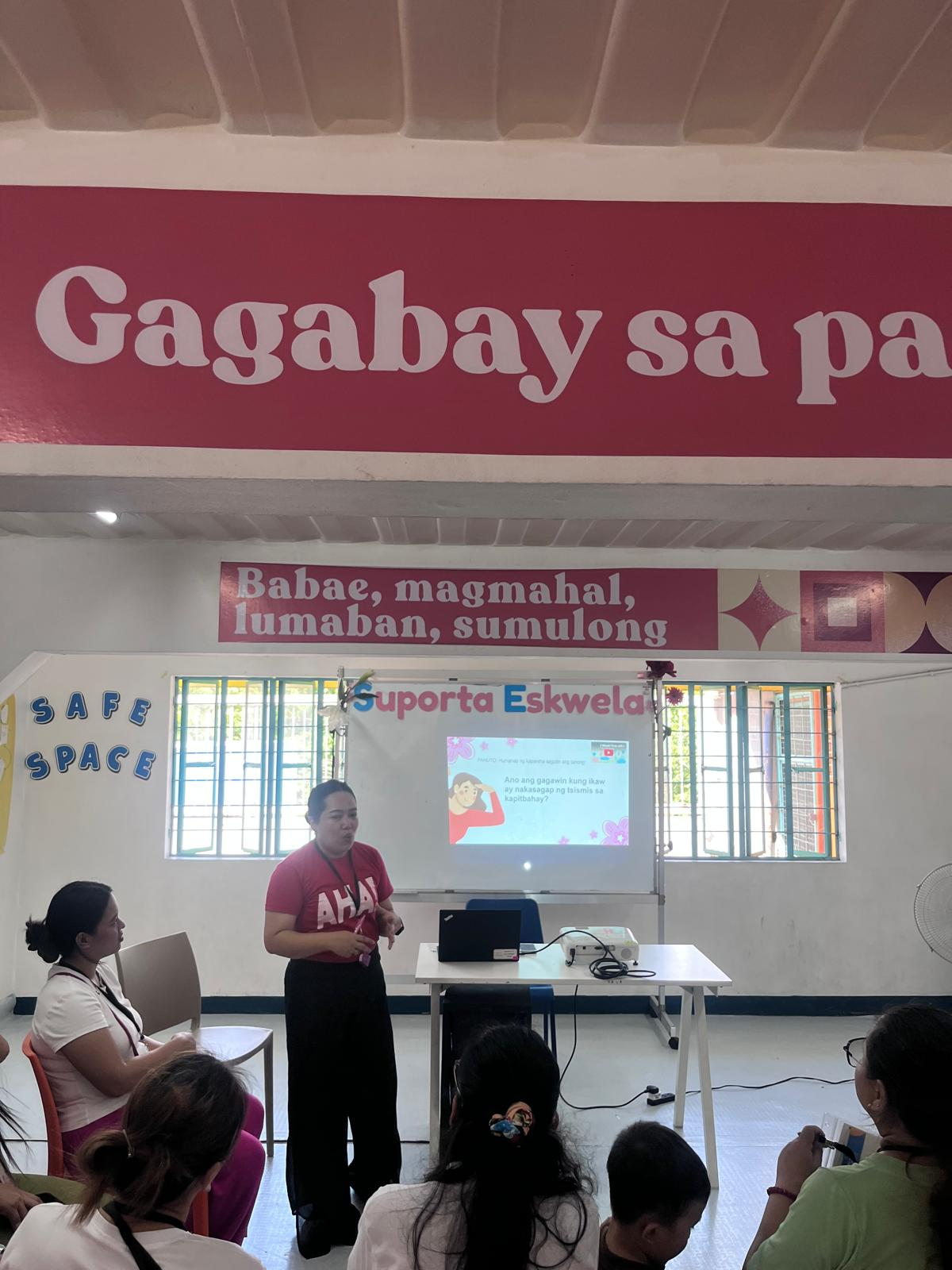
A-HA! Learning Center
One of the first institutions we visited was the A-HA! Learning Center – a renowned nonprofit organization for Filipino youth. Based on our guide’s descriptions, I could not quite gauge what this place was going to be like. Was it a school? A community center? A nonprofit? It was everything and more, and thus, it is located precisely in this blog rather than the one regarding schools. Venturing to the AHA Center provided us with a different glimpse of Manila – one where skyscrapers, vapid malls, and large avenues did not dominate the landscape. Rather, we saw where the inhabitants of Manila lived and worked, and these harsh conditions were vastly different from the skyscrapers and shopping malls that dominated Makati. The country’s vast wealth gap was on full display.
When exiting the bus to enter the AHA center, I immediately noticed a strong stench. Our guides notified us that this is due to the nearby “Smokey Mountain,” much different from the Smoky Mountains in the States. This Smokey Mountain was akin to a hill atop a landfill, which reminded me of the Desire Projects in New Orleans – a neighborhood also built adjacent to a landfill. The hosts of the AHA center greeted us warmly. They ushered us into a room to sit at a table with an AHA teacher, a parent of AHA students, and an adult learner. The AHA teacher, Love, greeted us eagerly and kindly. She was a teacher any school would be fortunate to have. It was immediately evident she had a sense of pride in her work. The mother of an AHA kid, Lovely, greeted us in the same manner. I felt welcomed from the start.
The AHA staff gave a short presentation about the inner workings of the school. They emphasized kapwa– a recognition of a shared identity (elaborated in this blog). One leader stated, “Your team is my team, your joy is my joy.” To them, kapwa meant seeing “through the eyes of our learners, ears of our parents, and centering community needs.”
After getting to know one another, they gave us a tour of the facility. From the outdoor staircases, you could see shanty houses built atop a small river. In the center, each room hosted a different class for various age groups. I found the adult classes most meaningful. As kids learned in one classroom, mothers learned in a nearby one. We visited a women’s empowerment class and saw a vision that starkly contrasted with the patriarchy embedded within Filipino society. The class started with a chant: I am a woman, not just a woman. I live, I fight, I move forward. Many of the participants were single mothers living in destitute poverty; several told us the AHA center gave them “hope.” Another particularly moving part of the center was the room in which mothers sewed clothes, from school uniforms and clothes for mothers to whatever the community needed. There was no alienation of labor here. They made clothes with care and community in mind.
Women empowerment class at the A-HA! Learning Center
Later, I worked with a group of students who looked to be second graders. The teacher taught them strategies on how to count whole numbers. The teacher then asked me to work with a group of students. Although I teach much older kids, I did find immense value in this vital, albeit brief, work. One of the kids, Kyle, truly enjoyed my company. He hugged me tightly when I had to depart.
After our time with the kids, the AHA folks took us to visit a family. They assigned Teacher Love to guide another Fulbrighter and me to visit Lovely’s home, the first AHA mother I initially interacted with. Lovely’s home was a short walk from the AHA Center. It was a tiny, compact apartment in a large apartment complex directly across the street from Smokey Mountain. Two of Lovely’s kids greeted us with excitement. One of them, Akron – named after Lebron James’ hometown – ran around the place donning a Lebron jersey. Kids outside the apartment did TikTok dances – a universal experience. Lovely talked with us about her life, from working multiple jobs to being a community advocate. Although she did not employ the latter term to describe her life, it is an evident description of her.
It is always humbling and moving to see the living conditions of others. Such experiences indeed frustrate me, as I know we collectively can improve the living conditions of those at home and abroad. During our debrief, Teacher Love gave us some words of wisdom. She asked us not to “feel sorry for them” or just return home thinking about how fortunate our lives are. Rather, she asked us to let the experience move us to enact change in our own communities. I made a personal promise to do just that.
Chosen Village Orphanage
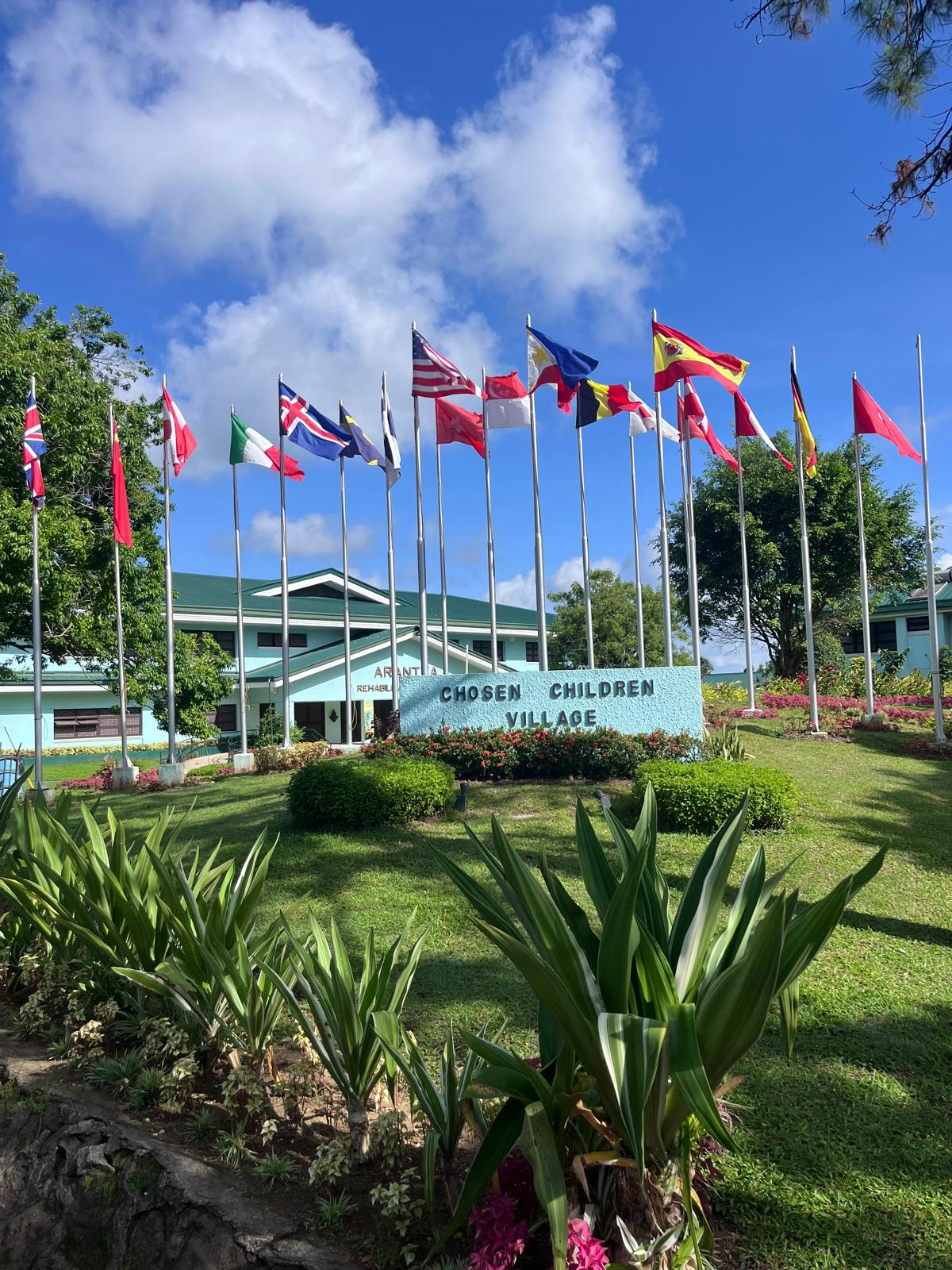
The Chosen Village Orphanage was the next community center we visited. Although it was a school, like the AHA Center, it also did so much more. Chosen Village was an orphanage, a home to dozens of kids whose parents abandoned them before they were two years old. Our guides ushered us into a small chapel as we waited for the orphanage staff to greet us. The small chapel had many figurines of saints, reminiscent of my grandmother’s home. Although I’ve only been in Manila a few days at this point, the presence of Catholicism seemed all-encompassing.
Entrance to the Chosen Children Village
The staff greeted us in the Catholic chapel to give a quick background of the facility. We then toured various classrooms where students with special needs were giving it their all to learn. The kids immediately reminded me of the special needs students I taught at Trist Middle School during my first years as a teacher. I’ve always had a special place in my heart for those with disabilities, leading me to get certified to teach the subject when I first entered the profession.
Our Fulbright guides assigned us with groups beforehand. Roch, our main guide, asked if I would be ok with working outside on the farm. I figured this was because I was from the South and that heat probably did not faze us compared to our counterparts. It is a fair and accurate presumption. The Chosen Village director asked me, along with a few other Fulbrighters, to work with Paul, one of their older students (early 20s?), in the fields outside. Paul immediately displayed fixations on two topics: weather and basketball – both of which I knew, fortunately. We chatted about all sorts of weather patterns. He showed particular interest in the weather that occurs in the States. Interestingly, he asked me about Hurricane Katrina, despite not knowing I was from Louisiana. I told him a bit of story as we swept leaves while cows moo’ed loudly nearby. He also asked about tornadoes, which I witnessed pass right by my house – twice.
After yardwork, we visited the farm animals. The cows eagerly rushed toward us as we approached. I thought they were excited for new visitors, but they were actually trying to escape through the gate we just entered. I only noticed when they darted past us. Once they realized their fate was sealed, they became slightly more curious about our presence. Paul ushered us to the pig den, in which two men were pouring boiling water atop a recently slaughtered pig to burn off the hair. The sight reminded me of the time the leaders of a displaced Maasai community asked me to help sacrifice a goat for dinner, which I did. Such practices are a nice reminder that societies who buy their plastic-wrapped meat from horrendous factory farms should never judge. The pigs in the den seemed unaware of the fate of their nearby buddy as they sucked their mother’s milk. One pig in heat caused absolute madness. This was self-sufficiency in action.
We ate a home-cooked lunch near many of the students. Afterwards, children performed various songs that truly touched our hearts. The hip-hop segment was incredible as one kid went OFF. For the last song, all of the kids sang, “We Are the World,” with as much passion and spark as they could muster. Many in the crowd were moved to tears; tissues couldn’t come fast enough. Afterwards, one of the kids with Downs Syndrome who crushed the hip-hop dance decided to talk with me, which I later figured was probably because I had a backwards hat on. He talked about the Step-Up movies, none of which I had seen, but I listened intently. All conversations made its way back to the Step-Up movies.
I ended up buying loads of jewelry from this center to bring back to my family and my students. They all appreciated it. I have no photos of these interactions as we were politely asked not to take any.
Legazpi
After Manila, a few of us arrived in our home city, Legazpi. Our greeters displayed a sense of community upon our arrival. Edgar, our main Legazpi host, greeted us with banners and hugs. Despite being thousands of miles away from family, his warmness eased the blow. After settling in, the six of us stationed in Legazpi ventured to get nearby Chinese food, which is always much tastier and richer than the Chinese food in the States. The history of the Chinese presence and the “Chinese Mestizos” who emerged over the centuries is a culture worthy of explanation on its own. The food in Legazpi truly embodied Filipino culture. Every meal was succulent.
In Legazpi, schools truly embed culture, a topic elaborated on in this blog. However, culture also surfaced in the night markets, where people sold street food and handcrafts as the sun set over the bay. We took their “tricycles” to get there, which were three-wheeled motorized bikes with a side cart. I ate some birria tacos from a quaint taco stand, and they were the best tacos I’ve had outside of the States and Mexico. Given the region’s history, I should not have been surprised by the deliciousness.
On another night, we had dinner with Judge Carlo Martin Adille, a local renowned judge and former president of Legazi City Science High’s Parent-Teacher Association. He offered us one of the best meals I’ve ever had during my time in the Philippines. The taste was a stark reminder that, like New Orleans, the best traditional dishes exist on the dinner tables throughout the Philippines. Judge Adille discussed his desire to assist the school his daughter attends. His fundraising is apparently one of the reasons that some classes at Legazi City Science High have AC. He also told us about his LDS faith; I was unaware that the LDS Church made such headway in the Philippines. After a succulent meal and a wonderful chat, we ventured to his roof to get a nighttime view of Legazpi. As we looked at the beautiful lights under a hiding volcano, Judge Adille expressed his desire to do more to help his city. I left the home with my stomach and heart filled. A home visit is always a special experience.
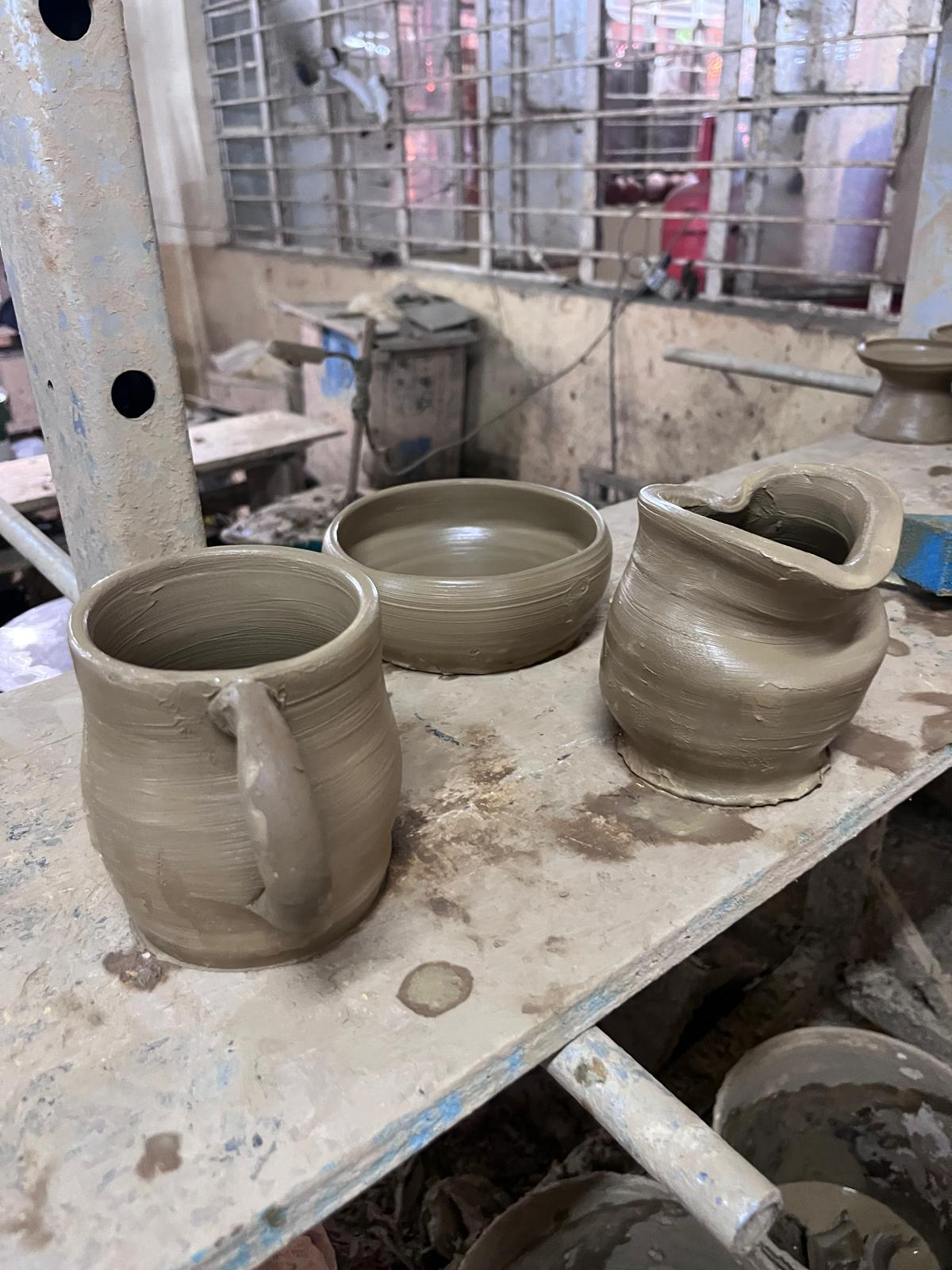
On our last day in Bicol, we took a trip to various sites, including the Philippine Ceramics Arts and Crafts Center in the small town of Tiwi, which is also home to a geothermal power plant. That was my first time trying to make pottery, and I’d like to think I did a decent job – don’t tell me otherwise. It was also quite fun to mold a dish out of clay within almost minutes. It seemed that pottery was rather popular in the rural areas – not just in a token way – but in a way where folks still heavily rely on it.
The results of my first ever attempt at pottery, Philippine Ceramics Arts and Crafts Center
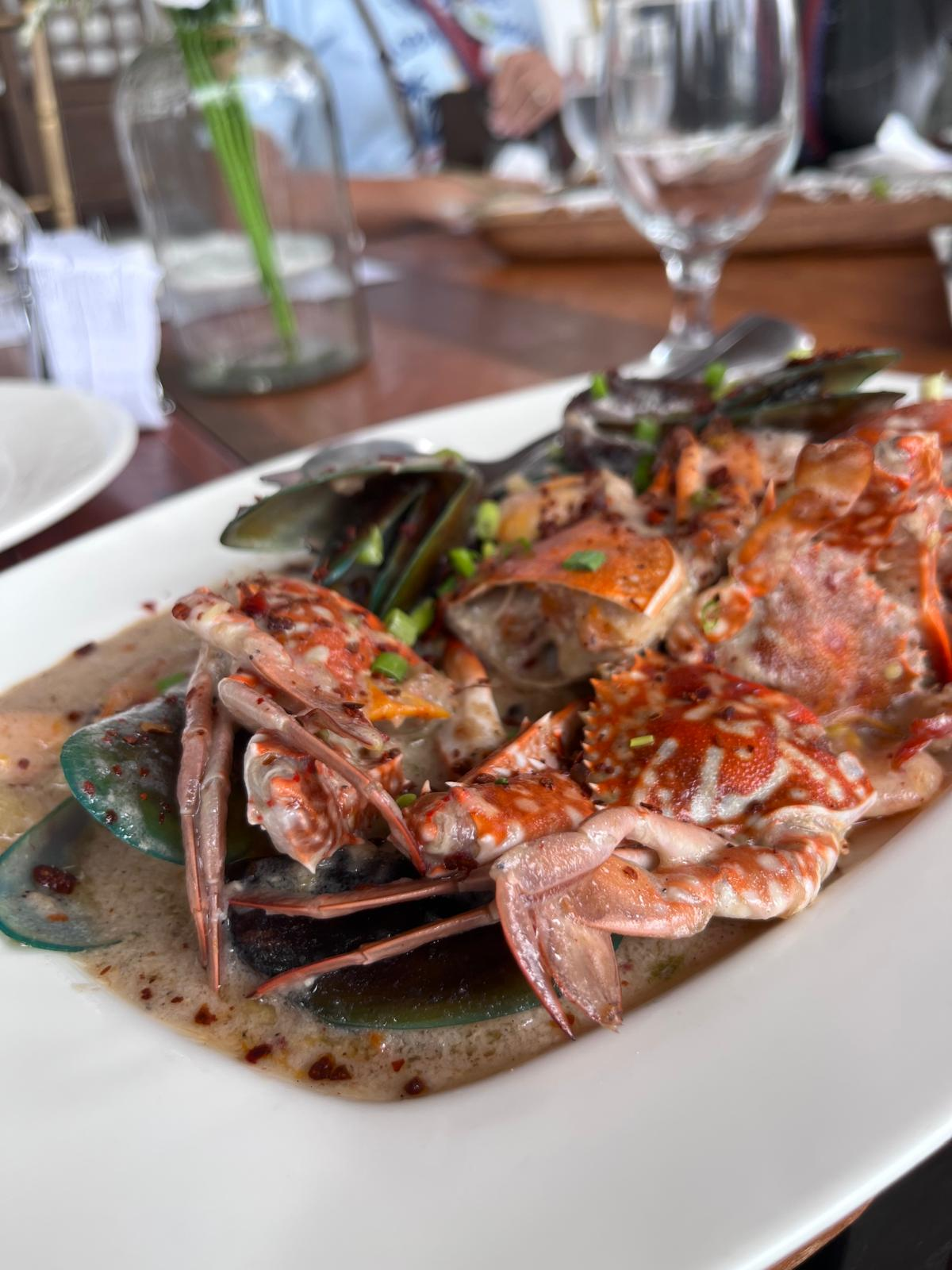
Afterwards, we went to a restaurant overlooking the Mayon volcano to eat our last meal in Albay. I had a seafood dish cooked in a rich coconut sauce. The texture felt familiar but the taste was foreign. It was delicious, of course.
Last meal in Albay
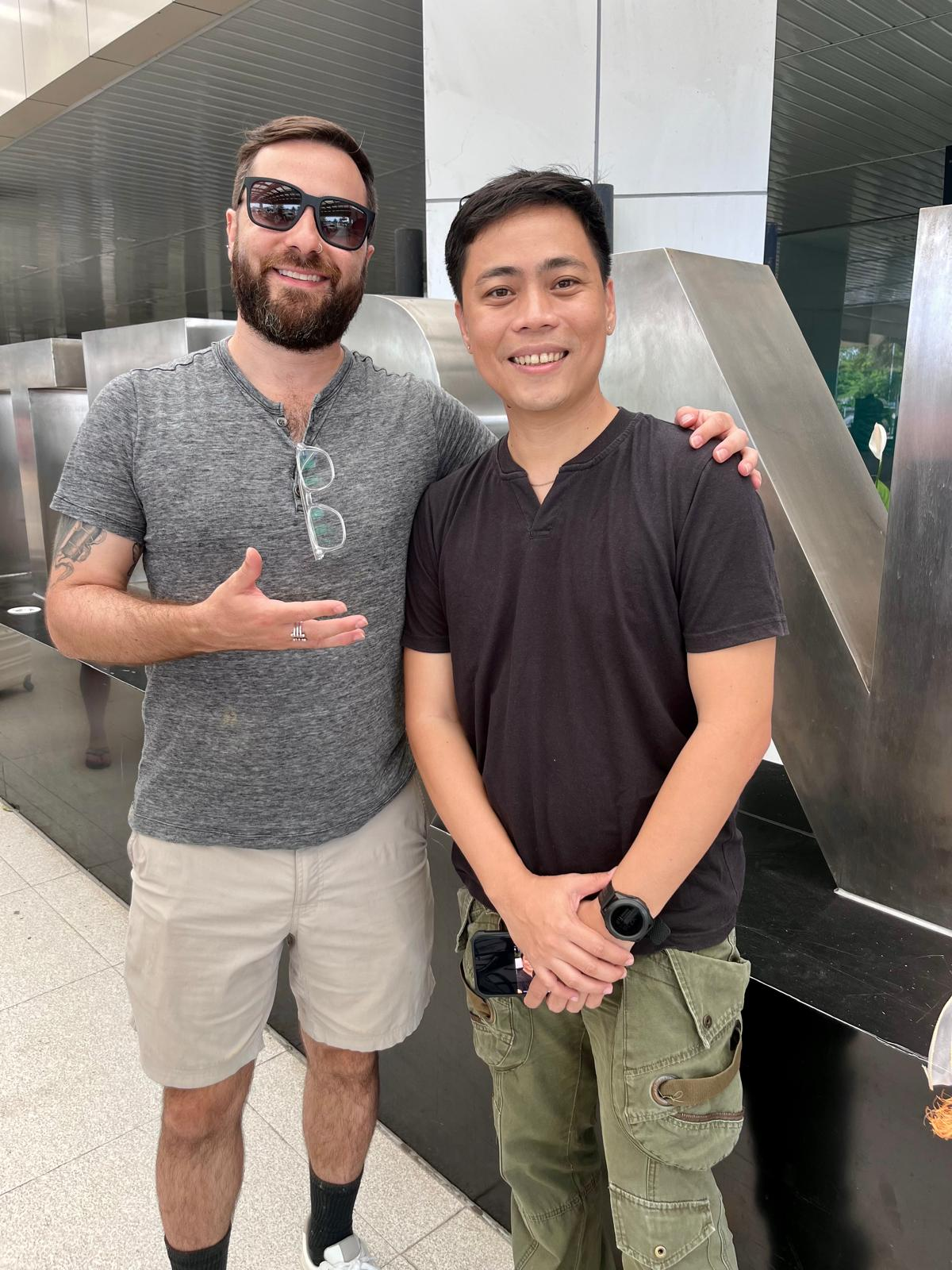
At the airport, we said our farewells to our gracious Legazpi hosts. Edgar and I took one last photo. I hope to repay his kindness back in New Orleans one day.
Edgar and I
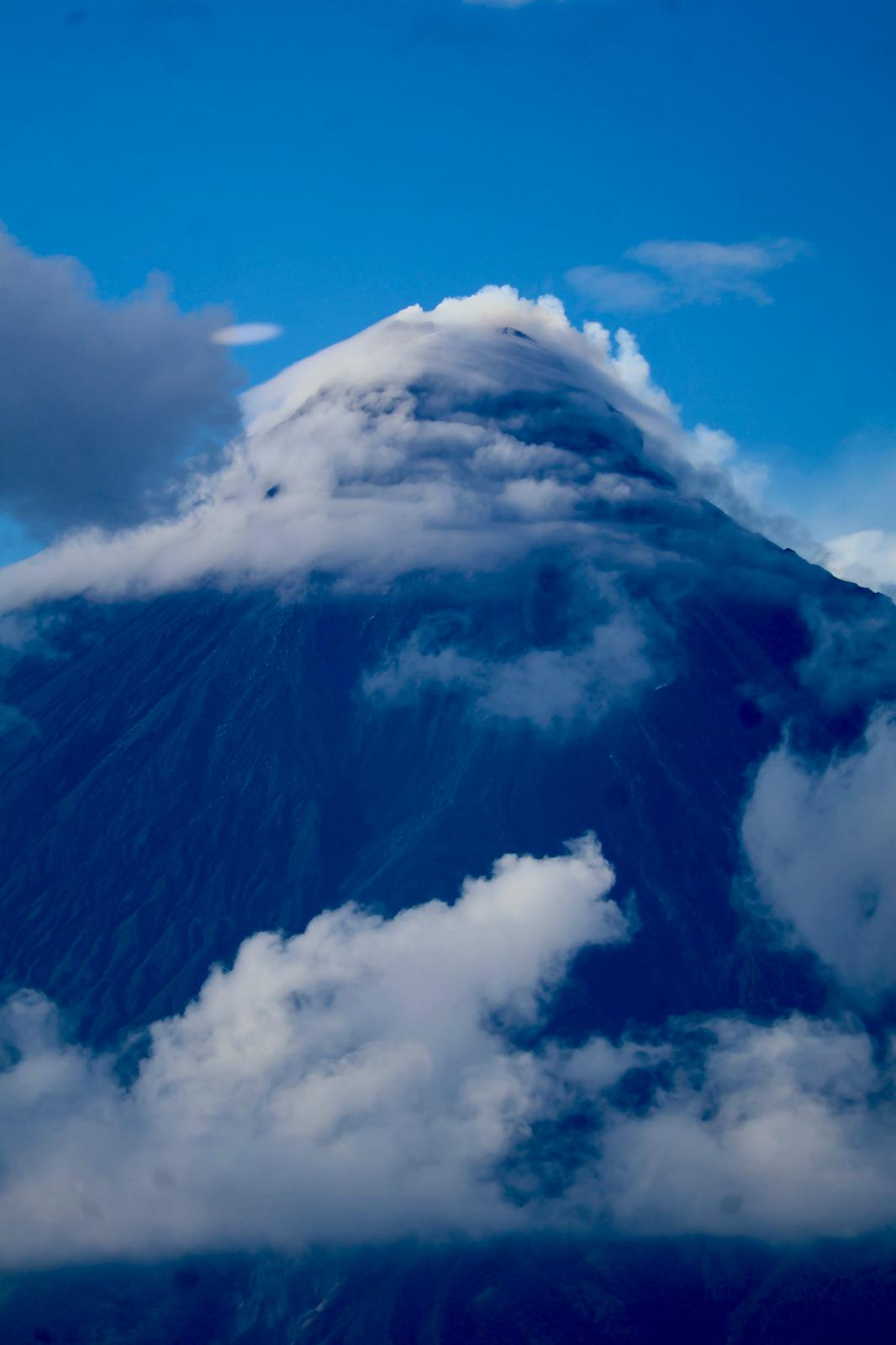
To be honest, I did not want to return to Manila as I felt our time in Legazpi was too short, and I already enjoyed the students I was fortunate to teach – albeit briefly. The pace of Legazpi was much more my speed. There was a community feel to the city that was absent in Manila. I took one last photo of the volcano before I boarded the plane as it showed its peak, just as it did the day we arrived. According to local legend, this meant our visit was a blessing.
Mayon Volcano
Back in Manila
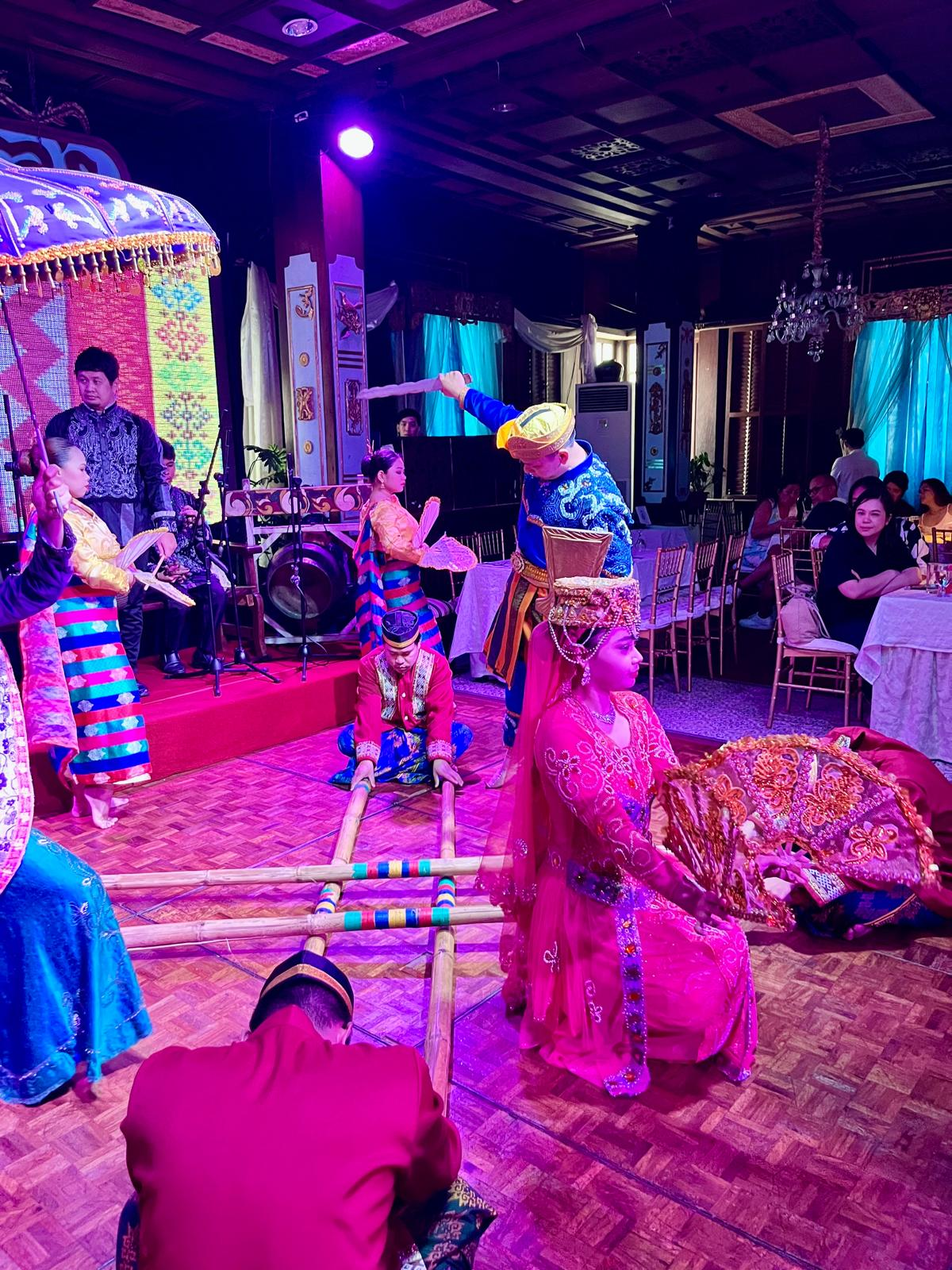
Back in Manila, the Fulbright team ensured to expose us to the rich culture of the Philippines. After we toured Intramuros, the ancient walled city, they took us to a restaurant that had a buffet of endless Filipino dishes, including desserts. After the meal, we had the opportunity to watch multiple styles of Filipino traditional dances from various regions of the country. In just one afternoon, we saw almost a dozen cultural dances, highlighting the true diversity of the archipelago. The Asik is a traditional solo folk dance from the Muslim Moro ethnic groups of Mindanao. Singkil is a famous royal Maranao dance where dancers weave skillfully through closing/crisscrossing bamboo poles to simulate a legendary forest. Pandanggo sa llaw is a famous folk dance that originated in Mindoro in which dancers remarkably balance oil lamps (tinghoy) atop their heads. These elaborate dances showcased not just tradition but resilience as many seemed to be speaking against outsiders who sought to suppress culture. I’ve rarely witnessed such a rich and mesmerizing culture on full display in one performance.
Singkil – a traditional royal dance
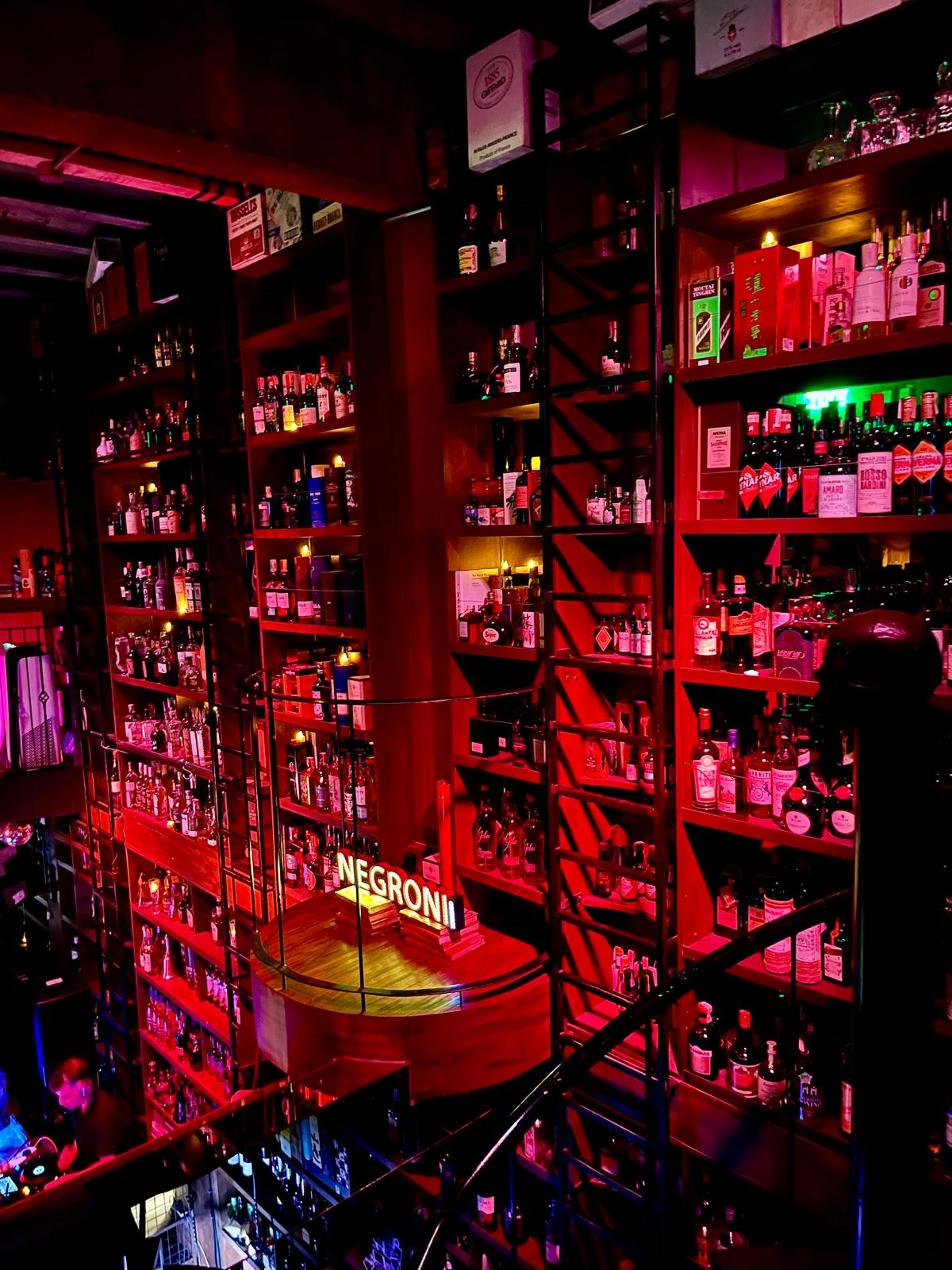
As with all major cities I have visited, I had to experience a touch of the nightlife – a defining aspect of a city’s culture. Teacher Love, from the AHA Center, took a few of us to The Spirits Library, a bar that had a massive library of alcohol – complete with ladders for bartenders to reach the top shelves.
The Spirits Library, Makati City
We then traversed P Burgos Street, Manila’s famous red light district. Bright neon lights lined the streets as partygoers eagerly sought their vices. We visited two New Orleans themed bars, which were interesting. They had Saints memorabilia, Dixie beer signs, and everything that resembled a bar at home. It made me happy to know that the reputation of my home city is global.
Reflection
The culture and community of the Philippines is arguably one of the richest I’ve ever experienced. It is vast, diverse, and one of survival. Filipinos woven culture throughout song, dance, food, and story. It is their love language that they want all visitors to feel. Filipinos celebrate their captivating culture through communities in rich and empowering ways. No blog, book, or video will ever give it proper justice – only experiencing it will give a slight taste. Still, I recognize that I have barely scratched the surface of what this dynamic and beautiful country offers. The rich culture has left a significant impact on me in ways that are difficult to describe. For that reason and much more, I must revisit.
I met my coteacher, Teacher Honeylet, when I arrived at Legazpi City Science High School – our “home school” for the Fulbright program. Teacher Honeylet and I had one Zoom meeting beforehand, so I was not quite sure what to expect. After introducing myself, I noticed that she was kind and curious. It was immediately evident that she was a teacher – you can just tell after being in the game for so long. I was slightly nervous that she might think that I perceive myself as some big hotshot from the U.S., as it could not be further from the truth. I was humbled, eager to learn, and ready to collaborate, and I wanted to show this from the onset.
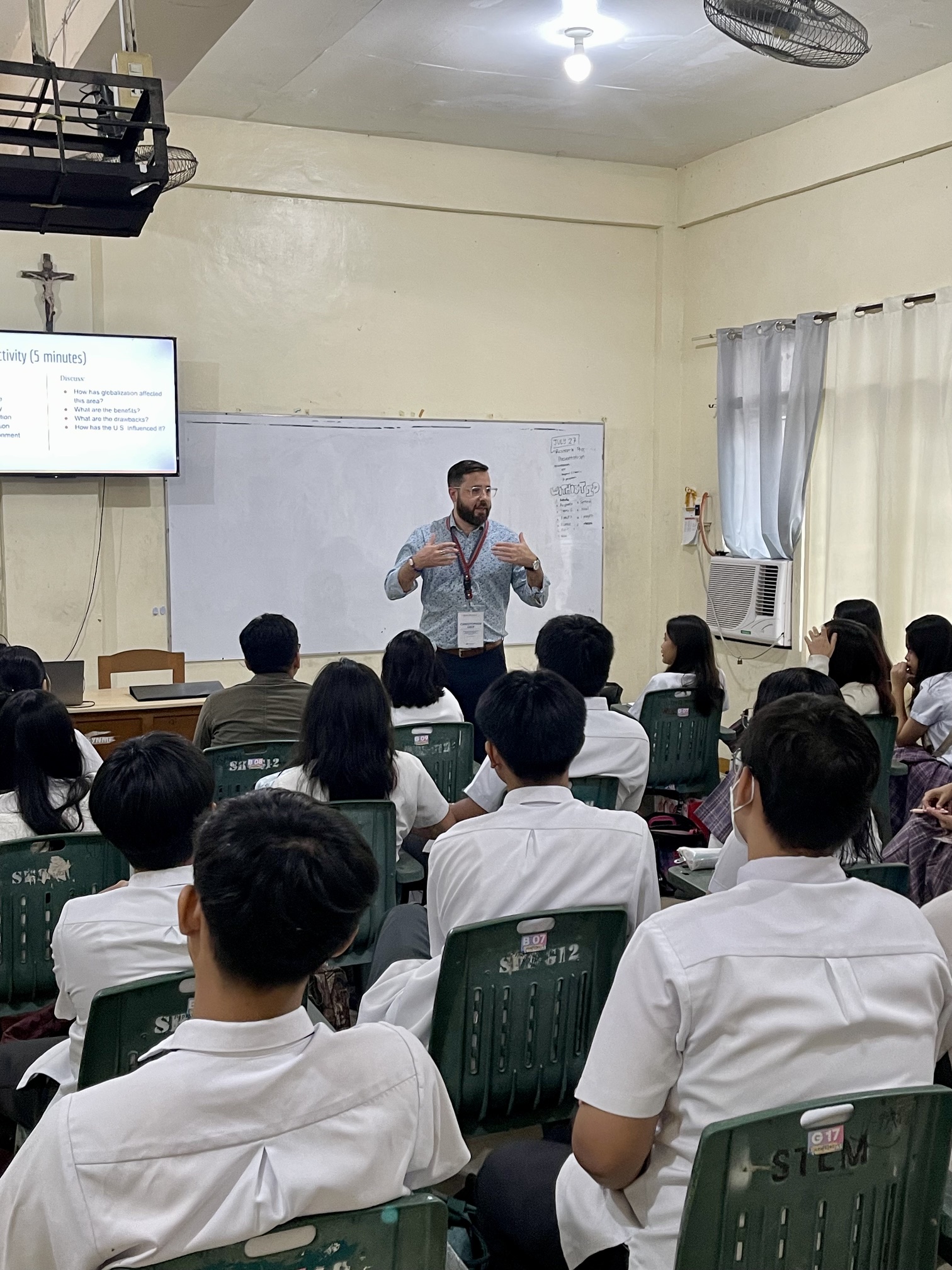
After watching a few of her classes (discussed here), I started to get a sense of her groove as a teacher. I studied this as I did not want to throw the kids off too much with an entirely separate, unrecognizable style of teaching. Rhythm matters. Teacher Honeylet asked me to teach a class on Globalization & US-Philippines Relations to her Contemporary Issues class. Hell yes. I excitedly drafted a lesson and edited it to match her curriculum, which she gave her stamp of approval.
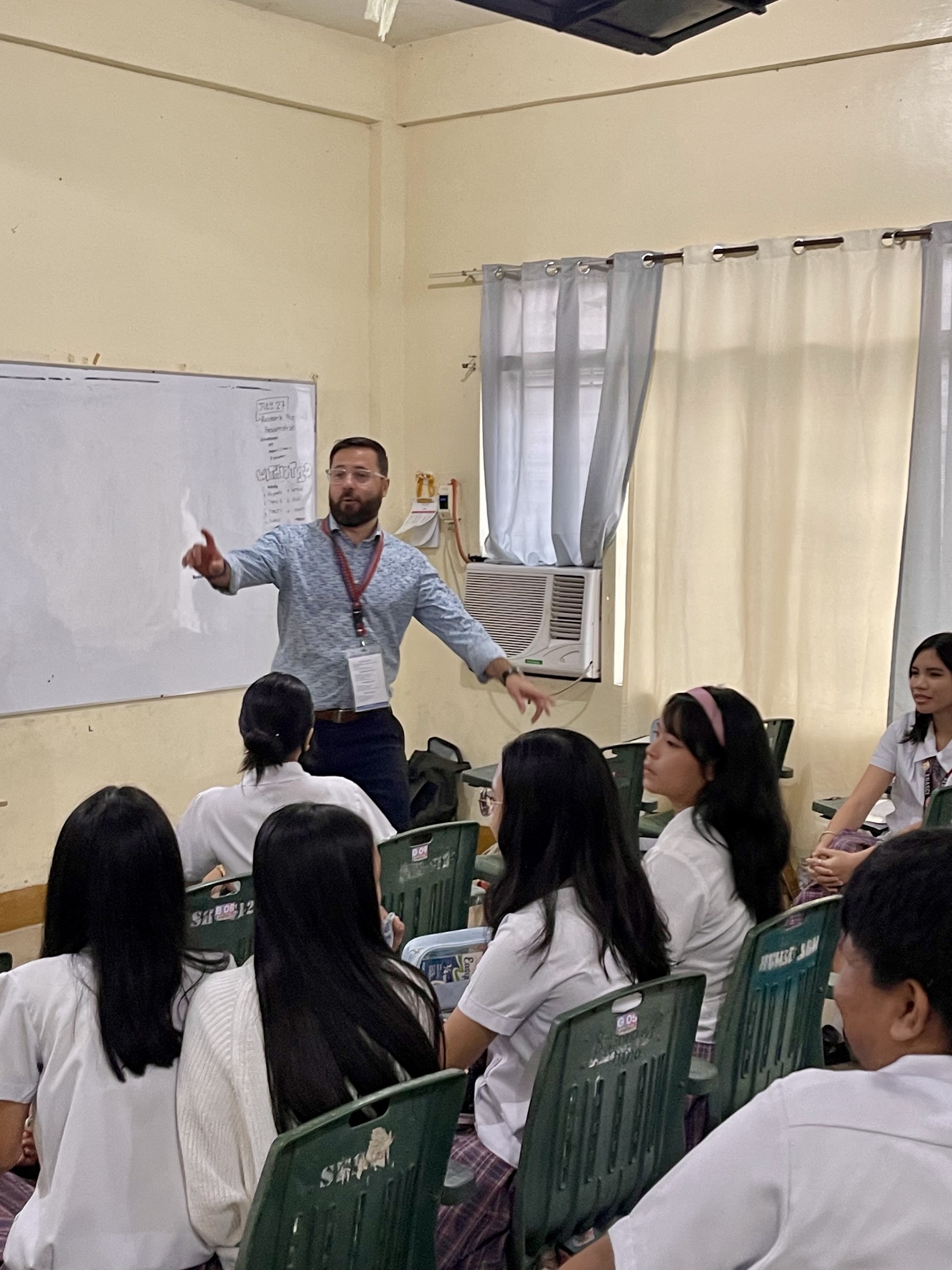
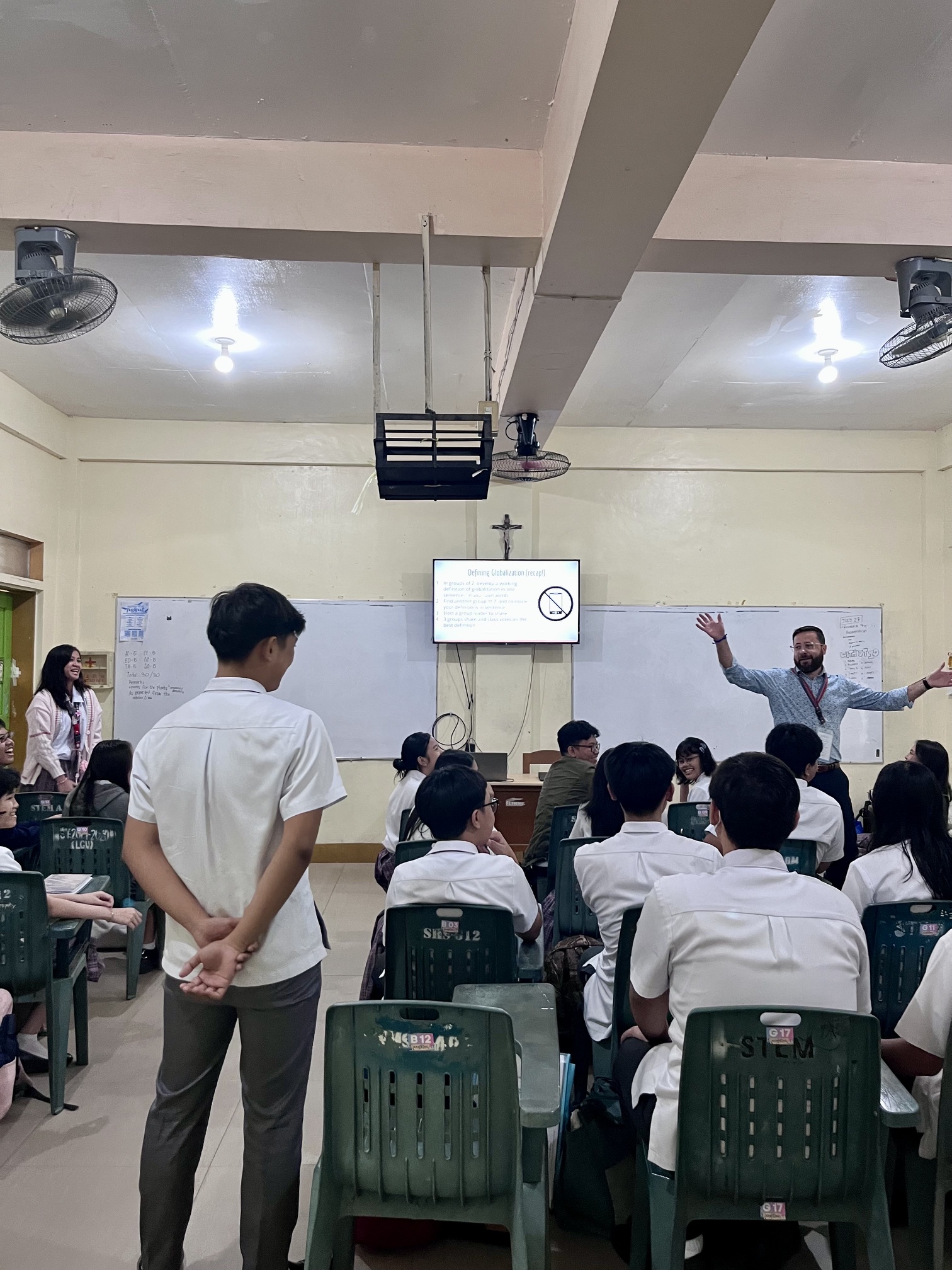
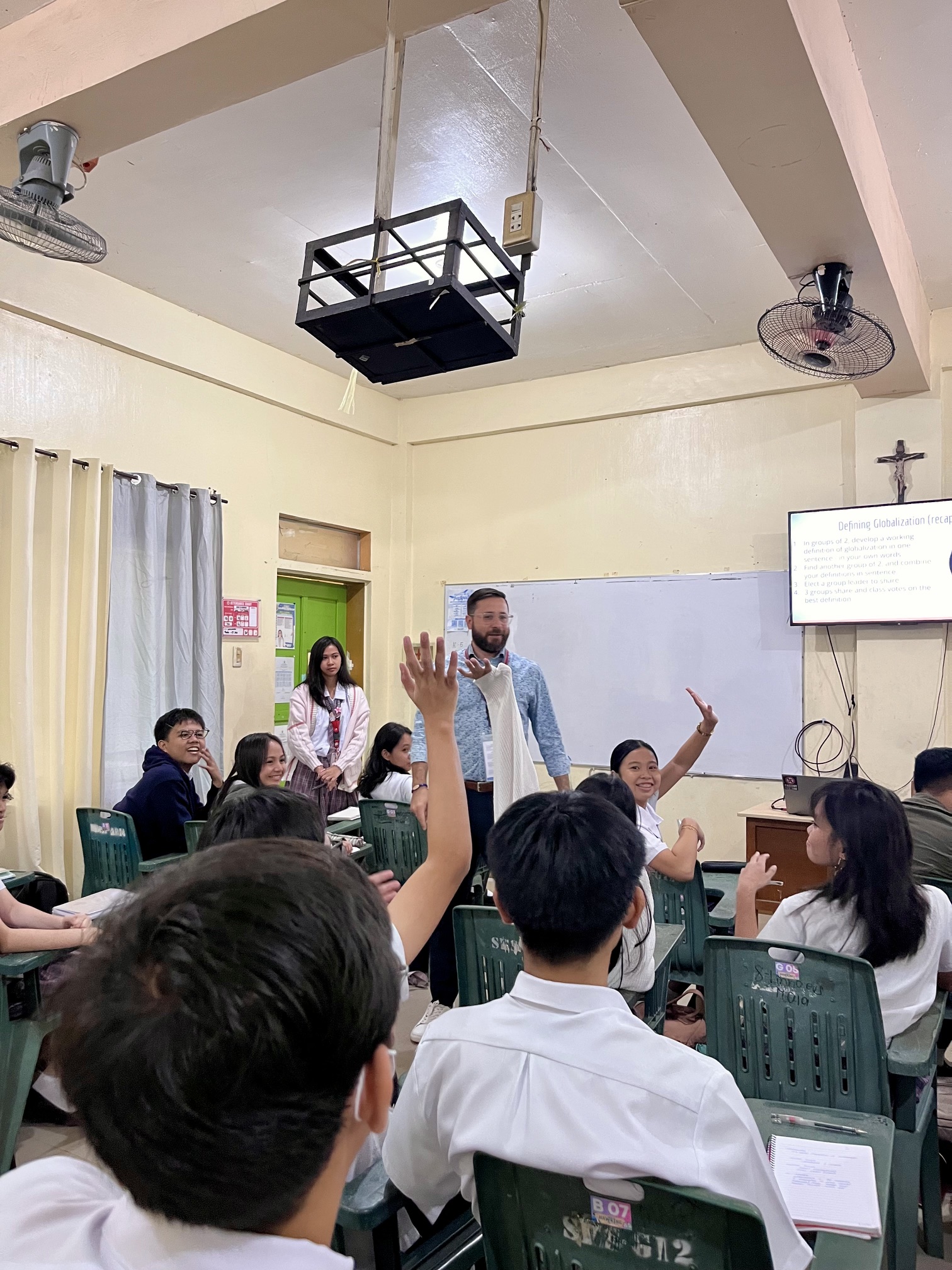
It was a peculiar feeling to be standing in front of a random classroom in a foreign city I had just learned about a few months prior. I taught my first class to students I’ve observed on four separate occasions in two different contexts, so I had some familiarity with them. They stood up and said their “Good morning, Sir Chris!” routine. As I connected my laptop to the screen, I noticed that they were still standing. I didn’t recall that the teacher was responsible for telling the students to be seated. As soon as I started, I immediately felt in my groove. Teaching provides a joy that is somewhat hard for me to describe accurately. You get to engage students about fun and interesting topics and watch them develop in real-time.
These students were ready, eager, and excited to learn. I wanted to nurture that excitement. They all immediately took out their little notepads, ready to copy whatever text popped up on the screen. After a brief introduction, I asked two students to read the essential questions. It was immediately apparent that one student, Yza, was ready to volunteer at a moment’s notice. I always seek these types of students from the onset, in case I have no volunteers for debates or discussions.
Afterward, I displayed the learning objectives. Then, I paired students up to develop their own definition of globalization based on what they recalled from previous lessons. After, I had pairs join one another, forming groups of four, to combine their definition into one sentence. Then, I asked three groups to volunteer their definition. After voting on the working definition (which matched the basic definition), I taught four key dimensions: Ekonomiya, Teknolohiya, Human Migration, and Kultura. I used the Filipino terms for the lesson since they were almost identical to Spanish. They seemed to appreciate this.
Because the lesson was about U.S.-Philippines relations, I gave a brief introduction to the historical intersection of the two countries, from the U.S. defeat of Spain in 1898 to the relationship today. I only hit the major points. Students listened intently as I discussed the Filipino’s fight for independence and the U.S. Empire’s goal of resource extraction to benefit itself. I wanted to ensure that I, an American, did not mince words or sugarcoat when it came to my country’s ambitions in these lands. One student later told me that he was thankful to hear that perspective from an American – the first American he had ever met.
The lesson culminated in a debate question: Is globalization mostly positive or mostly negative? I divided the class into three spaces: positive, negative, and neutral. On cue, students went to their respective spaces. At first, the majority of students were in the neutral space, with about eight on the positive side, and none on the negative side. I quietly asked Yza to argue for the negative side for the sake of the activity. She did so brilliantly – although not in English – so I was unaware of what she said, despite noticing a few random English and Spanish words I noticed. After the neutral students picked sides, the room was divided equally: 15-15. A stalemate that needed to be broken. I asked Teacher Honeylet to pick a side, and she slowly walked over to the positive side, which led to a mass cheer from those students. The students then asked me to pick a side, and I went to the negative side, prompting mass cheers from that side. We resorted to asking the cameraman to pick a side. After he chose the positive side, the clear winner erupted in even more celebration.
After each lesson, I taught students about the history of Mardi Gras and threw beads and trinkets to emulate a parade. They were beyond joyous as they stretched their arms to catch the light-up beads. This is certainly one of my favorite things to do when in a classroom in another country.
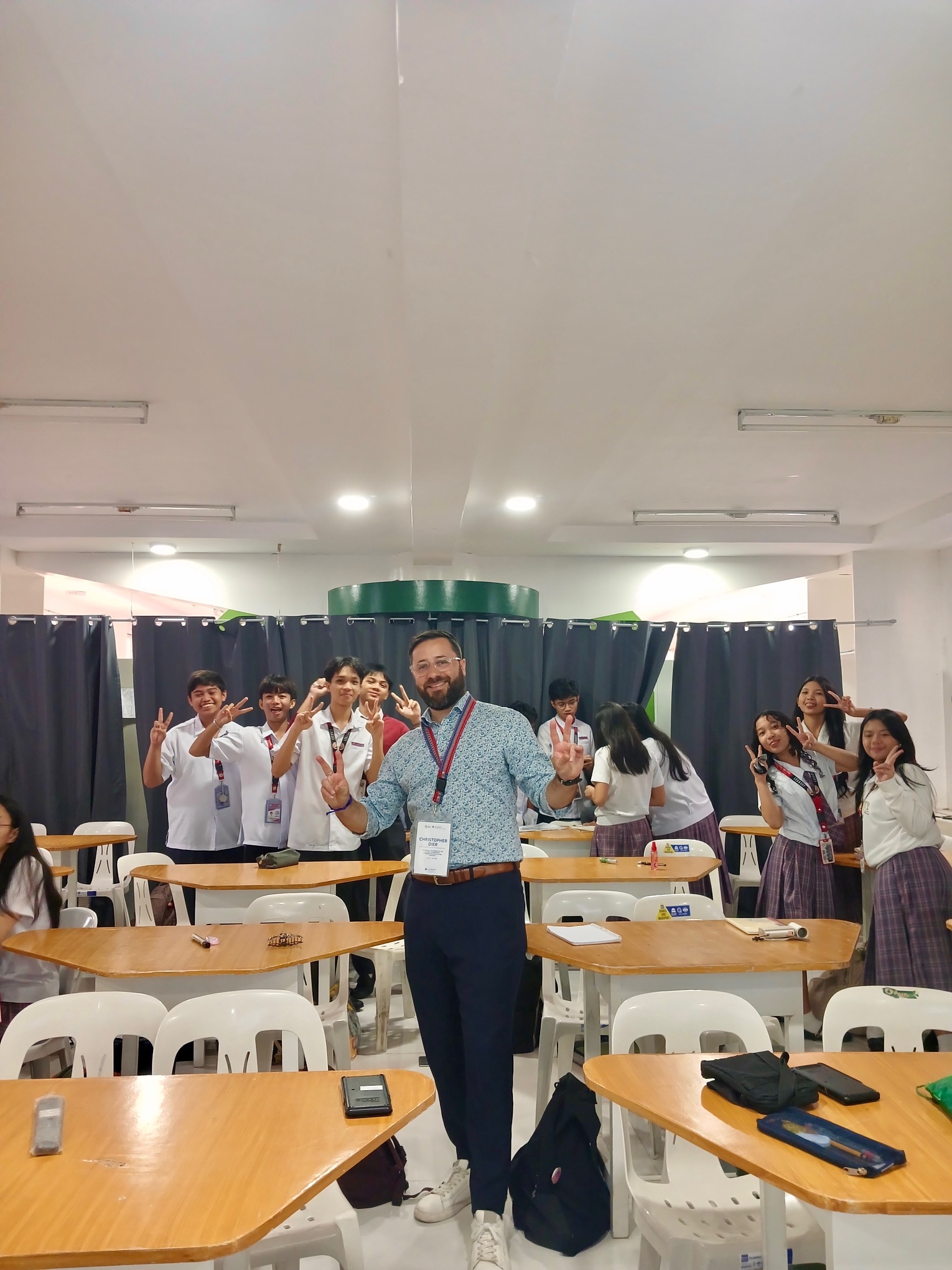
Despite my short time there, the students truly showed an amount of respect and appreciation that was unprecedented to me. I certainly feel appreciated in the States, but I’ve seen nothing like the love that these kids showed me. Upon arriving home, I spread all of their notes out and read them individually. Not only did I grow during this once-in-a-lifetime experience in immeasurable ways, but I truly felt valued as a human. That’s a currency no other job can provide.
Prior to discussing the classes I taught in Legazpi, Philippines, it’s paramount to provide context on the Filipino educational system, both from a systemic understanding and anecdotal experience. As always, this is a personal reflection that is not in any way designed to adequately capture the essence of the vast entirety of the Filipino educational system.
Background: Philippine Educational System
On our first full day in Manila, we visited the Philippine-American Educational Foundation (PAEF). One of the local Fulbright directors provided a brief background on the country’s educational system, as much as one could do in the hour she had. To be succinct, there were a few system mandates and core characteristics that I recall: universal access, global alignment (commitment to equitable, quality education), language modality (English and Filipino as primary languages), and a core philosophy that education should be learner-centered with competency-based frameworks that emphasize values and holistic development. From the onset, it seemed education in the Philippines was much more centralized than in the U.S.
After learning the theoretical framework of the Filipino educational system, the lecturer taught us that education is overseen by three main agencies: DepEd (Department of Education), which manages basic education; CHED (Commission on Higher Education), which oversees higher education; and TESDA (Technical Education and Skills Development Authority), which manages technical-vocational education and skills development. I appreciated how streamlined and organized it seemed, and wished the U.S. operated with a similar centralized approach. The basic education system consists of one year of Kindergarten, six years of elementary education (Grades 1–6), and four years of Junior High School (Grades 7–10), followed by two years of Senior High School (Grades 11–12) with various academic and technical/vocational pathways. After Senior High School, students can pursue higher education, technical-vocational training, or enter the workforce/entrepreneurship – all managed by the aforementioned trifocalized educational system. According to the lecturer, the system was designed for an ultimate output: to develop lifelong learners who are academically competent, socially responsible, globally competitive, and prepared to contribute positively to society.
The lecture highlighted several differences between the Filipino and U.S. educational systems, including larger class sizes in the Philippines, sometimes exceeding 45–50 students, different approaches to technology integration or lack of access to technology, and classroom routines such as students standing when the bell rings. Assessment practices include teacher-created assessments, exit assessments following key stages, and placement tests that can influence students’ high school trajectories, while Filipino teachers work within the Philippine Professional Standards for Teachers (PPST). Lesson planning in the Philippines was described as much more comprehensive/structured than in the U.S. The lecture also introduced the Alternative Learning System (ALS), which provides informal education opportunities for the “3 L’s:” the last, least, and lost, including incarcerated and working learners.
She concluded that effective work with Filipino teachers and students requires understanding cultural values such as malasakit (deep care for learners), may potensyal (Tagalog for “there is potential”), bayanihan (shared responsibility for educating children), and resilience. Teachers are often viewed as a pangalawang ina, or “second parent,” reflecting the high level of respect afforded to educators, while pakikipagkapwa emphasizes treating others with dignity, utang na loob reflects gratitude and reciprocity, and pakikisama emphasizes harmony, belonging, cooperation, and maintaining strong interpersonal relationships. More broadly, Filipino education is deeply connected to family and community, with teachers often aware of students’ family circumstances and schools responsive to community needs. I saw this respect and solidarity firsthand at Legazi City Science High School. The lecture also emphasized the resilience and resourcefulness of Filipino educators, who frequently adapt creatively to limited resources while maintaining flexibility, optimism, and a strong commitment to their students. Of course, it is necessary to emphasize that such descriptions are not completely standardized across the archipelago, as culture and traditions often override universality.
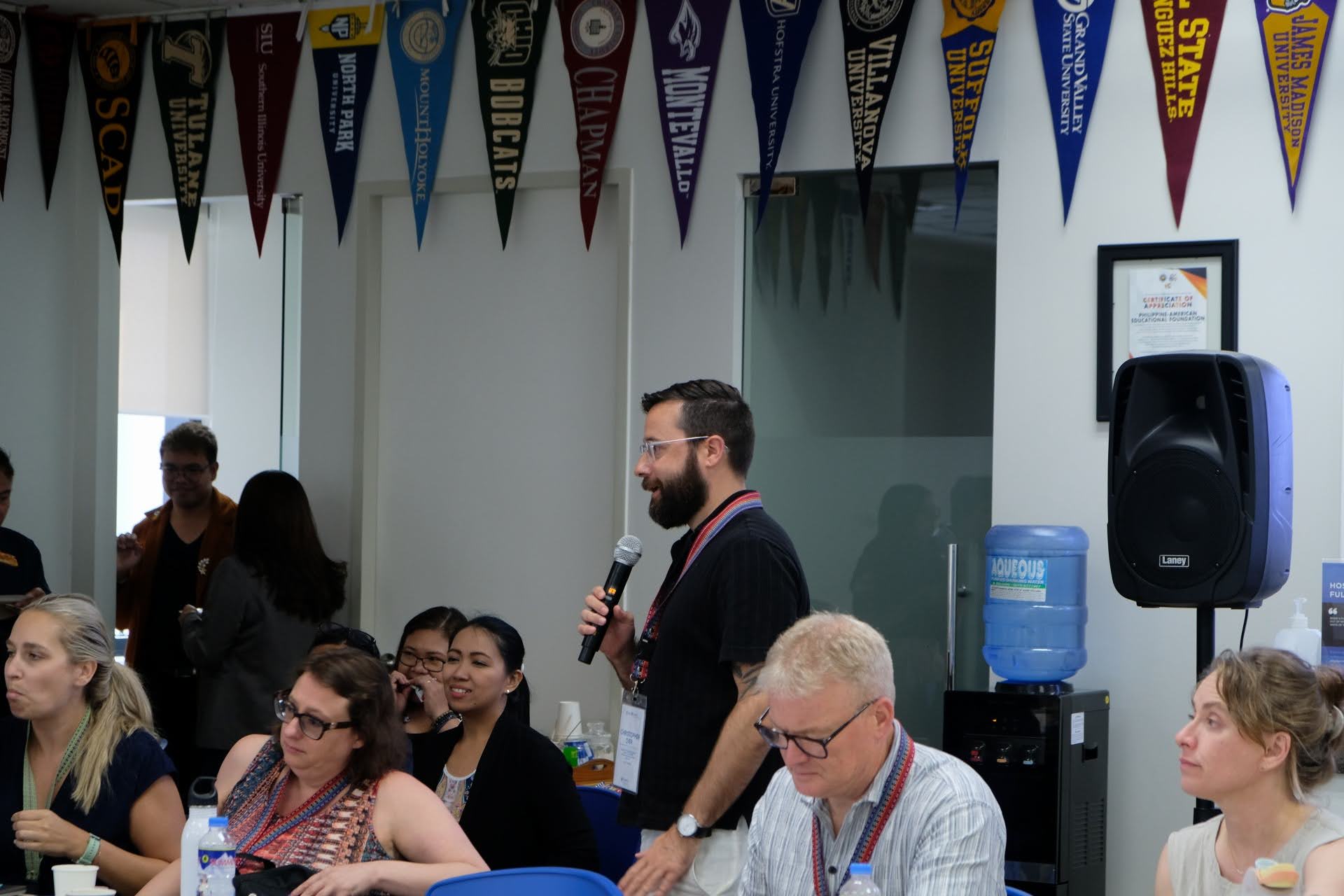
It was after this lecture that the PAEF paired us with a Fulbrighter from the Philippines to discuss the essential question that we had developed prior to the trip. My question: How do Filipino educators employ local history, cultural identity, and community experiences to foster civic engagement, cultural relevancy, and global competency, and how can these approaches inform social studies instruction in my own community? Our person typed up a massive response to my question, which delved into the concept of kapwa, which means “shared identity,” “fellow human being,” or “togetherness” in Tagalog. In the context of education, kapwa shifts the focus from individual success to collective learning, community, and mutual care. It means viewing classrooms not as rooms full of separate competitors, but as spaces where students and teachers share a collective identity and aim toward a common goal. I always find it fascinating that in the West, we develop terms for concepts that have existed before the United States even became a country.
Sharing my reflection on on the concept of “kapwa,” PAEF Headquarters, Manila
During our school visits, I saw kapwa in action. Visiting various schools was easily my favorite part of the Fulbright TGC program as I’m always fascinated with how education works in a material, on-the-ground sense in different countries. Although we visited a few schools and community institutions, I’m going to focus on the five of the main school sites that we’ve spent the most time in: Pitogo High School, Montessori de San Juan, Legazpi City Science High School, Legazpi City National High School for Inclusive Education, and Oro Site High School.
Pitogo High School
Pitogo High School in Makati City, Manila, was our first school visit. I was not expecting the roar from students upon our arrival. As we waited in the courtyard, I ignited a conversation with a couple of the boys who seemed eager to chat. We talked about basketball, and one of my opinions hyped them up.
After our brief interaction with the students, we were ushered into a faculty room to hear from school officials. It was evident that the administrators took great pride in their school as they discussed all that they were doing to succeed, including breaking test score records and showing up for their students. One aspect of their presentation that resonated with me was not just that Pitogo was a virtues-oriented school, as all schools make such claims, but the virtues themselves: “Maka-DIYOS – we value God and spirituality; MakATAO – we respect others and promote dignity; MakAKALIKASAN – we care for nature and our environment; MakABANSA – We love our country and serve with pride.”
In the meeting, pride was evident, especially that teachers are able to exercise autonomy in designing lesson plans – as long as they follow a “common framework” and collaborate with colleagues. As with many schools around the world, they emphasized how they addressed their external struggles (shootings, nutrition) by working to develop the holistic student. I asked about social studies instruction, and the administrator informed me that social studies content is standardized across the “region” (i.e., Southeast Asia).
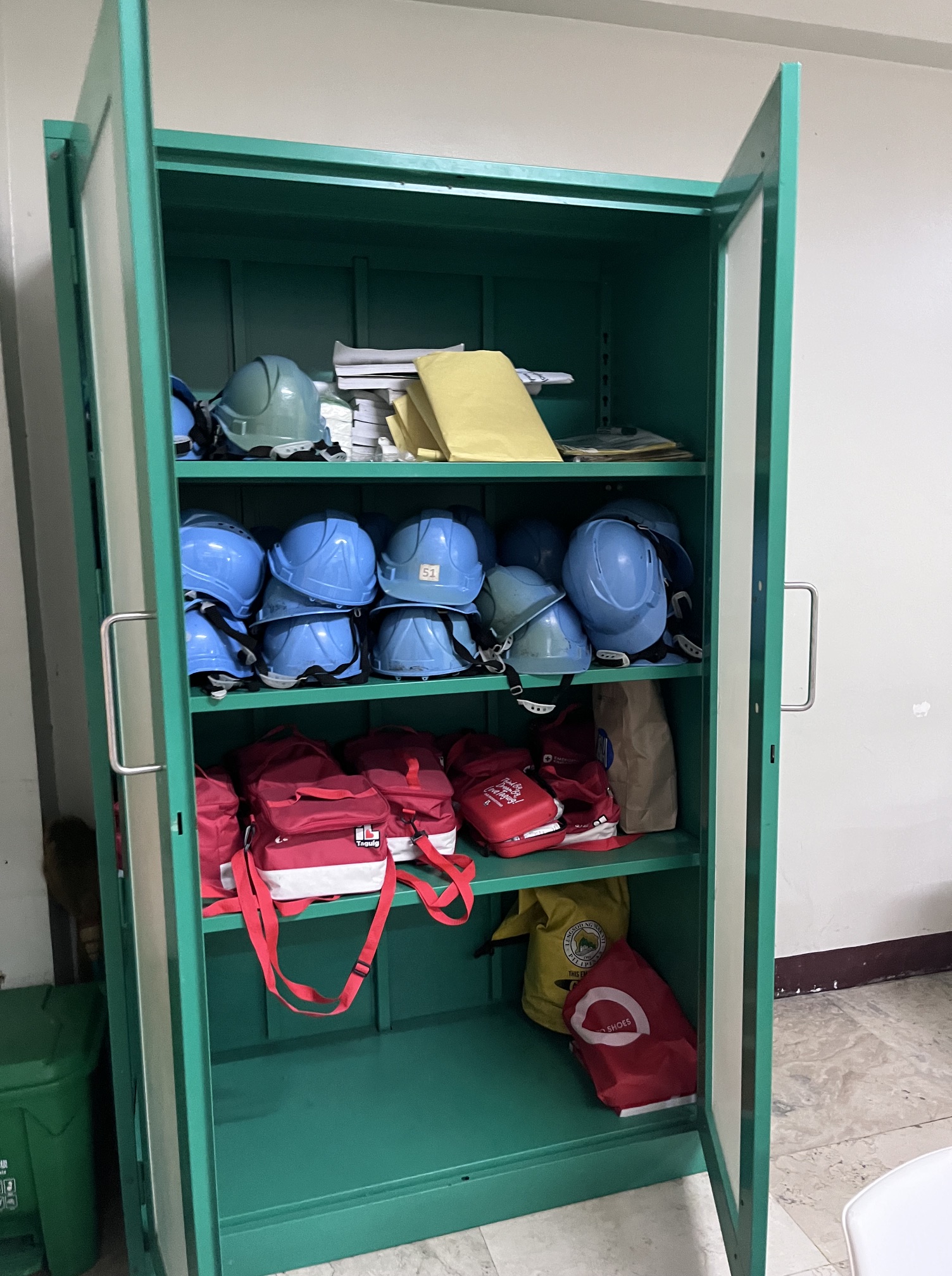
After some pedagogical dialogue with our host, a teacher took us on a tour of the school. Beautiful greenery surrounded the courtyard, which was not only aesthetically pleasing, but it also provided shade and fresh oxygen. As we passed through the outside halls, students eagerly waved and jovially cheered at our presence. It was nice to feel welcomed. It was also a reminder that Filipino students are far more animated than U.S. students. Our host ushered us into some classrooms, which had far more desks than a standard U.S. classroom, and the desks were far tinier. They showed us the inside of their closets, which were complete with hard hats in case of an earthquake. When I inquired, a teacher responded that they “nurture” their “learners with air and space competencies” (i.e., earthquakes and typhoons). As someone with a traumatic experience with disasters, I am also fascinated by how communities coexist with the looming threat of nature.
There were many aspects of the school I found interesting, but three resonated with me the most. One, there were quite a few anti-bullying signs. Moreover, some signs had QR codes for students to submit their concerns. There were also boxes for students to input slips for those without phones. I appreciated how seriously the school addressed bullying. Second, there was a basketball court atop the school roof. Incorporating sports into schooling always brings me joy. Third, there were statues and pictures of Mother Mary scattered throughout the school. This surprised me the most as a person hailing from a country with a strong, albeit declining, tradition of separation of church and state. In the Philippines, I’ve learned that Catholicism is woven throughout the state apparatus.
I spoke with John Tagala, one of the social studies teachers, before I left. He answered my inquiries with pride. When I asked about the structure of social studies content across grade levels, he responded that history at the younger ages starts locally, then progresses regionally (Southeast Asia), and finally, globally. The U.S. has the opposite structure, in which we start general and get more specific as the kids grow.
Montessori de San Juan
Montessori de San Juan, a private school in Manila, was our next school. The students here were excited but not as eager as the students from Pitigo High. At this school, we had an assembly for formalities and introductions. It was here that we had our American Fair to teach students about our particular home states. Another Fulbrighter and I represented Louisiana. Our slideshow had tidbits ranging from our cultural traditions to music. I was pleasantly surprised that students could identify Louis Armstrong and Princess Tiana – maybe the latter isn’t as surprising. We also showed them photos of our food, everything from gumbo to boiled crawfish, our wildlife, everything from alligators to endemic birds. For many, their single frame of reference for Louisiana was Popeyes chicken, which is a neat cultural ambassador to have. Because of the vast age differences and academic levels, we had to differentiate in real-time.
We distributed light-up Mardi Gras beads that I caught – mostly from the Orpheus parade. Kids accepted these beads with curiosity and sincere joy. Because basketball is prominent in Louisiana and the Philippines, I showed the kids some neat basketball tricks. Although basketball is not just a Louisiana phenomenon, it is easily one of the U.S.’ main exports. The kids enjoyed this activity the most, especially when I spun it on my finger, a move they tried to replicate. Overall, Filipino students found great joy in learning about our home states, which, in turn, brought me great joy.
Legazpi City Science High School
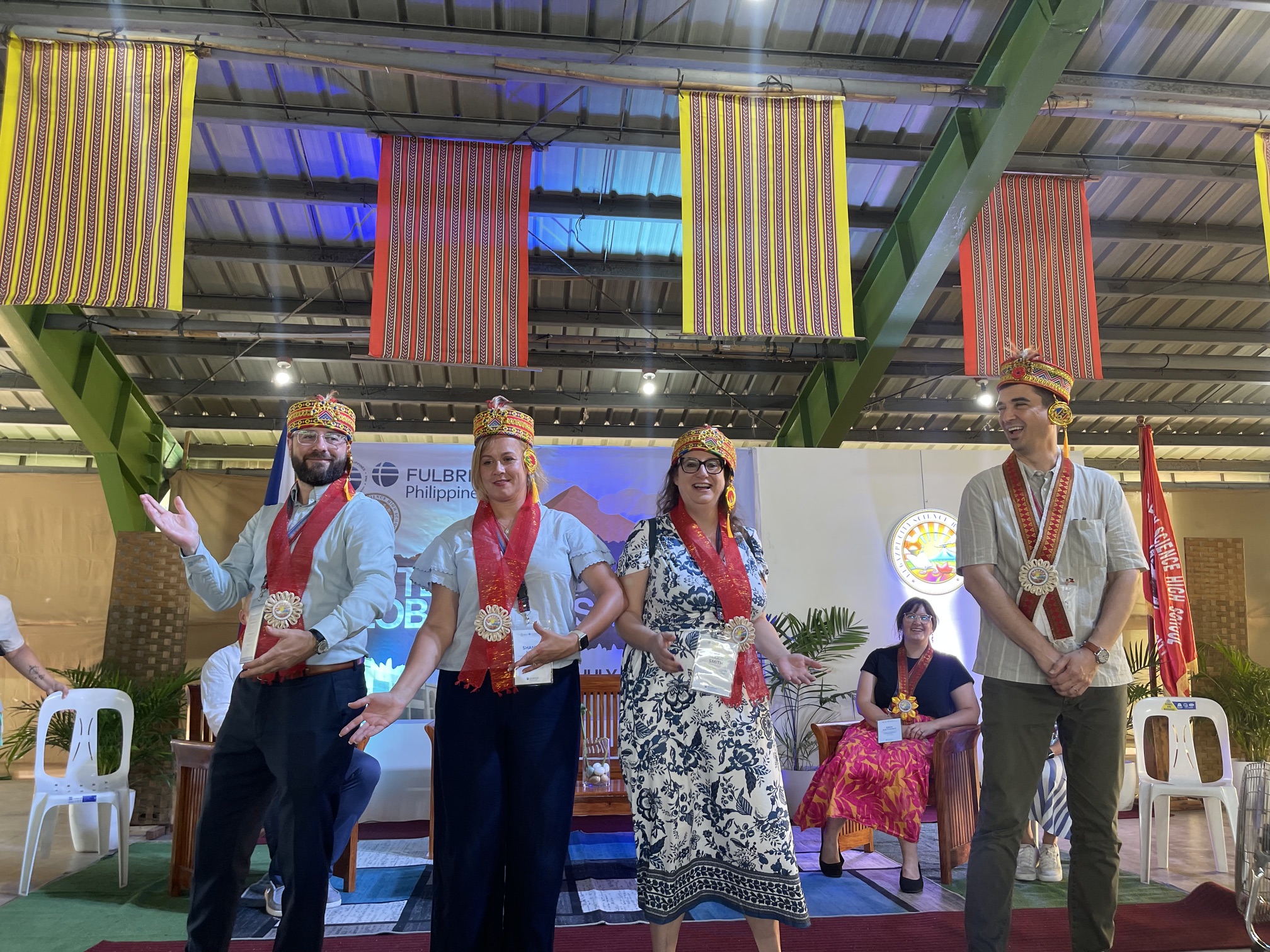
At Legazpi City Science High School – the school in which I’d eventually teach in – the day began with a “Flag Ceremony,” where students emphatically sang anthems to the country, province, city, and school. The students did so with such pride, dressing to the nines in uniforms complete with matching ties and socks. It was wholesome to witness, and it reminded me of how unpatriotic U.S. students can seem toward their own country compared to students in non-Western countries. As our gracious host, Edgar, ushered us down an aisle in the middle of the crowd, students in Indigenous garb danced alongside us, adding to what was already an incredibly welcoming atmosphere.
The students were absolutely delighted at our presence. They cheered as if we were celebrities and seemed overly grateful for our presence. To be honest, I figured this is probably the closest I’d ever come to feeling like a celebrity. The other two Fulbrighters and I were brought on stage, where our bios were read aloud, and students performed synchronized dances to welcome us. At one point, an administrator asked us to dance with them. Despite not knowing the dance or having the rhythm of the student dancers, we tried our absolute best, which was more than enough to make the entire student body erupt in cheers. I figured if a glimpse of this were to ever make its way on the internet, it may appear we were culturally appropriating. However, when folks invite you to participate in their culture, you do so, no matter how silly you may appear.
Folks took candid shots throughout the visit, and as the students were heading back to class, many of them asked to take selfies with us. It was a nice reminder that kids, despite vast global differences across cultures and ethnicities, are the same everywhere. It was a joyous, life-changing occasion.
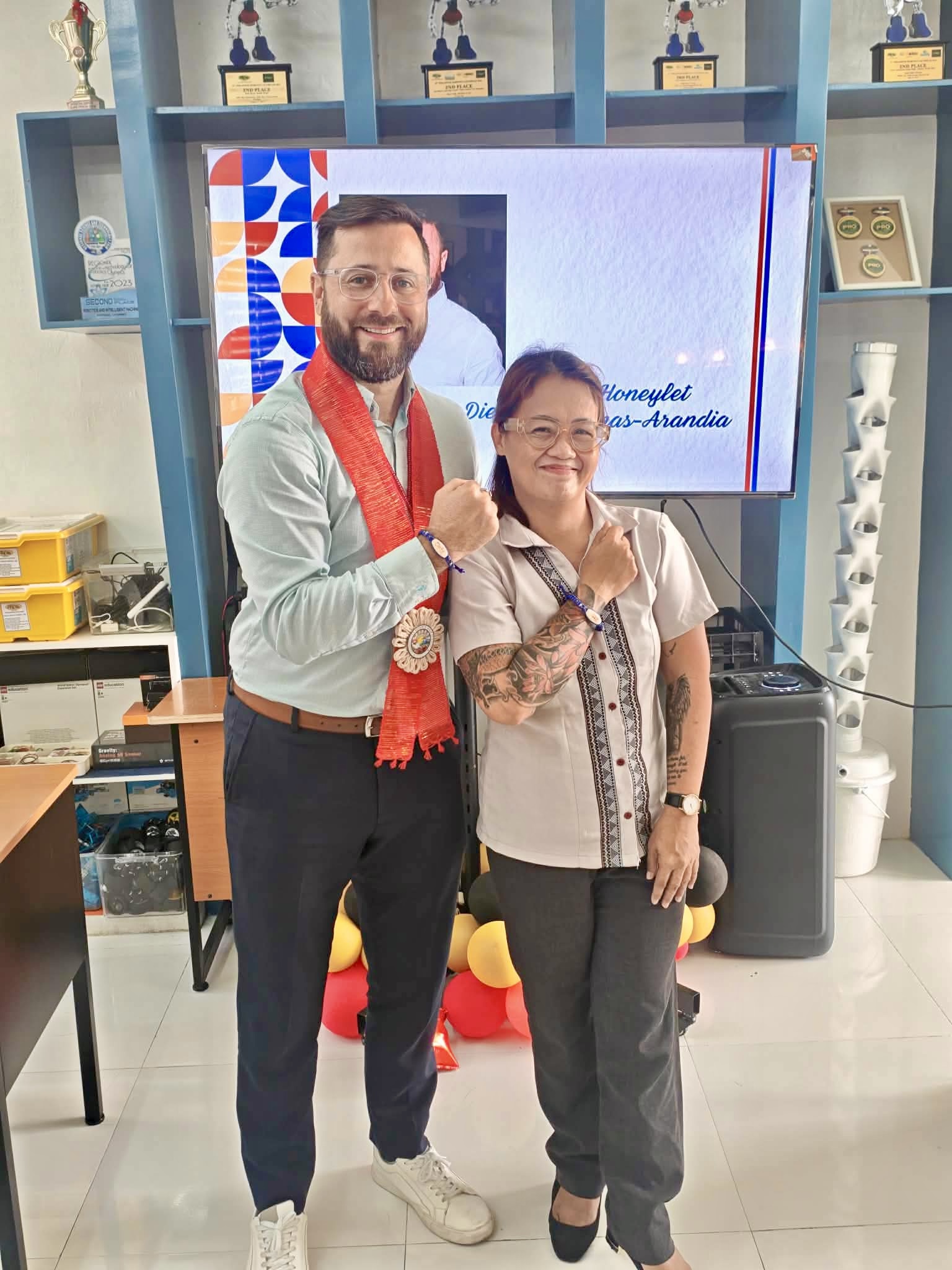
After lunch, we had a meeting with our co-teachers and administrators to learn more about the school’s inner workings. We also met our co-teachers. My co-teacher was Teacher Honeylet, a veteran teacher with an intricate sleeve tattoo. Afterward, they gave us more gifts, including a custom-made bracelet. During this meet-and-greet, a teacher notified me that students may stare, but it is inquisitive, as I’m only the second white man to visit their school in recent years – the previous being the UK Ambassador last year, a person of only slightly more importance (kidding).
Throughout my visit, I learned quite a bit about the school. Like Ben Franklin, where I teach, students must pass an entrance exam to be accepted. All parents are required to join the Parent-Teacher Association (PTA) – even the acronyms are similar to the U.S. All parents must contribute a small portion of their salary to the PTA to assist the school, which allows the school to have more resources than any school in the region. Some classes even have AC units, which was only possible due to increasing the necessary voltage, and that was only possible through the PTA donations. Students also get to have delicious homemade snacks between classes. These similarities, despite the enormous differences in our two school systems and cultures, were another reminder that many of the fundamental things that make a school community successful – pride, parental involvement, student enthusiasm, and a commitment to providing students with opportunities – are universal.
I first observed my co-teacher, Teacher Honeylet, teach a macroeconomics course. Teacher Honeylet had a strong presence in the classroom – students listened intently. The students deeply respected her. She taught about “economic trends,” GDP, inflation, and the like, and they were incredibly responsive throughout the lesson. They also learned about the National Spending Formula and made economic comparisons between Singapore, Vietnam, and the Philippines, with lots of comparisons to Vietnam. Oddly enough, I also compared the Philippines to Vietnam as I spent almost an entire summer there before, and it was the only other Southeast Asian country I spent significant time in. The lesson included a trio activity in which groups of three students represented a macroeconomic analytical unit: the “economist,” the “household budgeter,” and the “policy synthesizer.” Teacher Honeylet asked the final question, “How do national economic indicators – like GDP, inflation, and national debt – interconnect to shape the everyday decisions of a Filipino household?”
When Teacher Honeylet spoke in Filipino, I heard plenty of Spanish words, although they were spelled slightly differently in Filipino: Ekonomiya, Teknolohiya, Edukasyon, Siyensya, Politika, Impormasyon, Bokabularyo, and Kultura. In one lesson, I even heard the word “sapatos” to reference shoes. When I prepped for my own lessons, I incorporated many of these Filipino words into the Google Slideshow. It was interesting to see how familiar so many of these words sounded to me despite being spoken in Filipino. As expected, class sizes were in the low 30s, which was dramatically low for the Philippines.
I also had the opportunity to work with a robotics class, in which students showed me their motherboards and all the inner workings – “this joystick moved this switch,” “this button made this light bulb shine,” and the like. It was fun interacting with such brilliant and passionate students. I asked plenty of questions and audibly gasped when they presented a neat gadget. They truly enjoyed teaching me, and I enjoyed learning from them. In many ways, they reminded me of my Franklin students.
Class at Legazpi City Science High School
I observed another Macroeconomics class, which covered the same lesson, before moving into a lesson on globalization. Students analyzed everyday items – “sapatos” and “phones” – and examined how products were connected to different parts of the world. Phones, for example, were developed in the U.S. but manufactured in China. The lesson explored both the positive and negative undercurrents of globalization. I designed my lesson to take the baton from this one.
The group activity was called “Supply Chain Mapping.” In groups of four, students received a product image and were tasked with drawing their supply chain flowchart on ½ Manila Paper in landscape orientation. Groups created their flowcharts and then presented them to the class. Once again, students were incredibly responsive and engaged with the activity.
I also observed an 8th-grade World History class. Students were divided into groups of four to review an empire: Classical Greece, the Roman Empire, Han China, and the Gupta Empire. Each group presented its empire to the class. Afterward, Teacher Honeylet went over “key patterns” and “pillars of stability.” After observing multiple classes, it became increasingly evident that the students not only respected Teacher Honeylet but truly wanted to impress her. She had a strong presence in the classroom, but there was also a clear level of comfort and engagement between her and her students. When the kid presenting on the Roman Empire said “6-7” as he was counting, the entire class did the iconic 6-7 hand motions. Memes are universal and universally annoying.
Legazpi City National High School for Inclusive Education
We also visited Legazpi City National High School for Inclusive Education, a school dedicated to immersing students with significant disabilities into mainstream education. While this may be a concept U.S. schools are required to do, this does not seem to be the norm in the Philippines. The school welcomed us with open arms. Upon entering the office, the secretary greeted us in a variation of American Sign Language – a clear indicator that the school also hires people with hearing challenges. She appreciated the two of us trying to greet her in ASL.
The school gave us a tour to show us all the ways in which they’re incorporating students with significant disabilities into the classroom. This school lacked many of the resources available at Legazpi City Science High School, from no AC to much larger class sizes. We met multiple students whom they labeled as “mainstream learners” because they were in mainstream classrooms. In each classroom, mainstream learners stood up and introduced themselves. Interacting with these classrooms reminded me of why I enjoy schools – kids are just wholesome and kind throughout the world. When I asked whether this practice was potentially singling out students, the administrators told us that the students appreciate being recognized and that their peers celebrate them.
After a tour of the school, we sat down with administrators to learn all about the school. Turns out, they actively recruit throughout the entire area, as many people are unaware of the possibilities for kids with disabilities. Because of their efforts, Legazpi City National High School for Inclusive Education has won numerous awards, which was unsurprising. Such schools give me hope in this world.
Oro Site High School
Oro Site High School is located in the heart of Legazpi City, Albay. One of the first things they told us about the school was how frequently it flooded and how the surrounding community was often tasked with managing the dire circumstances that came with it. This immediately reminded me of New Orleans, where flooding is also a familiar part of life and where schools and communities have to learn to adapt to circumstances that are often beyond their control. There was something familiar about seeing a school navigate these challenges, even though the setting was thousands of miles away.
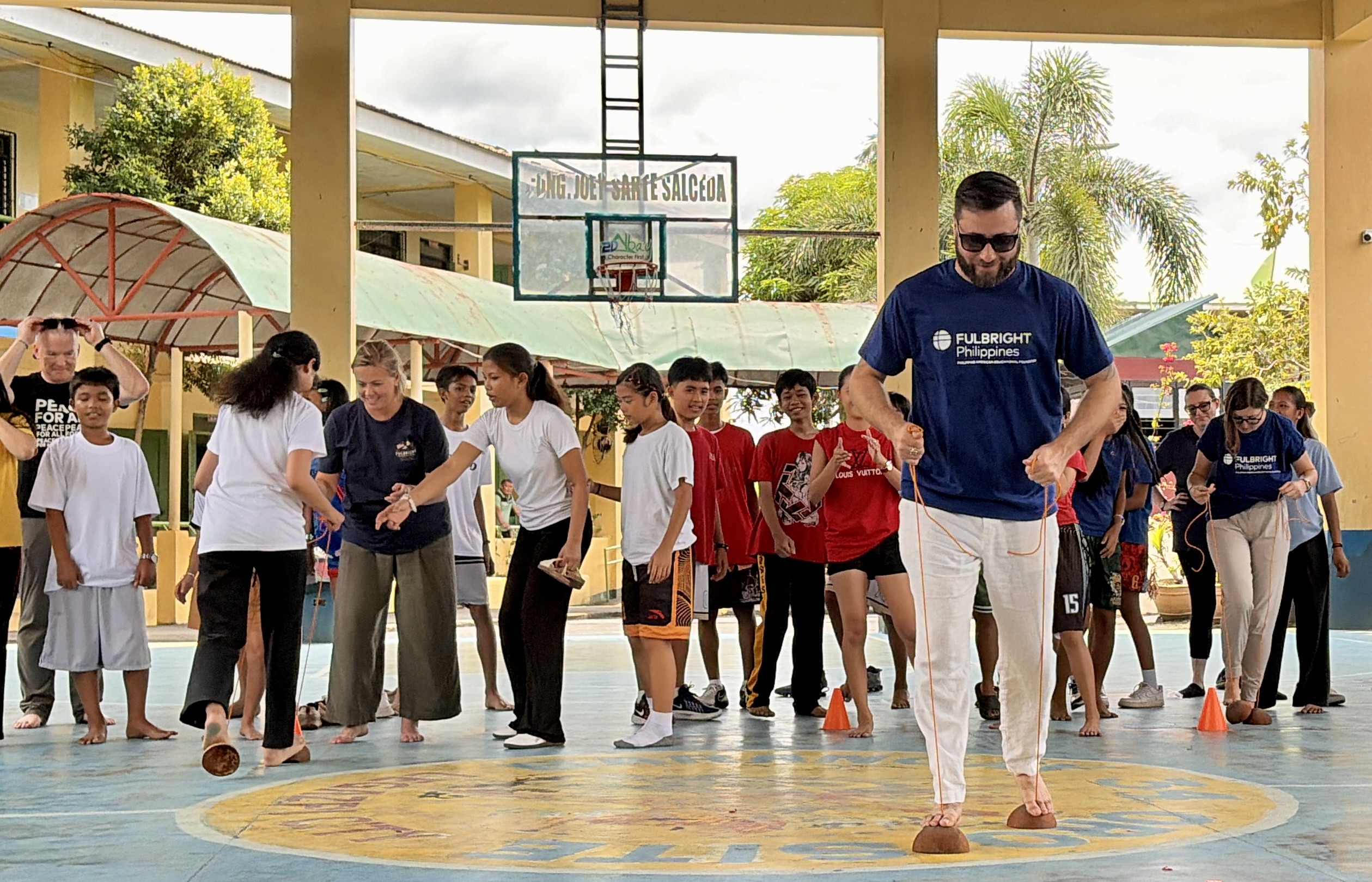
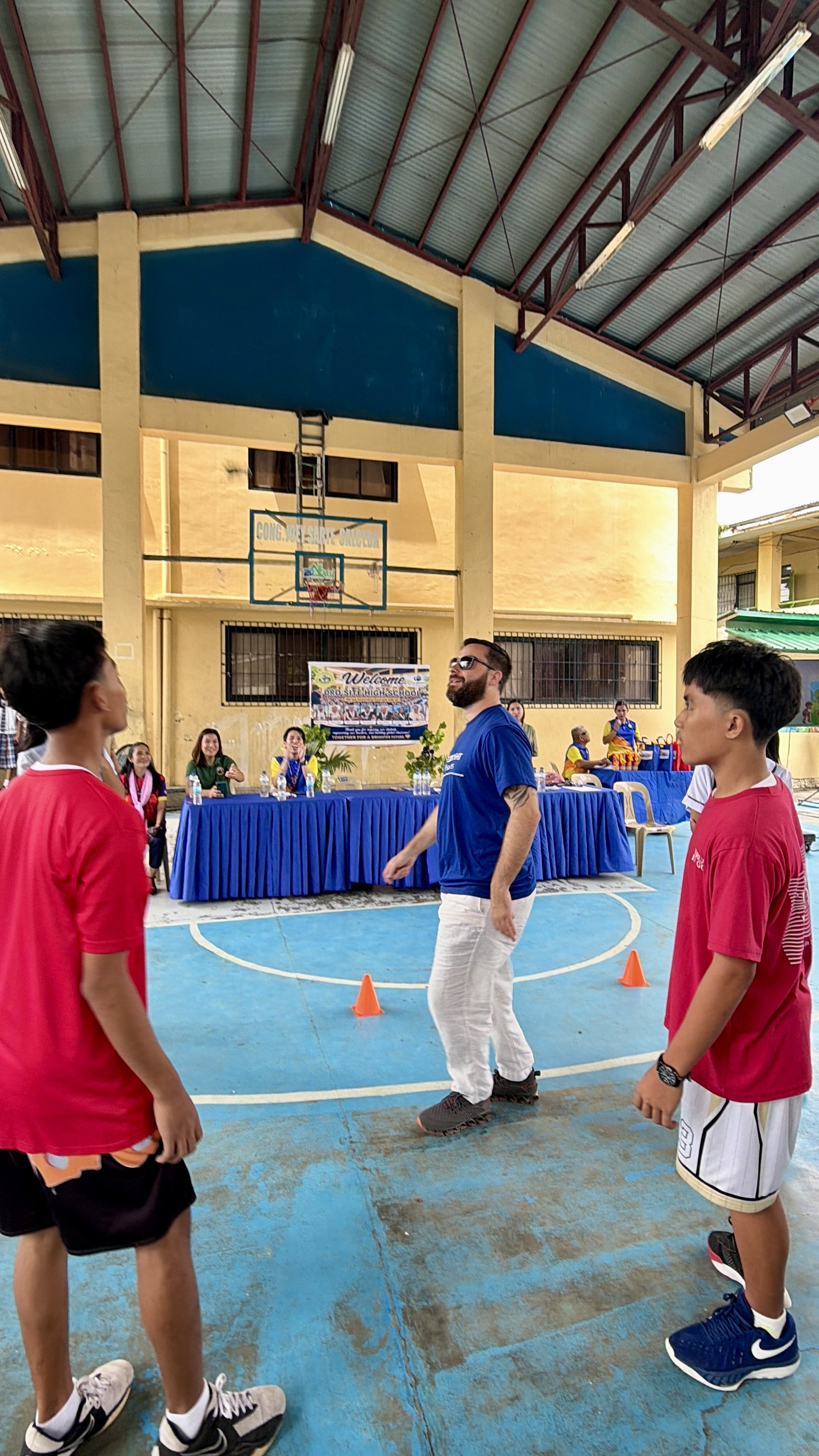
One of the highlights of our visit was playing Filipino games with the students. Each Fulbrighter was put on a team with Filipino students. Some of these games were indigenous to the country. The first game was a sack race, a classic outdoor game where players place both legs inside a large sack or pillowcase, pull it up to their waist, and hop toward a finish line. This was the only game that felt familiar to me because it was similar to games we played in the U.S. We then played sipa, a traditional game in which players use their feet, knees, or elbows to keep a weighted washer in the air. It reminded me a lot of hacky sack. I was rather decent with this one, as I’ve played soccer my entire life. The next game was kadang-kadang sa bao, also known as tiyakad, in which players race on stilts made from halved coconut shells and string. As clumsy as it felt walking on coconut shells, it was a fun test of balance, speed, and teamwork, and was played as a relay race. I could not find the name of the last game, but it was another relay race in which some people had to balance an object on their elbows while others had to place it between their toes. Each person on the team had to position the object differently before racing to the finish. If you dropped it, then you started all over.
kadang-kadang sa baoPlaying sipa
It was a fun competition, and I was proud that my team won first place – not even going to lie there. Beyond the competition itself, I enjoyed being placed alongside Filipino students because it gave us an opportunity to interact with one another in a way that did not feel like a traditional school visit. We were laughing, competing, and figuring out the games together. The kids were in leadership roles as they played these games to us, and we were the goofy, tall foreigners looking silly. It was a small but meaningful way to experience Filipino culture rather than simply observe it.
Afterward, we met with quite a few students and learned more about how their school operates. I also observed a social studies teacher give an economics lesson, and she had all 35 of those students engaged as she cleverly gamified the lesson. It was beautiful to witness students so invested in winning for their team, which was based on their gender. The competition gave the students another reason to participate, but it was clear that the teacher had intentionally created an environment where students wanted to take ownership over their learning. Watching the lesson reminded me of the power of gamification when it is used intentionally – students who might otherwise sit quietly or idly were completely invested in what was transpiring because they wanted their team to win.
We also had the opportunity to speak with the school’s Muslim students to learn more about Islam in the Filipino educational system. They were initially shy, but as we asked questions respectfully, they gradually opened up and shared more about their experiences. I appreciated that we were able to have those conversations directly with students rather than simply learning about Islam in the Philippines from a presentation. Their willingness to share, once they became comfortable, made the conversation feel much more personal and authentic. Overall, my time at Oro Site High School was a mixture of competitive fun, classroom observation, cultural exchange, and organic and fruitful conversation; it gave me another opportunity to see how Filipino schools build community despite challenges that felt surprisingly familiar to me.
Concluding Reflection
I’ve learned quite a lot from these visits, but there are a few aspects of the Filipino school culture that truly resonated with me.
First, Filipino students highly value and respect their teachers in ways I’ve never witnessed in other classrooms I’ve experienced around the world, notably in the U.S., Germany, South Africa, or Morocco. Whenever I entered a classroom, the students simultaneously stood up and said “Good morning, Sir Chris!” in unison. Students do not dare pass you without giving a respectful bow, some of which were full bows. It didn’t matter if the student was playing or eating. Sitting students quickly stood up as soon as a teacher walked in. Honeylet notified me that it’s not mandatory to return bows to students; I learned quickly why that was the case after my neck started to hurt after a few days. In classes, students stood up when speaking to the rest of the class, which U.S. students only do when prompted. Perhaps the biggest indicator of teacher respect is the fact that schools have no bells to end class. I’ve noticed that when a class that is supposed to end at 10:45 am, it is common for the lesson to spill over without any sign of frustration from the students.
Second, Filipino teachers are highly esteemed and respected by society. They have to wear a uniform similar to that of a pilot, which they are identified for their profession. One of our hosts told me that he was ignored when he went to purchase a motorcycle, so he went home to change into his teacher uniform. Upon return, the motorcycle salespeople were clamoring for his attention. These notions of respect, from students to the broader society, are not as common in the States. I’ve only found such deep value from students and families I’ve developed meaningful relationships with, and institutions that are happy to give an accolade to advance their own PR. In the States, you have to earn respect as a teacher. In the Philippines, it seems everyone respects the entire profession from the onset.
Third, Filipino teachers are proudly passionate and care deeply about their students. They talk about them with as much fervor as we do our students in the States. There are some students I’ve taught that I’ve grown to appreciate as if they were my own. I sense such sentiments from the teachers I’ve interacted with in every school I visited.
Overall, education is deeply valued in the Philippines, from the orphanages to the high-performing schools. Filipinos intrinsically embed aspects of community and culture within facets of the school. Culture drives relationships and pedagogy. There is no separation. In the States, schools seek to be fortresses against a society that refuses to address the root cause of school shootings. In the Philippines, no such concern exists. Overall, I’ve gained much from my time visiting and working with Filipino teachers and students. I am better for it, and I hope that others are better from my visit. May the lesson I’ve learned remain ingrained in my conscience, and may the connections I’ve gained be fruitful and everlasting.
Personal Reflections on Historical Memory in the Philippines
In terms of historical memory, I am always intrigued by how a society views and interprets its past. In the Philippines, I became fascinated with the various ways in which people on these islands interpret their long, multifaceted history.
On Historical Nomenclature
I often wondered about the name of the country – the Philippines – named after King Philip II of Spain. One Fulbrighter asked John Ray Ramos, our resident historian, whether there were conversations about changing the name of a country praising a European monarch. The historian gave a short answer stating that the name has essentially been “reclaimed” and its meaning is entirely divorced from its original intention– reminiscent of certain historical terms in the U.S. Taking that name became a symbol of empowerment. Professor Ray stated that this was the consensus among many Filipino historians and activists within the last decade. I quickly contemplated what thoughts emerge when I think of the Philippines, and ultimately saw deep value in what the historian stated. A quick Google search exemplifies this is still an ongoing dialogue – not one an outsider, much less a Westerner hailing from the former colonizing country, should weigh in on.
I stayed in Legazpi during my site visit, named after Miguel López de Legazpi. Legazpi was a brutal conquistador, best known for leading the successful expedition that firmly established Spanish supremacy over the islands in the 16th century. He completely dehumanized and eagerly sought to subjugate the local populations. Yet, there is a city named after him, complete with a statue of him situated at a busy intersection near the coastal night markets. One of our Filipino guides in Legazpi said that classes only teach him so students can get an answer right on a test, and that there is no active celebration of the person. I thought of the Confederate statues that were taken down in New Orleans.
Miguel Lopez De Legazpi Monument, Legazpi, Albay, Philippines
During my first day at Legazpi City Science High, the students welcomed us with Indigenous dances that praised their folk heroes – such a powerful introduction. One of the folk heroes, Baltog, is the first great hero of the Ibalong Epic, a pre-Hispanic traditional folk story from the Bicol region. The people of Bicol know him as the brave pioneer settler who introduced agriculture and skillfully killed a massive wild boar with his bare hands. It is profoundly fascinating that this legend predates Spanish colonization and survived through a vibrant oral tradition, knowing that these traditions are thriving despite centuries of foreign influence designed to suppress culture.
Baltog Statue in Legazpi City, taken by me.
The Legacy of Global Empires
During all of my conversations and tours, it seems that there was a collective sense of anti-Spanish and anti-Japanese sentiment (rightfully so on both ends), but such sentiments did not extend to the U.S., at least not nearly as much. There seemed to be a proclivity to view U.S. imperialism in a much softer light than the Spanish era or under Japanese imperialism. I found this slightly peculiar as historians estimate the U.S. killed over 200,000 Filipino civilians in the Philippine-American War. Such sentiment was most evident during the Intramuros tour, in which the guide revered all of the martyrs for Filipino independence and heavily praised U.S. military efforts during the Battle of Manila.
Could this be due to the U.S.’ educational aims when the Philippines was a U.S. colony? It is difficult to imagine such U.S.-designed curricula instilling an objective take on the vast war crimes during the Philippine-American War. Even today, the curricula in the U.S. do not present an objective take on that war. Most curricula in the States – at least as far as I’ve analyzed – want students to know that the Philippines was simply a colony that the U.S. rightfully earned after easily defeating Spain in 1898. If a student is fortunate, the teacher may even discuss the role the U.S. played in defeating Japanese forces there.
Nowhere was this more evident than on our tour of the U.S. Embassy. The tour guide and the representatives praised U.S. efforts in the Philippines in both the tour and subsequent conversations. No one mentioned the protests against the U.S.-led Pax Silica that just occurred outside the U.S. Embassy. Pax Silica is a U.S.-led international initiative launched in 2025 to secure global supply chains for AI, advanced semiconductors, and critical minerals, functioning as a Western-allied counterweight to Chinese technological dominance. The growing influence of China concerned some of the officials in the embassy, and they made no attempts to hide that concern. The anti-Pax Silica protests, and the accompanying online discourse, are evident that there is a large contingent of Filipinos who reject U.S.’ soft power approach.
During the tour, the Embassy tour guide praised American teachers, dubbed Thompsonite teachers, who moved to the Philippines after the Philippines-American War, as she gestured to framed photos of early 20th-century American teachers. Outside, we saw the physical remnants from the Battle of Manila – the bullet holes on the flagpole displayed like a badge of honor. She also showed us the gravesite of the U.S. flag that fell during the war. Later, we entered the exact location the U.S. charged Japanese army officers for their crimes against humanity. Obviously, holding war criminals accountable is a necessary and just move. However, the tours and representatives should be more objective regarding U.S. imperialism. This tour reaffirmed my obligation to teach U.S.-Filipino history more objectively during my upcoming lessons.
As I spent more time in the Philippines, it grew ever more evident that such pro-U.S. sentiments mostly stemmed from the U.S.-Filipino joint effort during WWII. Many Filipinos discuss the vast horrors Japan inflicted on the country as if it happened yesterday. The profound impact and legacy of WWII on Filipino memory cannot be understated. As Americans, we were fortunate that the unfathomable war never truly hit within our borders (outside of our territories), and thus our view of that conflict is etched differently in our collective memory. No one can say the same about the Philippines.
Manila-American Cemetery and Memorial
In Manila, I used some of my free time to visit the Manila American Cemetery and Memorial, which commemorates over 36,000 soldiers Missing in Action (MIA) and over 17,000 Killed in Action (KIA) – totaling over an estimated 53,000 US soldiers. When I put feelers out in the group chat, three American Fulbrighters accompanied me on the journey. The cemetery was vast and seemingly endless. White crosses and the Jewish stars spread neatly across a finely trimmed grassy knoll while Manila skyscrapers towered in the distance. It was an odd juxtaposition. The latter may not have occurred without the sacrifices made by those buried in the cemetery.
Manila American Cemetery and Memorial, taken by me.
The experience became more personal as we approached the wall of those MIA. Before I left, my mother tasked me to find the name of our relative, Joseph Bruno. Joseph heroically died in Papua New Guinea fighting Japanese forces. I have heard his name and story throughout my life, so I knew how much this visit meant to my mother. However, I failed to realize the grave personal impact it would have on me. After searching in the Marines section of the wall with the help of my new buddies, we spotted Joseph’s name etched into the wall. My heart jumped.
Pointing to my late relative’s name on the MIA wall at the American Manila Cemetery
A local guide approached us after our quick photoshoot and asked to escort me to the Visitor Center. There, one of the curators pulled up information about Joseph and printed an official U.S. government certificate. He told me as much information about Joseph as he could find. To surmise, he died in Papua New Guinea protecting his comrades – the ultimate sacrifice – and those comrades buried him there. I became emotional as I listened. He organized the certificate and information into a neat folder – a custom of the museum for family members who visit. Apparently, I was the first known relative of Joseph to visit the center.
It was an emotional and surreal experience to know that somewhere in the world, a relative of mine is buried, yet he is being memorialized almost a century later in such a beautiful, heartwarming fashion. While I was playing soccer in college when I was his age, he was fighting in foxholes with boys who had just become adults in a brutal war against global totalitarianism. It caused me to reflect on the privileges I’ve had growing up.
The museum at the Manila-American Cemetery and Memorial did quickly emphasize that the U.S. rejected the Filipino nationalists’ desire for independence after the Spanish-American War. After, it was what one might expect a military museum would cover – battle strategies, diary excerpts from soldiers, propaganda posters, photos of complete devastation, and the like. It was indeed an informative museum, especially for military history buffs.
Closing
The historiography of the Philippines is as complex as the history itself, and this reflection by no means seeks to minimize it. Any Westerner, especially a white American, entering these lands must first seek to understand; I truly felt I was mostly successful in accomplishing that goal. In doing so, it is evident that Filipinos have a deep understanding of the history of their homeland. People speak about historical events and people from ancient days as if they experienced or knew them personally. Ancient epics hold just as much weight as pop culture icons. The lands in which various influential leaders, like José Rizal, trekked are sacred. In all of the historical richness woven throughout the Philippines, notions of agency, resistance, and love are consistent throughout.